

While the Super Bowl yesterday was a blowout victory for the Seattle Seahawks over the New England Patriots, for many, the real performance was with Bad Bunny’s Apple Music Super Bowl Halftime Show.
Affectionately called the “Benito Bowl” by many, it was both a musical extravaganza and a history lesson about Puerto Rico. As Wonkette’s resident Puerto Rican writer, I’m gonna dive into all the meanings and politics in Bad Bunny’s artistic performance.
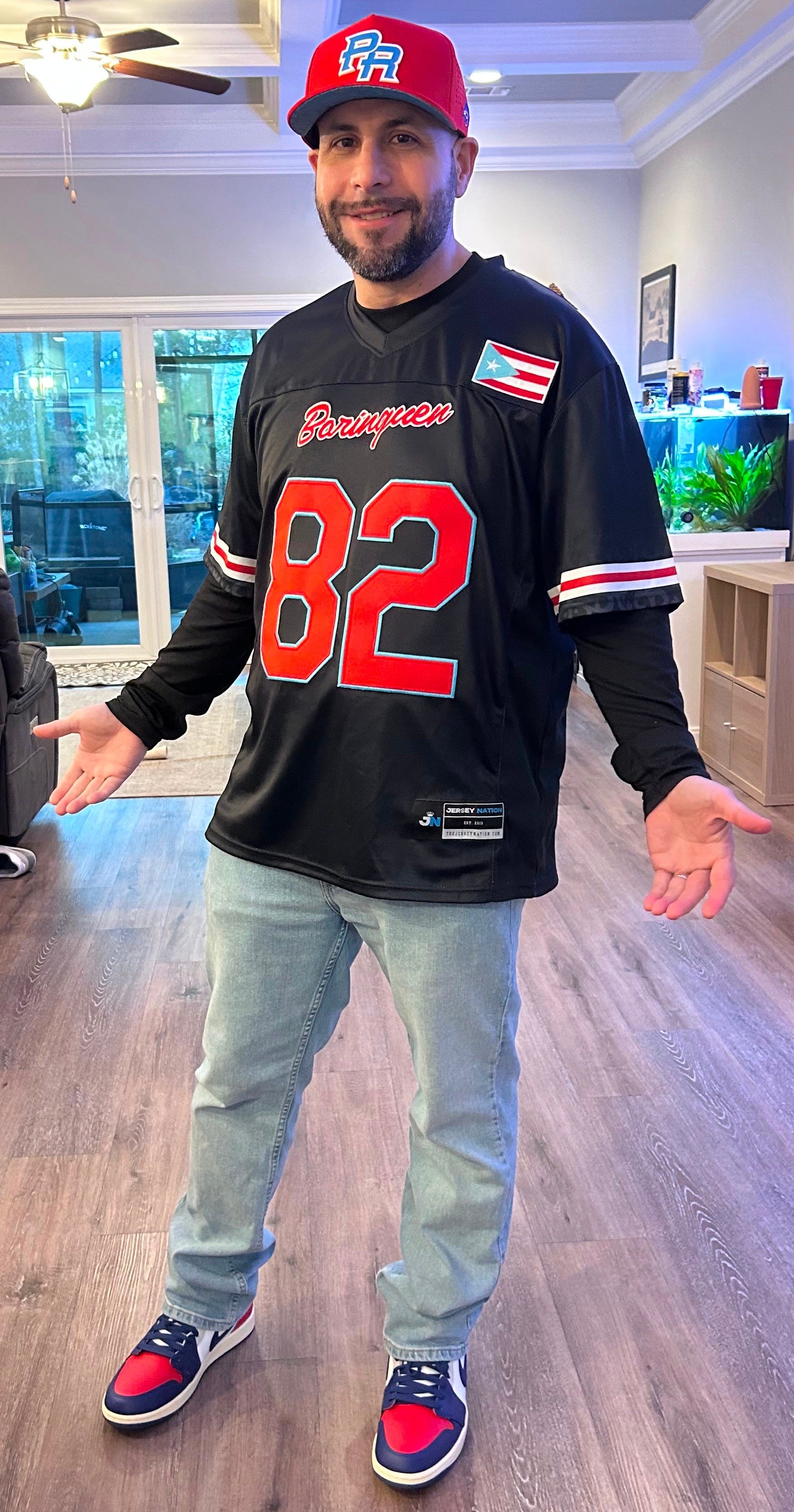
But first, a brief moment to gaze on my amazing fit yesterday, before we get serious:
Ok, here we go! (Watch the performance here if you want to follow along.)
Bad Bunny began his performance by invoking the sugarcane fields of Puerto Rico and the jíbaros, the sugarcane farmers and symbols of Puerto Rico’s resilience as he performed “Tití Me Preguntó” (Auntie asked me).
Bad Bunny, wearing an all-white jersey with number 64 (perhaps a subtle nod to Puerto Rico’s first peaceful transfer of power under its constitution in 1964) and his mother’s surname of Ocasio (respect to his matriarch) while holding a football “high and tight” (best position to not fumble), then moved on to a coco frio stand, which invokes a desire to maintain our traditions, in spite of the US importing brands and conglomerates to our island.


Benito continued his tour of Puerto Rican iconography, like old men playing dominoes, getting a piragua (flavored shaved ice like a snowcone), handing the football to a nail salon worker and her customer, before ducking under two boxers’ gloves (while giving some love to Los Angeles favorite Villa’s Tacos).


Then, while performing a song about his many girlfriends, and despite his fear of commitment, Bad Bunny got a box from a Puerto Rican gold and jewelry vendor. Upon opening it and seeing an engagement ring, he immediately refused “the call to marriage” and handed the ring to a fellow Puerto Rican to propose to his girlfriend.


He moved on to a “party de marquesina” (carport party) taking place on a recreation of the “casita” (little house) that was the centerpiece of Bad Bunny’s No Me Quiero Ir de Aquí (“I don’t want to leave here”) concert residency in Puerto Rico.
As he performed on the casita’s roof we got some quick cameos from his famous Latino friends, like rapper Cardi B, singer Karol G and actors Pedro Pascal and Jessica Alba. Fellow actor and honorary Puerto Rican Jon Hamm (AKA Juan Jamón) was not in the casita this time, but was dancing (adorably badly) on the sidelines.


As Bad Bunny performed “Yo Perreo Sola,” “Safaera” and ”Voy A Llevarte Pa’ PR,” the physical and metaphorical roof caved in and dropped him into your living room. He kicked the door open, and ventured back into the halftime show. Shaking the dirt off his shoulder (perhaps a nod to a song by Roc Nation CEO and rapper Jay-Z, who chooses NFL’s halftime performer), Bad Bunny gave some love to the marginalized parts of lthe Latin community, like Afro-Latinos and the LGBTQ community, as he performed ”EoO.”


We then got an appearance by Puerto Rico’s national animal, the coquí frog, before moving on to “Monaco,” featuring the juxtaposition of classical violins with the sugarcane fields.


Bad Bunny here addressed the crowd directly in Spanish, and here is the translation if you didn’t learn Spanish in the four months he gave you:
"My name is Benito Antonio Martínez Ocasio, and if I'm here today at Super Bowl 60, it's because I never, ever stopped believing in myself. You should also believe in yourself. You're worth more than you think. Trust me."
After performing Monaco, there was a now-confirmed-real wedding on a stage adorned with a lookout post symbolizing the Spanish fort El Morro in Old San Juan, where we were greeted by a surprise performance from Lady Gaga!


Wearing a light blue dress, a red “Flor de Maga” (Thespesia grandiflora, Puerto Rico’s national flower and the only true “Maga”), and dripping with white beads, she was the embodiment of Puerto Rico’s original flag (more on this later). Gaga sang a salsa rendition of the duet ”Die With a Smile” she originally did with fellow Puerto Rican Bruno Mars.
Viewers didn’t see this, but Super Bowl attendees captured footage of Bad Bunny taking a second to dance to Lady Gaga, an artist whose music he’s praised as helping him through troubling times.
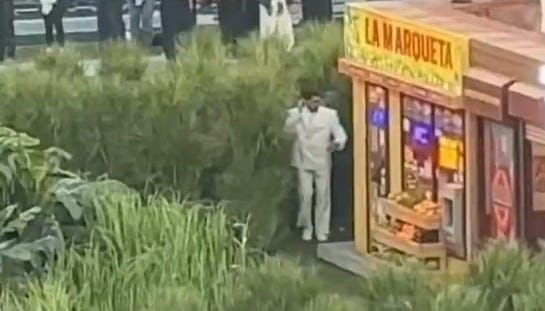
Bad Bunny then joined Gaga on stage to dance and sing “BAILE INoLVIDABLE.” The camera panned the Puerto Rican wedding reception:


Next up, after taking a trust fall onto fellow boricuas, came “NUEVAYoL.” In this song Bad Bunny is giving love to the New York Puerto Rican community (Nuyoricans) as he sings about spending magical summers there. The scene features bodegas (with “we accept EBT signs”), barbershops, and restaurants like you’d see in Brooklyn or Washington Heights before getting a drink from Toñita — a Brooklyn icon whose Caribbean Social Club, the last surviving Puerto Rican social club, has anchored the community for decades. (And that was the owner who served him a shot.)


Bad Bunny then handed a Grammy to an actor representing his past child self, who was watching his future dreams come true on TV.


Now, the two most politically powerful songs of the night.
First, a surprise appearance by Ricky Martin on “Lo Que Le Pasó a Hawaii” (“What happened to Hawaii.”) The song is about not wanting our culture, history, and paradise to be taken by greed and gentrification, and what happened to Hawaii when it became a state is an example deeply felt by puertorriqueños. Sung by Ricky Martin, it’s powerful. Martin himself had to assimilate multiple times through his career — be it MENUDO or his 1990s English pop crossover or his decades of being a closeted gay man — to succeed globally. His lamentation for Hawaii, Puerto Rico, and himself personally resonates because (as he recently wrote to Bad Bunny) he made those sacrifices so artists like Benito didn’t have to.


Martin’s performance was “interrupted” by power lines blowing up as Bad Bunny performed “El Apagón” (The Blackout), a critique of the fragile (and neglectful) power situation that’s plagued the island since Hurricane Maria. Despite the loss of literal power, Benito rose to show that even darkness can’t stop the light of Puerto Rico. As he sang of how everyone “wants to be Latinos but they are missing sazón (seasoning), batteries (energy), and reggaeton (the rhythm),” he invited everyone to join if they embrace this (unlike bigots who hate this only to put on stereotype costumes to eat guac and get drunk on Cinco de Mayo).
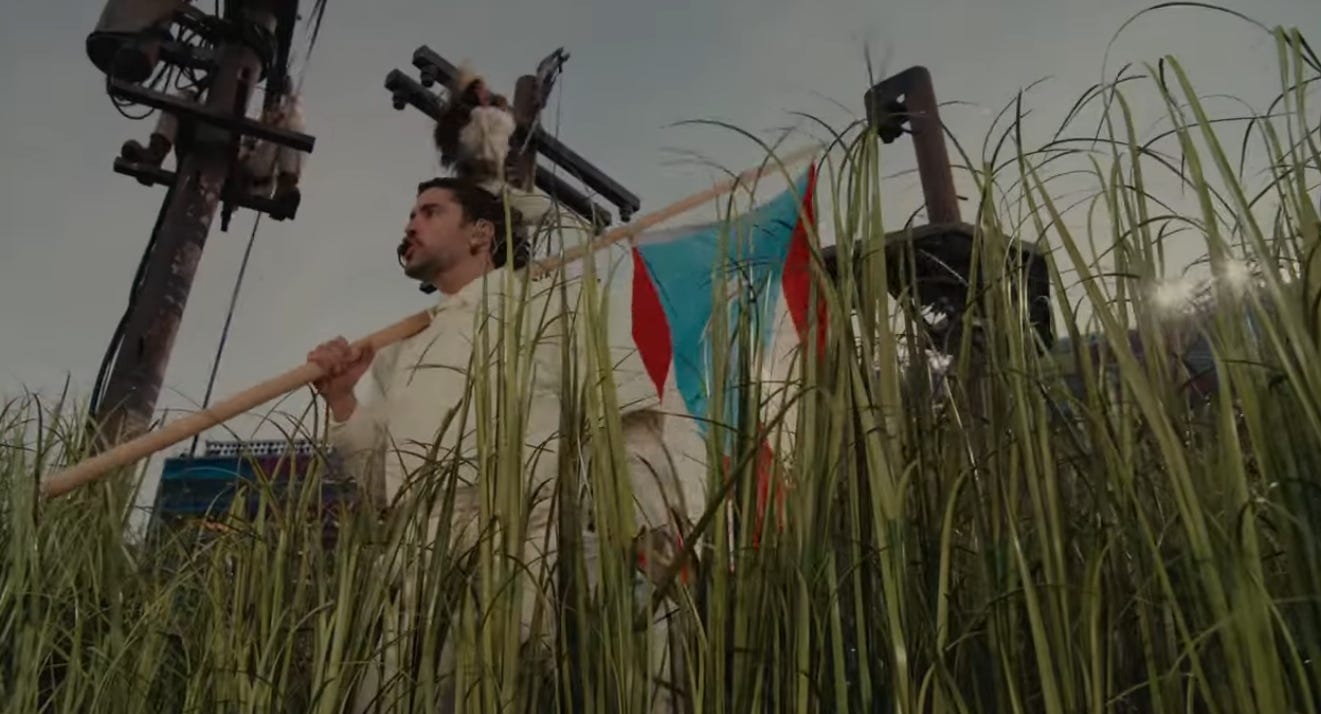
Benito waved the original Puerto Rico flag, with its light blue, which was made illegal by 1948’s Ley de la Mordaza (Gag Law). Waving this flag, until the law was repealed in 1957, was seen as an act of revolution, as the law allowed police and national guardsmen to enter anyone’s home without a warrant and search and seize all property, regardless of probable cause. It is why many Puerto Ricans everywhere display the flag so prominently to this day.
When the law was repealed, the United States changed the shade of blue to royal blue, to more closely match the blue on the US flag. So flying the lighter blue flag is both a sign of pride and defiance against a colonial power that tried to erase our identity.


Bad Bunny began his grand finale performing “CAFé CON RON” (Coffee with Rum). As he descended the power lines, Benito yelled “God Bless America!” and proceeded to name all the countries that entails: Puerto Rico, Chile, Brazil, Colombia, Mexico, Canada, Nicaragua, Honduras, Cuba, Jamaica, Haiti, Dominican Republic and more, with a banner that said “The only thing stronger than hate is love” behind the parade of flags.


He revealed the inscription on his football — “Together We Are America,” a rallying cry uniting the entire contiguous American continent and Caribbean —then spiked it for emphasis.


As Bad Bunny left the stage while performing “DeBÍ TiRAR MáS FOToS,” a song about appreciating all the moments of love and joy you can while you can, I was moved to tears.
The performance and this song in particular conveyed the feelings of being in diaspora. As a Puerto Rican who moved to the US when I was 10, DtMF hits hard, as it distills the homesick feeling I’ve experienced since then in a way even I couldn’t verbalize. Like someone reached into the core of my soul and reawakened the sadness I repressed to survive in the States.


Thank you for joining us in this journey through this transcendent performance, and I hope you now understand how important this was for all Boricuas like me.

Seguimos aquí.
¡Viva Puerto Rico Libre!
¡Wepa!
OPEN THREAD!
Follow Michael Mora on Bluesky and Threads. (If you are still on Twitter, I’m also HERE)
You can subscribe to Michael Mora’s Substack, The Diasporican Writer, for additional thoughts and topics!
This gringa was waiting all day for this exact post, so I am so grateful that you wrote it, and I'm even more grateful that I got to watch this performance. It was so goddamn fun and beautiful and important, and I didn't have to understand a word of it to get that. Gracias and thank you!
I was transported back to my old hood of The Heights a few different times.
"like old men playing dominoes, getting a piragua (flavored shaved ice like a snowcone),"
"The scene features bodegas (with “we accept EBT signs”), barbershops, and restaurants like you’d see in Brooklyn or Washington Heights"