


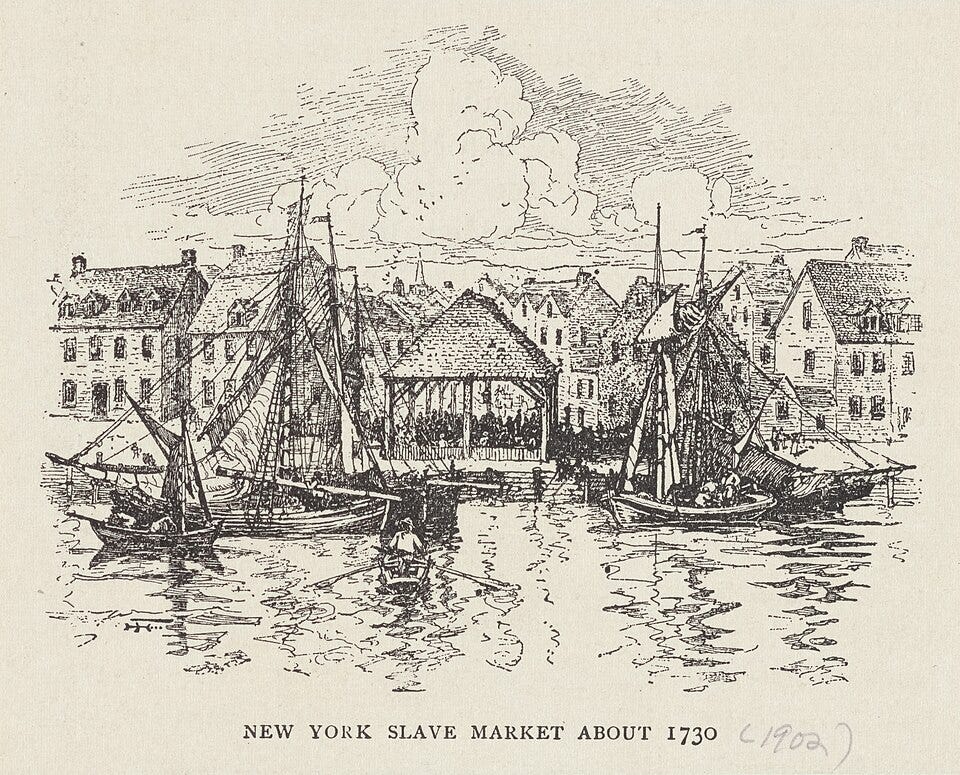
On April 6, 1712, a group of enslaved people gathered in Manhattan, setting fire to a building on Maiden Lane, near Broadway. When white people gathered to put out the fire, the enslaved people attacked with hatchets, guns, and swords. This brief incident of violence became known as the New York Slave Revolt of 1712, one of the earliest slave revolts in what became the United States.
New York was a major center for the slave trade, and remained so until after the American Revolution. The Dutch had brought enslaved African people to New Amsterdam, but day-to-day, they had a relatively high amount of freedom, at least compared to other enslaved people in the Americas. In fact, under the Dutch, such people had some legal rights, including the right to marry and the right to own property.
When the English took the small colony over in 1664 and renamed it New York, those rights started to disappear. Moreover, slavery became a bigger part of the city under the English, with the Royal African Company importing enough enslaved people that the city built a slave market near what is today Wall Street.
By 1700, about 20 percent of New York was made up of enslaved people. Slavery was absolutely central to life in New York, something that is largely unknown today. Northerners like to think slavery was a southern thing, but not only were northern ship owners and sailors largely responsible for bringing enslaved people to the American colonies and then the United States, and not only were many northern fortunes for families and institutions that are still wealthy today founded on ripping enslaved people out of their homes, but there were also just generally a whole lot of enslaved people in the North, especially in New York.
These people did the basic, common labor of colonial America. Given it was New York, they did a lot of the dock work, the hard labor. Construction of course, as well as housework and laboring as servants. There was lots of room for their labor in the colonial North.
Given this reliance on enslaved people and thus the growth in slavery, white people became nervous. Governments started creating greater restrictions on the lives of those in bondage. They began to need a pass if they were more than a mile from their master’s home. Marriage rights were stripped. Gatherings of more than three people were banned. Segregation was created for church services. Most of the enslaved at this time were African and many spoke little to no English. Many were desperate, outraged, ready to do anything. Obviously, going through the process of enslavement is something that we cannot even begin to relate to today.
We don’t know all that much about the details of this rebellion. The total number of participants could be up to 50 or as few as 20 or so. There were probably some enslaved Native Americans involved; certainly there were some around, as Native slavery was an important part of the slave labor force at this time.
After they set fire to the building, they started attacking the whites who came to fight it. Probably nine whites were either shot, stabbed, or beaten to death. Another six were wounded. To my knowledge, no reliable information exists on the motivations of the enslaved people involved.
What we do know is that in the aftermath, New York authorities arrested about 70 enslaved people. Of those, six died by suicide in prison, although precisely what was considered suicide and what was outright murder isn’t something we can really figure out today. I see different numbers on how many were put on trial, but most sources have numbers around 45. In any case, 21 were found guilty and executed. One was unlucky enough to die on a breaking wheel, the others were burned to death. The breaking wheel had been banned for punishing whites by this time, but was brought back to demonstrate to all how brutal whites could be to enslaved people who revolted. Another was pregnant. They waited until she had the baby. Property after all. Then they executed her.
Greater restrictions on slave life followed as well, including new laws limiting gatherings, the banning of gambling, and making carrying guns illegal. New capital crimes were established for those enslaved, including rape, property damage, and conspiracy to murder. Moreover, the city made slave manumission a pricey hobby for whites who would do so, taxing the owners £200 for each enslaved person freed, which was much higher than it cost to buy a person.
New York’s governor Robert Hunter defended this policy in 1715 while appearing in London before the Lords of Trade by arguing that these people needed the “opportunity” to inherit some of their master’s wealth, and that freeing them would drive them into poverty. That’s, uh, interesting logic. Yet Hunter was a pretty odd guy. An actual friend of Jonathan Swift, he was genuinely outraged by the brutality of the executionsm, and saved five men from execution while writing to the Lords of Trade how poorly this compared to the relative mildness with which the Spanish dealt with slave rebellions. Yes, this compared badly to the Spanish. Anyway, people are complicated.
This would not be the last slave revolt in New York City. The 1741 revolt would not only use similar tactics, but everyone in New York compared it to 1712 and acted with similar levels of brutality.
FURTHER READING:
Herbert Aptheker, American Negro Slave Revolts
Kenneth Scott, “The Slave Insurrection in New York in 1712,” New York Historical Society Quarterly, 1967.
I'm home. Got back about 30 minutes ago. They've given me a whole host of new meds and told me to come back in 2 weeks for an appointment with fracture clinic.
When the slave burial ground in Manhattan was excavated, they found many signs of malnutrition, overwork, and abuse even on the children's skeletons.