


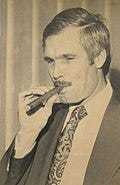
Ted Turner is dead. Although not much in the news for the past two decades, Turner played an outsized role in creating twenty-first century America. He wasn’t the worst billionaire ever, not by a long shot. But he was also very very billionaire. He also played an enormous role in shaping late twentieth century America through his media empire that transformed the reporting of news in the United States, and not really for the better. CNN, like all 24 hour media, is a curse upon the world.
Born in Cincinnati in 1938, Turner grew up well-off, the son of a guy who ran a billboard empire. The family moved to Savannah in 1947 and Turner went to all the southern fancy schools, including a boarding school in Chattanooga for high school. Then he was sent north to Brown for college. He had a good experience there — he was captain of the sailing team and VP of the Debating Union. Now, Turner’s parents were not interested in him getting a liberal arts education. They wanted something concrete. So when he decided to major in Classics, his father “almost puked,” according to his son. But later he switched to Economics. However, things didn’t end well. Turner liked sex and he didn’t like rules and so when he was caught with a girl in his dorm room, he was expelled. College in the ‘60s, what a different world …
He was also a total asshole at Brown to Jewish and Black students and really to everyone. He was privileged, he was a southern white male, it was the times. He would always remain a privileged southern white male, but his politics got weirder and more interesting as he aged.
Prefer a non-Substack subscription? The button below will take any amount of your choosing at Paypal — let me know if you want the newsletter subscription too! Paypal won’t automatically sign you up for the newsletter! — or we have a Patreon too.
Turner spent a bit of time in the Coast Guard Reserve to avoid being drafted and since he did this before the draft for Vietnam had started, he got it out of the way and completely avoided the war. When he wasn’t on “duty,” Turner ran his father’s business in Macon, Georgia. In 1963, his father committed suicide and Ted started running the whole operation. He was also a pretty conservative Republican and was cool with Goldwater in ‘64. He later stated he hadn’t really thought about any of this much and just followed his father into it like so many things. Give Ted this, he did become a man to think for himself and at least avoided the far-right turn of the rich of his era.
Turner turned into an excellent businessman pretty quickly. He first went into more billboards, a quite lucrative market, as he discovered. He made quite a bit of money selling billboard space in the South that required effectively no capital investment and that also had tax advantages. I confess that I don’t understand what those were, but this was Turner’s claim. He realized there was a huge opportunity in media and started buying small radio stations throughout the South. But then he sold those and bought a struggling UHF TV station in Atlanta, WJRJ. He immediately changed the name to WTCG, as in Turner Communications Group, and started showing old movies.
Turner believed there was a market for people to have choice on television. Being an ‘80s kid and thus growing up with cable, the idea of only having the three stations and maybe PBS and a couple of little UHF stations is a bit foreign to me. I think I kind of remember that era when I was a small child, but my television life definitely centers MTV and ESPN and, well, TBS. Ted Turner was in fact a huge part of my life thanks to him showing the Atlanta Braves. But let’s not get ahead of ourselves here. Let’s just say that Turner was absolutely correct in this hunch.
So what could Turner show for cheap on his new station? Old cartoons, old TV shows, old Westerns. Most of the early stuff was really bad, but over time, better product moved from the VHF market to the UHF market and Turner invested in quality syndication properties — Looney Tunes, Gilligan’s Island, I Love Lucy, Star Trek. It’s worth noting that so many of the shows from the past we remember today were not because they were hits at the time, but because Turner or other early pioneers of syndication showed them on repeat. Think about The Brady Bunch. This was not a good show. But I will be good and goddamned if every person my age can’t remember effectively the entire series because it was just on syndicated TV all the time. Turner bought those rights in the early ‘80s and TBS was the home of the show until 1997.
In 1976, Turner applied to send his signal nationwide, through the growth of cable TV, at the point of its birth. The Federal Communications Communication agreed to his request and he developed what he called the “superstation.” That was the same year he bought the Atlanta Braves and Atlanta Hawks. Cable providers just wanted content at this time and he provided it. Turner had a brilliant mind when it came to showing sports. What’s almost impossible for me to remember is an era without a lot of live sports. But when I go back to when I was a kid, it was true and that sucked. I remember when I couldn’t even watch an Oregon Ducks football game. Hell, I remember in the late 2000s when the networks still ran regional games and because I lived in New Mexico and Texas, I would get the goddamn Big 12 instead of the Pac 10 and so instead of Oregon-Washington, I’d get Kansas State-Oklahoma State or some other game I didn’t care about. That was very uncool. By that time, it was the age of satellite TV, so at the least the modern sports bar was an option. Still, watching sports on TV has become an amazing experience and Turner has some credit for that.
But the best thing Turner ever did was buy the Atlanta Braves and then broadcast them on his channel. At first, this was just local. Then he bought a channel in Charlotte and started broadcasting the Braves there. He also got Atlanta Hawks rights, though the Hawks in the ‘70s were perhaps even less entertaining than the Braves of that era. Now, Turner owning the Braves did not make them good, at least not for a long time. It didn’t help that time in 1977 when he named himself manager, as if he had any clue what the hell he was talking about when it came to in-game baseball strategy. In fact, Major League Baseball had a really useful rule on the book that originated in the 1950s, saying that managers could have no financial stake in their ballclub. That didn’t originate from the idea of owners deciding to manage, but the other way around. After one game, MLB forced him out. That game was the Braves’ 17th consecutive defeat. Ted had an ego, can’t deny that one.
It’s pretty hard to argue as such that Turner was a good owner. He was a big brazen clown more than anything else and the team demonstrated his lack of leadership. The Braves teams of the ‘80s were pretty bad. Dale Murphy was great for a few years, though he fell a bit short of the Hall of Fame. Bob Horner was a good slugger with a questionable haircut. That was about it. But you could watch them. I wasn’t a National League kid at all. I was a Toronto Blue Jays fan early in my baseball fandom and then went geographical with the Seattle Mariners. I could never see those teams on TBS. But I could watch baseball, every single day. Later, WGN copied the Turner format to some extent, but my town did not have WGN as part of its cable package, so I didn’t have the Cubs option. Nope, it was the Braves. And I watched. A lot. And I knew a lot of Braves fans too, based entirely on just being able to see them everyday. Then in the early ‘90s, when the Braves got good and started their excellent run (despite ever only winning one World Series in that era), those fans had a lot to cheer for. It was annoying.
The strategy was total genius and Turner deserves credit for understanding that the best thing about TV is the ability to watch sports all the time. Or watch whatever is your bag, but the point is that this media was there to transform our lives and Turner understood this in quite profound ways.
In 1980, Turner decided to expand into the news world. He started the Cable News Network, one of the most revolutionary moments in the history of television. Now, CNN is terrible and almost always has been. It turns out that 24 hours of constant news just creates horrendous bubbles of misinformation as news turns to infotainment, reflecting the centrist desires of Beltway elite reporters rather than much in the way of actual news or analysis. It would have been nice if there was room for real investigative journalism that explored the problems of the world. Alas, CNN was meant to make money and make money it did.
But that doesn’t mean we should underestimate the world changing nature of CNN. Turner, in all his noted modesty, stated when it started in 1980, “We won’t be signing off until the world ends. We’ll be on, and we will cover the end of the world, live, and that will be our last event … we’ll play the National Anthem only one time, on the 1st of June [the network’s debut on June 1, 1980], and when the end of the world comes, we’ll play ‘Nearer My God to Thee’ before we sign off.” He actually has a recording of that song ready to play that was leaked to the internet in 2015.
Ted was always prepared to see his vision through. It didn’t take long for CNN to become an international phenomenon, not only in the United States, but internationally. CNN International was an important network for Americans traveling abroad, especially the corporate class, but also for international leaders. Then there was CNN Business, that became the first real network reporting exclusively on news that mattered to the capitalists. I didn’t realize the importance of these networks until I went to teach English in South Korea after college. I rarely watched this stuff, but the people I knew sure did. He is a serious agent in the history of globalization, tying the world together through the English language and respectable political and business reporting that was more geared to an international corporate elite than the more politainment world he developed on CNN at home.
Turner had no limit to his media ambitions. He tried to acquire CBS in the mid ‘80s. That didn’t work out, so he turned his attention to buying MGM, which he purchased in 1986 for $1.5 billion. This placed Turner in massive debt, so he immediately sold parts of the conglomerate under that title off, including, well, MGM. But one thing Turner did keep was the MGM historical film library. He loved old movies. This had an upside and it had a downside. First the downside — Turner decided that people would watch old films more if they were in color, so he hired people to colorize them. Not only did these look terrible, but for many it was a threat to film history. In fact, it was Turner’s colorization efforts that led the Library of Congress to create the National Film Registry to preserve American film treasures in their original forms. That was established in 1988 and protects 25 American films a year. So thanks to Ted I guess for being so egotistical that people responded in this way.
And yet, Turner’s love of old films contributed another much more positive development — Turner Classic Movies. TCM is a national treasure, one of the greatest things about this largely terrible country. At a cost of almost nothing, TCM shows classic Hollywood films for free to a national audience. The ratings were never great and the profits basically nonexistent, but costs were also so low that it barely mattered. I’d wish that the higher power of his choice would bless Turner for this, but he was a noted atheist, so I’ll just say thanks to him for this contribution to American life. It doesn’t make up for CNN though.
Turner also went into the professional wrestling world, founding World Championship Wrestling in 1988 after buying Jim Crockett Productions and rebranding it. To be clear here, professional wrestling is not a sport in any way. This became the top competitor to the odious Vince McMahon and his World Wrestling Federation. Turner also engaged in yachting, truly the ultimate activity of the rich man. He got involved in this stuff early enough that he actually competed in the 1964 Olympic trials in sailing, so he was legitimately pretty good at it. He then commanded the boat that won the 1977 America’s Cup. He got on the cover of Sports Illustrated for that one. In fact, he came to hate Rupert Murdoch when the future Fox mogul, who did so much to make the world worse through his existence, rammed his yacht into Turner’s during an Australian race. Turner, drunk in the aftermath, verbally berated Murdoch and challenged him to a fistfight, which he then proceeded to repeat on national TV. Murdoch did not take the bet, but in 2003, Turner again challenged Murdoch to a fistfight. This was over Murdoch’s support of George W. Bush’s unjust and evil war in Iraq, which Turner thought was a stupid idea. Maybe this Ted guy wasn’t too bad after all. On the other hand, CNN.
Turner’s other big endeavor was buying up enormous tracts of the American West, old ranches that came up for sale. Like a lot of these rich white men, he glorified the idea of the American West with all its frontier heritage and an older generation of white men “conquering” nature. That said, Turner very much loved the land too. His commitment was very real. He bought 19 different properties, 16 in the United States and 3 in Argentina. They combined for just short of 2 million acres. His Vermejo Park Ranch in northeastern New Mexico is the largest privately owned tract of land in the country, at a mere 550,000 acres. He tried to make all this work financially through raising bison, which he hoped to market as a meat competitive with beef. It really was a good idea. The Great Plains was bison land.
I had the luck to get to know some of Turner’s land. When I was at graduate school at the University of New Mexico, studying environmental history and the American West, one of my professors was the son of one of Turner’s chief biologists. So on two different occasions, I had access to Turner’s ranches in New Mexico. The first was a trip to the Armendaris Ranch, which is mostly grassland in the central part of the state, in the northern edge of the Chihuahuan Desert. There are a lot of endangered species there, but we didn’t really see any of them and it’s cool, but not like the most beautiful place in the world unless you are really into desert grasslands.
But the second time, I was on the trial run of what became a National Endowment for the Humanities summer institute on the environment of the U.S.-Mexican border. We stayed at the Armendaris but then also got to explore the Ladder Ranch, which is in the foothills of the Gila Mountains in southwestern New Mexico. Now that’s a beautiful piece of land, teeming with all sorts of wildlife. It was the first time in my life I saw a big colony of burrowing owls, for example. First time I saw a hepatic tanager too. But also, that ranch is used in the New Mexico wolf reintroduction efforts. They are placed in very large kennels as part of the process to get them ready to be in the wild and we stood on a ridge. The guy who does the wolf program howled at them and they all howled back, so I can say that I have heard howling wolves, even if I’ve never seen a wolf.
All in all, I don’t overly criticize a super rich guy buying up these big western ranches specifically for wildlife conservation. Yes, sure it would be better if this was a public good, but that’s not the world we live in these days. Better this than some guy buying it up to raise more damn cattle. One criticism of Turner’s management is the guy was so into bison that he forced the managers to introduce bison to the ranches that didn’t even have the animals historically. Of course introducing them to his big ranches on the Great Plains, I mean that’s great. But in the pantheon of weird billionaires, and Ted Turner was a weird guy, this is one kind of weirdness you take.
Turner was just kind of an interesting guy, for an egotistical billionaire. Unlike so many, he wasn’t an outright scumbag and he grew up in the white South during Jim Crow so he had every reason to be! He was a big time supporter of the United Nations and global governance programs. In 1988, he gave $1 billion to start the United Nations Foundation, which originally primarily gave out grants, but today does things like support public-private partnership to support sustainability and stuff like that. I don’t know how successful or meaningful this kind of thing really is, but Turner could have spent his money on much worse ideas. He also was very into nuclear issues. In 2001, he and Sam Nunn started the Nuclear Threat Initiative, focusing on a nonpartisan approach to tackling not only nuclear but chemical and bioterror threats. I think Turner was on the board of directors until the day he died.
Turner was an atheist and an asshole about it. He famously called Catholics getting their heads marked on Ash Wednesday “Jesus freaks,” which kind of misses the point. He became famous again for marrying Jane Fonda in 1991 and they were a celebrity couple for the next decade. But when they divorced in 2001, one of the reasons was Ted’s disgust over Fonda’s conversion to Christianity. I mean, c’mon Ted.
Turner also strongly supported the US having universal healthcare programs. He continued his active support of environmental causes, thinking a lot about alternative energy in later years. After the Upper Big Branch Mine collapse in 2010, where the coal magnate Don Blankenship was convicted of misdemeanor conspiracy that led to the deaths of 29 workers, Turner said on TV that this was a sign to leave the coal in the ground and develop renewable energy sources.
Turner’s last years were pretty rough. He was diagnosed with Lewy body dementia, which is a horrible disease.
In the end, Turner was kind of a lunatic and from the people I knew who dealt with him personally, he was not an easy man. That’s not too surprising. The ultimate impact of CNN is pretty mixed, at best. But between preserving huge tracts of the American West from the kind of small ranch development that is devastating to wildlife and the modern creation of sports television, we could do a lot worse if Turner was your normal weirdo billionaire instead of, say, Elon Musk or Peter Thiel.
This is without question the nicest obituary will ever have about a billionaire, except maybe for Warren Buffet. That despite CNN, which I hate so very very much.
Jane Fonda's tribute to him is lovely and epic.
“He swept into my life, a gloriously handsome, deeply romantic, swashbuckling pirate and I’ve never been the same. He needed me. No one had ever let me know they needed me, and this wasn’t your average human being that needed me, this was the creator of CNN, and Turner Classic Movies, who had won the America’s Cup as the world’s greatest sailor. He had a big life, a brilliant mind and a soaring sense of humor.
He could also take care of me. That was new as well. To be needed and cared for simultaneously is transformative. Ted Turner helped me believe in myself. He gave me confidence. I think I did the same for him, but that’s what women are raised to do. Men like Ted aren’t supposed to express need and vulnerability. That was Ted’s greatest strength, I believe.
He also taught me more than any other person or school classes, mostly about nature and wildlife, hunting and fishing (hunters and fishermen who follow the law are the best environmentalists), but also about business and strategy. Ted was supremely strategic. It was likely innate, but he studied the Classics in college, knew about the Peleponesian War inside and out and the strategies used by Alexander the Great and even Genghis Khan. And sailing big boats as he did further honed those strategic talents which he then brought into his businesses to much success. He could see around corners for sure.
Next to Katharine Hepburn, Ted was the most competitive person I have ever met and that was fascinating to witness. Whether it was who’d made the most ski runs at the end of the day, to acres of land owned (stewarded is the more fitting word for his relationship to land), who had the most billions, how many countries he’d made love to his prior lover in and could I match that, it was challenging. Ted was challenging, but I’ve always been up for a challenge, and with Ted it was almost always worth it.
As our friend, Ron Olson, said, “Ted was a great teacher, often by example. He challenged us to think big (he once asked me to draft a resolution for the UN and the US Congress to ban all nuclear weapons; I did) and act small (for the twenty years since meeting Ted, I too, pick up trash on my walks).”
I loved Ted with all my heart. I see him in heaven now with all the wildlife he helped bring back from extinction – the black footed ferrets, the prairie dogs, Big Horned sheep, Mexican Gray Wolf, the Yellowstone wolf pack, bison, the red cockaded woodpecker and so many more, they’re all gathered at the pearly gates applauding and thanking him for saving their species.
Five children survive him, five talented, complex kids who I had the privilege of becoming stepmother to. I had four stepmothers growing up and I know how important stepmothers can be, so we all did our best to build an extended, rag tag family, and I love them to this day. If it was complicated to be married to him, think how complicated it was being his child. And they are all doing fine.
Rest in Peace, dearest Ted. You are loved and you will be remembered.”
"This is the nicest obituary we'll ever write about a billionaire. Probably."
Here's hoping you write many, MANY more. And ASAP.