


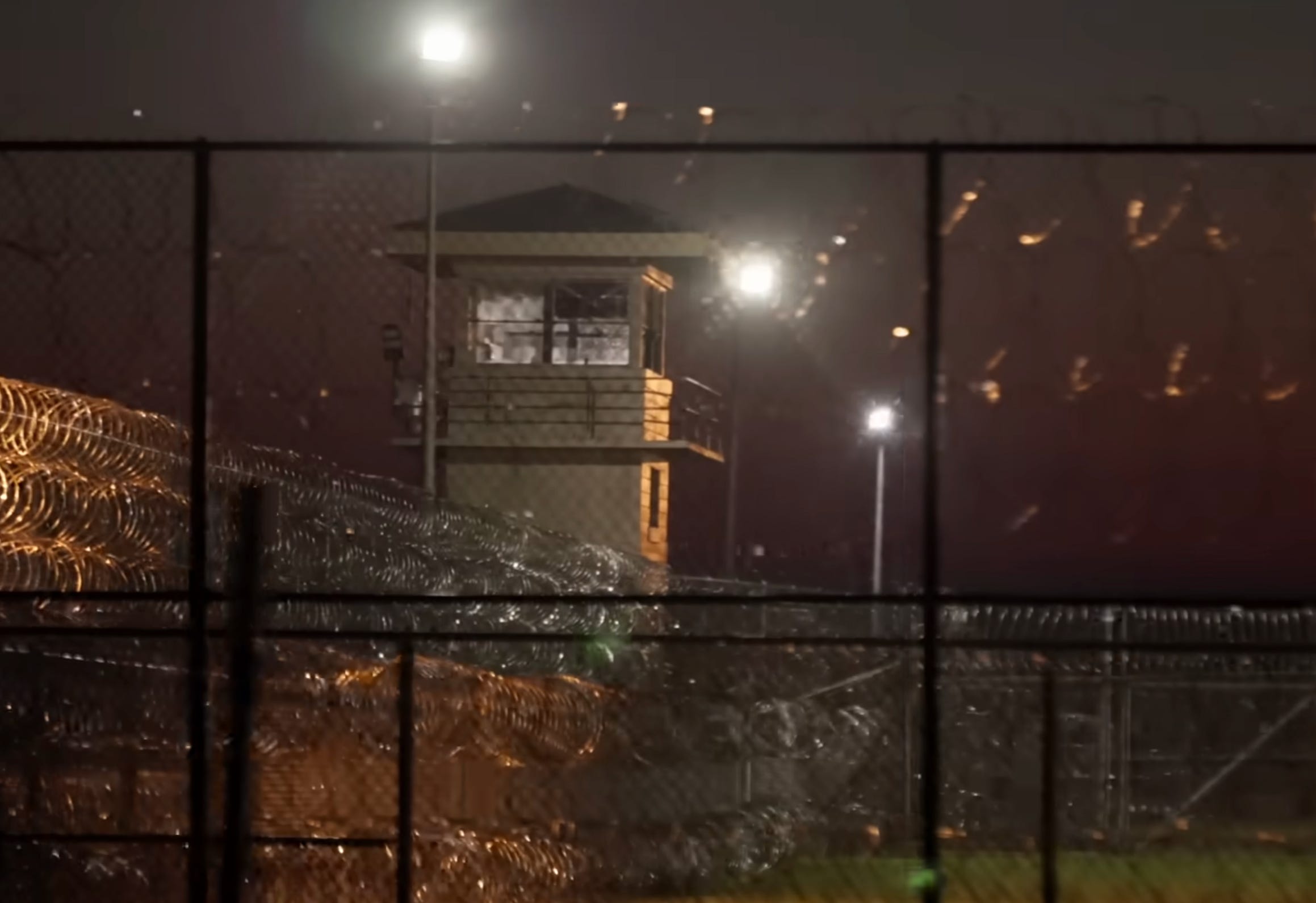
Last week, the Academy of Motion Picture Arts and Sciences announced the 2026 Oscar nominees. Among them was The Alabama Solution (currently streaming on HBOMax), a documentary about the deeply disturbing conditions, corruption, and institutional violence in Alabama Department of Corrections facilities — much of which was filmed on illicit cell phones. It had to be, because Alabama doesn’t allow the media into its prisons, as they don’t want people to see what is going on inside those walls.
Now it turns out that the three whistleblowers who risked their lives to collaborate on the documentary were, according to one of the film’s co-producers, “abruptly snatched” from the Easterling Correctional Facility and moved to the Kilby Correctional Facility in mid-January, where they have since been living in extreme solitary confinement.
It is not clear exactly how long they have been in there, but solitary confinement lasting more than 15 days is a violation of international law and the Nelson Mandela rules. We know that it causes lasting harm and induces psychiatric issues — specifically “characterized by a progressive inability to tolerate ordinary things, such as the sound of plumbing; hallucinations and illusions; severe panic attacks; difficulties with thinking, concentration, and memory; obsessive, sometimes harmful, thoughts that won’t go away; paranoia; problems with impulse control; and delirium.”
In addition to their collaboration on the film, which is getting renewed attention following the Oscar nom, prison activists Raoul Poole, Robert Earl Council (aka Kinetic Justice), and Melvin Ray had also recently announced plans for a prison labor strike to protest the abuses in the system.
This is something Alabama takes very seriously, as prison labor is worth an estimated $450 million to the state annually, both from the money they get from outside sources and the money they save by not having to hire staff within the prison for things like kitchen or cleaning duties. Or from prisoners working at Kay Ivey’s mansion or building her a lovely gazebo. Indeed, they love prison labor so much that they won’t even parole people who ought to be paroled (including many on work-release programs, who are apparently not too much of a danger to work at McDonalds or Golden Corral during the day).
Despite the fact that, according to the state parole board’s own standards, about 80 percent of those who are up for parole should be released, in 2023, only eight percent were let out. That number has increased to a whopping 20 percent since 2024.
After Poole, Council, and Ray helped to organize a prisoner strike in 2022 (featured in the documentary), Governor Kay Ivey put out an executive order requiring that encouraging or participating in a work stoppage be punished the same as having drugs or trying to escape.
Via the Alabama Governor’s Office:
High-level violations shall include offenses such as assault without a weapon, fighting with a weapon, sexual offenses (non-assault), robbery, possession of a weapon, rioting or inciting a riot, encouraging or causing a work stoppage, failure to obey a direct order of an ADOC employee, drug possession, extortion or blackmail, bribery or attempted bribery, absconding from supervision, and attempt to escape without force.
Workers are also not allowed to ever take a day off from work if they are sick, which is both cruel and something I’d really want to look out for if I were eating fast food anywhere in Alabama. The state takes 40 percent of what the inmates make at these work-release programs (generating $250 million since 2000) along with $5 a day for transportation and $15 a month for laundry.
If you are thinking “Huh! This sounds a little bit like slavery and the convict lease programs that ‘replaced’ slavery!” … you would be correct. Alabama was, of course, the last state to ban the convict lease programs (in 1928), and has clearly found its own alternatives since.
This kind of retaliation these men are now suffering is nothing new, and was a large part of the premise of the documentary itself. During the time it was being filmed, guards beat Council to the point where they actually thought he was dead until he was revived by a chemical smell in their office (they had dragged him, face down and bleeding, from the bathroom in which the assault took place). There was also the “mysterious” death of a man who had witnessed a guard beat his roommate to death. Said guard has since been promoted twice by the Alabama Department of Corrections and is now a lieutenant.
The documentary itself is beyond harrowing. The violence, the extreme overcrowding, the unsanitary conditions, the guards providing drugs to prisoners who then overdose, the fact that the prison death rate there is literally four times what it is in other states — and perhaps the worst part of it is that this is something that has been known for well over a decade now. It is new video footage, but it is not new information. In 2016, the Department of Justice began an investigation into the conditions in ADOC facilities and, in 2019 determined that these conditions were a violation of the Eighth Amendment. In 2020, the DOJ sued the state over said violations … but nothing seems to have come of it since then and nothing probably will under Trump.
The state has maintained that it does not need federal oversight and will find an “Alabama solution to an Alabama problem” — although said solution seems to be limited to “more prison labor and even worse conditions.” Indeed, this past May, one Republican in the state Legislature introduced a bill that would allow the state to send its prisoners to CECOT and other notably horrific prisons on the grounds that its own prisons — widely known to be the most deadly in the United States — were “too soft.”
Of course, that would never pass. Not because they care about the inmates’ human rights, but because they don’t want to give up all the money they are making off of them.
These conditions continue to exist in Alabama prisons and prisons throughout the United States because those in charge know that no one is watching. They know that most people are much happier believing that our prisons are actually “too soft,” that they will willfully ignore and brush off what happens in them because it’s happening to “bad people,” and that is why it is important to show them that this is not the case for us all.
So please give Kilby prison a call at 334-215-6600, to let them know we are watching.
PREVIOUSLY ON WONKETTE!


It's nice that we're keeping up with Russia in terms of human rights violations.
"We know that it causes lasting harm"
Which is precisely why they do it