


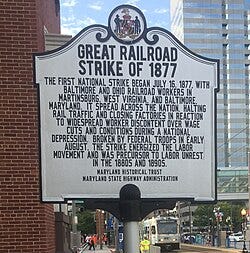
On July 14, 1877, the Great Railroad Strike began in Martinsburg, West Virginia. Workers were desperate in hard economic times to make ends meet and they finally had enough of seeing their wages cut. When they struck, the government at the local, state, and even federal level decided the only response was murderous state violence, a fact that is mostly forgotten today except by labor historians. Let’s change that.
After the Civil War, industrialists engaged in an enormous rail building program. Much of this was funded through shaky and corrupt means. I mean, if you think crypto is a bunch of grifitng bullshit, you should get to know the shenanigans around railroad construction in the Gilded Age. When the bubble burst in 1873 due to the disgusting corruption of the rail capitalist Jay Cooke, whose greed proceeded to bring down the American economy, many railroads went bankrupt and those that survived forced workers to bear the brunt of cutbacks. Throughout the nation, rail workers became increasingly angry. Feeling like they had no power to lead dignified lives and betrayed by the new capitalist system of the age, desperation set in.
You know WHO ELSE is betrayed by the new capitalist system of the age?
The button below will take any amount of your choosing, one-time or monthly, at Paypal, or we have a Patreon too.
It’s also worth noting the extreme hatred many non-railroad workers felt toward the railroads. The railroads overcharged farmers to make up for the sweetheart deals they cut with the big capitalists. If you were poor, the railroads were out there to make you poorer. The trains ran roughshod through the streets, creating unsafe rail crossings that routinely mowed down anyone who happened to be on the tracks. The tracks themselves often created barriers that made carts crossing them very difficult. Many got stuck and that contributed to the deaths. They’d run you down and not care. Compensation for your loss? Give me a break you commies. The noise and soot from the trains now defined urban life for millions of people. The railroads were an uncontrolled behemoth transforming the nation and, from many people’s perspective, very much not for the better.
The Pennsylvania Railroad led the charge in oppressing workers. It forced workers to accept pay cut after pay cut and then doubled the length of runs with no increase in crew size. Other railroads quickly followed suit in a race to the bottom. In Martinsburg, the Baltimore & Ohio Railroad forced its workers to accept their second pay cut in a year. This broke the camel’s back and workers walked out. Rail workers on big lines had a lot of potential power because if they refused to allow trains to roll on a given line, it would disrupt traffic across the country. They knew this and used this tactic.
The strike quickly spread across the nation. Within days, 100,000 workers were on strike, with many more non-rail workers on the picket lines in support. In many areas, there were a lot of everyday citizens, outnumbering the railroad workers. This became a huge expression of anger toward the dominance of railroads over American life. In Maryland, Pennsylvania, and Illinois especially, workers halted the nation’s rail traffic, bringing the country to a screeching halt.
The strike lasted 45 days and the workers didn’t succeed. Nonetheless, it is one of the most important events in labor history for two reasons. It was the first mass action of industrial workers in American history, which scared the hell out of the capitalists. It now seemed America was susceptible to what were considered foreign ideologies from Europe. These paranoid greedy capitalists thought every worker action was the Paris Commune come to American shores. This made about as much sense as Donald Trump ranting about communists today, but then we call this the New Gilded Age for good reason.
Second, the capitalists set the tone for dealing with striking labor throughout the Gilded Age: Crush it with violence. Wrote an anonymous Baltimore merchant, sympathetic to the strike: “The strike is not a revolution of fanatics willing to fight for an idea. It is a revolt of working men against low prices of labor, which have not been accomplished with corresponding low prices of food, clothing and house rent.”
On the other hand, many Americans were outraged. “It was evident,” said the Annals of the Great Strikes in the United States, published in 1877, “that there were agencies at work outside the workingmen’s strike. The people engaged in these riots were not railroad strikers. The Internationalists had something to do with creating scenes of bloodshed …. The scenes… in the city of Baltimore were not unlike those which characterized the events in the city of Paris during the reign of the Commune in 1870.” Again, for these paranoid elites the Paris Commune was like two workers bitching about their shitty jobs at the bar after work.
Thomas Alexander Scott, president of the Pennsylvania Railroad, said that strikers should receive “a rifle diet for a few days and see how they like that kind of bread.” His hopes were answered in Pittsburgh on July 21 when militiamen fired on strikers, killing 20. In response, workers went ballistic, burning 39 buildings and over 1400 rail cars. The next day, militiamen struck again, killing another 20 workers. In Reading, state troopers killed 16 people. In Chicago, nearly 20 died after the mayor called for a volunteer militia to crush the strike. Over 100 people died overall.
Judge Thomas Drummond of the Seventh Circuit Court of Appeals ordered federal marshals to protect the railroads from the strikers, saying, “A strike or other unlawful interference with the trains will be a violation of the United States law, and the court will be bound to take notice of it and enforce the penalty.” Finally, President Rutherford B. Hayes called out the U.S. military to end the strike, setting another precedent — that the federal government would openly side with corporations over workers, no matter how legitimate their grievances.
Railroad workers would remain among the most volatile laborers for the next half a century. At the front lines of an industry rife with corruption, questionable business decisions, and thin profit margins, they would feel the brunt of the American boom and bust cycle. Building off their experiences in 1877, they would remain at the forefront of American radicalism for decades to come.
FURTHER READING:
Richard White, Railroaded: The Transcontinentals and the Making of Modern America
David O. Stowell, Streets, Railroads, and the Great Strike of 1877
Jack Kelly, The Edge of Anarchy: The Railroad Barons, The Gilded Age, and the Greatest Labor Uprising in America
Richard White, The Republic For Which It Stands: The United States during Reconstruction and the Gilded Age, 1865-1896
Michael Hiltzik, Iron Empires: Robber Barons, Railroads, and the Making of Modern America
M. John Lubetkin, Jay Cooke’s Gamble: The Northern Pacific Railroad, the Sioux, and the Panic of 1873
I'm gonna go OT - E. Jean has been paid the 5.6 million. How do ya suppose his morning's goin?
"The right of the people peaceably to assemble and to petition the government for a redress of grievances"
The problem is that workers are often not thought to be 'real, full people.'
Remember the Irish and the Chinese immigrants who built the trains?
Yep, them.