


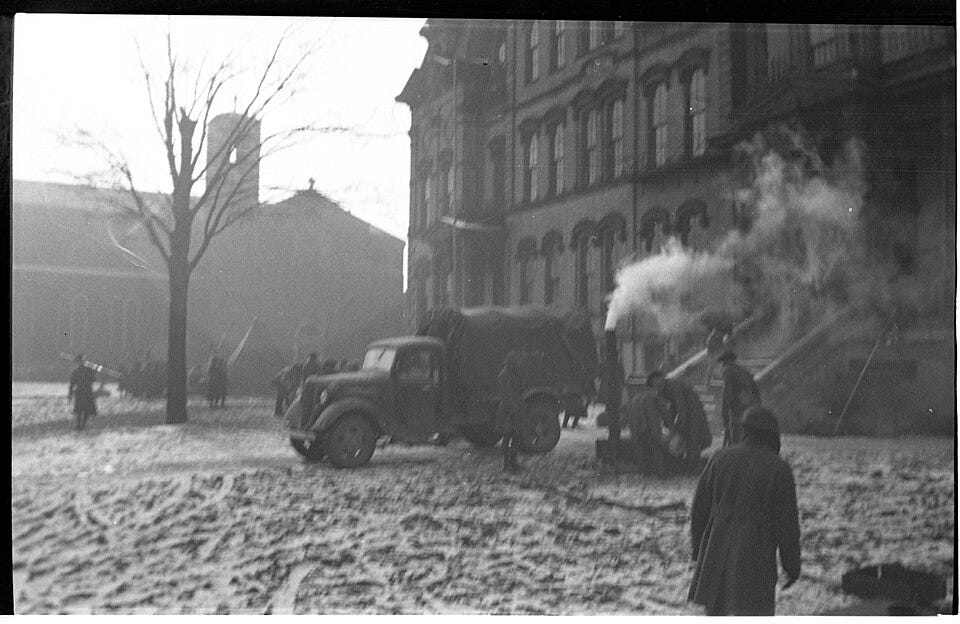
On this date in 1937, the Flint Sit-Down strike ended after General Motors recognized the United Auto Workers as the bargaining agent for GM employees. This titanic victory legitimized the new industrial organizing of the Congress of Industrial Organizations, leading to millions of workers joining unions. Simply put, it’s the most important strike in American history.
Flint, a city of 150,000, was an auto industry town. Auto companies employed 80 percent of the city’s workers directly. The largest, General Motors, effectively owned the city. The police force was at its beck and call and outsiders were closely watched, lest they be agitators ready to unionize the auto workers. The auto industry was vociferously open shop; along with steel, big auto resisted unionization with all its might. The CIO had formed in 1935 to create industrial unionism in the big American industries and the UAW was part of that. But organizing auto was hard and dangerous, what with companies such as Ford hiring ex-boxers who would quite literally murder organizers. UAW had sought to unionize GM plants, but its numbers rose and fell depending on the campaign. Its inability to win a union contract made its future tenuous.
To raise the stakes, UAW organizers in Flint and Cleveland decided to shut the industry down in January 1937. But workers in Cleveland walked out on a wildcat strike in late December, causing the UAW to speed up its plans. On December 29, 1936, the UAW shut down the Fisher Body plant in Flint. Fisher Body supplied bodies for Buick, one of the most profitable GM brands. Militants sat down on the job and refused to leave until GM agreed to a union contract. At this time, the UAW only had about a 10 percent unionization rate among the city’s GM plants, which employed 47,000 workers. Most of the workers had migrated from the rural Midwest and Appalachia, not areas with strong unionization rates. The UAW’s organizers had to teach unionism to workers at the same time that they battled the auto companies.
The sit-down strike put the company in a tricky position. Violence against the strikers threatened the capital of the plant itself, making a forceful eviction potentially costly. However, the success of the Fisher Body occupiers in galvanizing attention led to a huge wave of workers signing up for UAW membership and spawned radical actions throughout the GM system. In response, on January 11, GM ordered the city’s compliant police force to attack the occupiers. The company decided that even if the plant was destroyed, it was better than having a union. But the workers inside began spraying fire hoses and hurling metal objects onto the police below, quickly convincing GM that a frontal assault was not a good idea.
GM also hoped to convince the state or federal government to crack down, in the style of what corporations might soon call “the good old days.” Vice President John Nance Garner wanted to send in the military to crush the strikers. (Side note, how disastrous would a Garner presidency have been had FDR not run for a third term in 1940? Horrible.) GM attempted to use an injunction to declare the sit-down strike illegal. A judge complied but UAW officials discovered he owned $200,000 in GM stock, which disqualified him from ruling on GM-related cases.
More importantly, Frank Murphy had just taken over as governor of Michigan. A committed New Dealer, Murphy has previously been the pro-working class mayor of Detroit. He would later serve as Attorney General for Roosevelt and as a Supreme Court justice, where he dissented strongly in Korematsu v. US, the hideous case in which the Court decided it was cool to throw Japanese Americans into concentration camps. In fact, the UAW had originally hoped to time the sit-in to coincide with Murphy taking office. Finally, President Franklin Delano Roosevelt rejected federal intervention out of hand, despite the desires of his Dixiecrat vice president. Once again, the ability to neutralize the state-corporate alliance at the heart of American history proved critical to union success.
The strike worked because it galvanized the community. While workers might have feared for their jobs by joining the UAW in 1936, after the strike started, it unleashed enormous pent-up desires for justice, decent wages, and good working conditions within the people of Flint. The UAW did an outstanding job of tapping into the community. A women’s auxiliary quickly formed to support the workers inside, bringing them food, clean clothing, newspapers, and other items to while away the long days of boredom inside the plant. While the whole idea of a women’s auxiliary reinforces the male-dominated single-income family, it was 1937 so it was a good strategy at the time.
The workers both inside and outside the plant also showed a tremendous amount of discipline. Conditions inside the plant could have deteriorated quickly, giving the police a clear reason to evict the strikers. Strong leadership within the UAW and first-rate organizers worked closely with the workers and community to stay on message, keep the pressure on GM, and not allow frustrations to boil over in counter-productive ways. The actions of the UAW in 1937 should provide a lesson on how to organize. Self-discipline and community-discipline are both key tenets of successful organizing campaigns. It’s not about what you want to do. It’s about what’s good for the movement.
Another key lesson of the GM strike is the absolutely vital role state and federal governments play in deciding labor battles. Labor had been routinely crushed by the state before 1933. During the GM strike it was the neutral and even pro-labor attitudes of Murphy and Roosevelt that allowed the UAW to win. Traditionally, the American state had oppressed workers. The Roosevelt years saw a marked change in this attitude. Not surprisingly, millions of Americans joined unions. This seems self-evident, yet people seem to misunderstand this basic equation. The politics matter, a lot.
GM obtained a second injunction on February 1. The UAW not only ignored it, but occupied another GM plant in Flint on February 4. CIO leader John L. Lewis arrived to lend his considerable weight to the negotiations. GM leaders refused to sit in the same room with UAW members, but Governor Murphy then stepped in, sending in the National Guard — not to serve as GM’s private army, but to protect the striking workers from strikebreakers. Murphy’s move was the last straw for GM. On February 11, GM agreed to a 1 page union contract recognizing the UAW as the bargaining agent for all union members in its plants, not only in Flint but throughout the nation. The workers left the Fisher Body plant in a state of jubilation.
The UAW quickly signed 100,000 new workers to membership cards at GM plants around the country. The UAW would build off this victory to organize the other auto plants over the next few years and the other major CIO member unions would use similar tactics to unionize the steel and rubber plants of the Great Lakes states, turning America into a union nation, however briefly.
The Flint sit-down strike is arguably the most important moment in the history of American labor. After a century of struggling, failing, and dying for the right to form a union, workers’ own militancy coincided with a new attitude from the government to create the greatest period for American workers in the nation’s history. Sadly, the CIO never could turn the overall tide of this nation against suspicion of labor, and over the decades, the gains labor made in the mid-20th century faded under withering corporate and government attacks. But we have much to learn from the success of Flint for our reorganization of the nation’s workforce.
FURTHER READING:
Robert Zieger, The CIO, 1935-1955
Sidney Fine, Sit-Down: The General Motors Strike of 1936-1937
Nelson Lichtenstein, The Most Dangerous Man in Detroit: Walter Reuther and the Fate of American Labor
OT: Jasmine Crockett is ripping these reprobate Rethugs a new one and it is BEAUTIFUL.
I enjoy practicing the respectful articulation of President Crockett. It pleases me enormously to do so.
Bondi has a tell. When she lies, which is often, she smoothes the hair on her right side.