


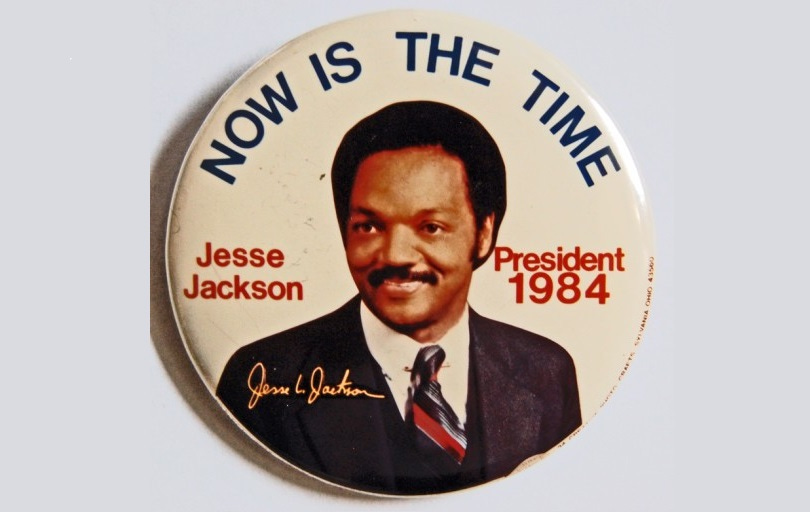
Jesse Jackson died today at the age of 84, after a long career as a leader of the civil rights movement and as an activist for social justice. In his two presidential runs, in 1984 and 1988 — the first serious Black contender for the presidency — Jackson remained as a steadfast voice for progressivism when the Democratic party was trying to respond to Reaganism by moving to the right instead of providing a real alternative to Reagan and the GOP. Rush Limbaugh hated him, and mocked him as “the huh-REV-er-runnnd Jesse Jackson,” because right-wingers are just comedic geniuses that way.
He inspired millions to register to vote, and used his influence on the international stage to win the release of an American pilot from Syria in 1984 (without any illegal arms sales, even); to convince Saddam Hussein to release 700 foreign women and children after the invasion of Kuwait in 1990; and to get Slobodan Milošević to let three Americans imprisoned in former Yugoslavia in 1999. In 1991, he won a term as one of Washington DC’s “shadow senators,” which he used to push for DC statehood.
We won’t try to give Jackson the full New York Times obit treatment, since you can read the real thing easily enough at this archive link. In these fascist days, It may be enough to remember Jackson’s political credo: Keep Hope Alive.
We keep coming back to a line that Times obit highlights, from Jackson’s 1984 speech at the Democratic National Convention in San Francisco.
My constituency is the desperate, the damned, the disinherited, the disrespected and the despised. They are restless and seek relief. They've voted in record numbers. They have invested faith, hope and trust that they have in us. The Democratic Party must send them a signal that we care. I pledge my best to not let them down.
It’s worth remembering the context here: Ronald Reagan was hard at work trying to dismantle the New Deal and the Great Society, and to hand control of the economy to the investor class. That’s the political legacy that brought us to Trump.
Bizarrely, Jackson’s call to empower Americans who’ve been left behind was perverted by Trump, who also claimed to speak for the downtrodden, but redefined them narrowly as the white working class, especially the poorly educated, whom he loved most.
In 1984, Jackson said that political leaders “must heed the call of conscience, redemption, expansion, healing and unity.” Trump found enough angry white voters to instead respond to his apocalyptic call for revenge: “I am your warrior. I am your justice. And for those who have been wronged and betrayed: I am your retribution.”
Compare and contrast. Jackson’s “Rainbow coalition” speech from the ‘84 convention still holds up pretty well, especially as a reminder of what coalition-building can sound like:
Some of the language is a little out of date, but it still works:
America is not like a blanket — one piece of unbroken cloth, the same color, the same texture, the same size. America is more like a quilt — many patches, many pieces, many colors, many sizes, all woven and held together by a common thread. […]
Even in our fractured state, all of us count and all of us fit somewhere. We have proven that we can survive without each other. But we have not proven that we can win and progress without each other. We must come together.
Gosh, how divisive.
For too long, Democrats were happy to triangulate like Bill Clinton, positioning themselves as being in the muddy middle between unkind conservatives like Newt Gingrich and supposed firebrands like Jackson. As the GOP gleefully embraces open racism, we might finally be getting over the myth that a “Sister Souljah moment” can win over conservatives, although Gavin Newsom’s willingness to throw trans people under the bus suggests that myth hasn’t died out entirely.
Could we not do that, please?
Jackson was also really, really good at television; while everyone is also remembering his career as an activist today, the memories are also seasoned with his iconic moments on the small screen, like his 1971 visit to Sesame Street (NYT archive link) to teach kids the simple affirmation “I am somebody.” Wow, imagine anyone on kids’ TV today saying, “I may be on welfare, but I am somebody.”
Times TV critic James Poniewozik lovingly sums up the power of that 90-second clip:
The message of Jackson’s litany is the beginning of education, and the beginning of democracy. It says that you have worth as a person, simply because you are a person. It says that you have a voice. And it says that your voice is most powerful when it joins with other voices.
Amen.
On a far lighter note, there was also Jackson’s 1991 cameo on Saturday Night Live to mark the death of Dr. Seuss, where he brilliantly delivered excerpts from Green Eggs and Ham.
We could do with a few more political figures who can have so much fun reading a very humane children’s book while keeping its sincere message — be open to new things! — intact.
OPEN THREAD.
[AP / NYT (archive link) / PBS Frontline / other NYT (archive link)]
Yr Wonkette is funded entirely by reader donations. If you can, please become a paid subscriber, or if you’d like to make a one-time (or recurring) donation, here’s your button:
I'll never forget the look on his face, and his tears of joy, when Obama gave his electoral address from Grant Park here in Chicago. My town is in pretty deep mourning today, as are we all, who care about good people who have given so much to us all. Jackson was divisive only insofar as Black people who teach justice are viewed as divisive, by white people.
The last thing a cat treat sees.
"My God, it's full of stars"
https://substack.com/profile/155618292-ziggywiggy/note/c-216027473?utm_source=notes-share-action&r=2knfuc