

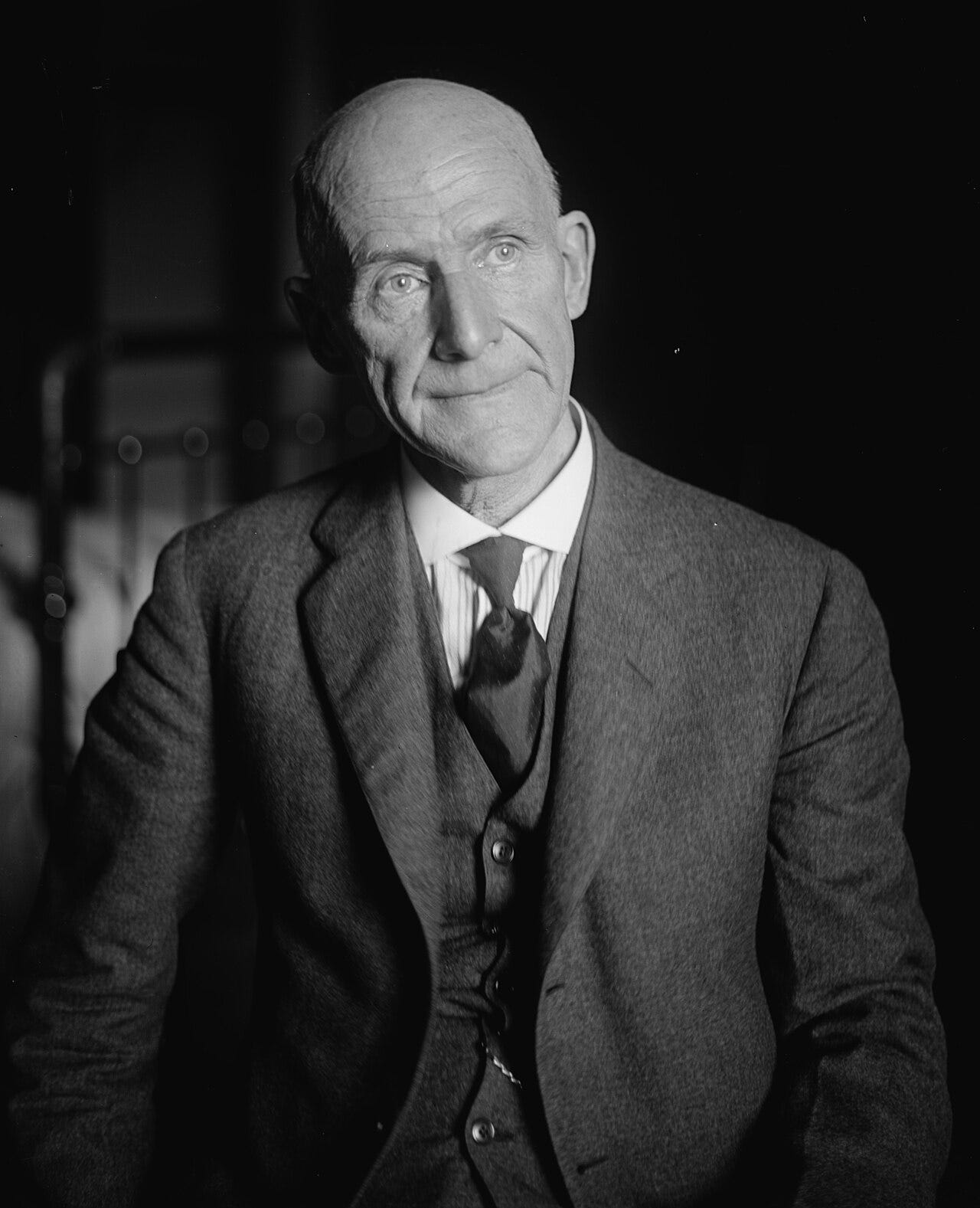
On this day in 1894, the American Railway Union headed by Eugene Debs called a nationwide boycott in solidarity with their striking members at Pullman, Illinois. This action turned a small strike into one of the largest labor actions in the nation to that date, led to the pioneering use of the injunction to crush labor unions, and ended with President Grover Cleveland calling in the US military to serve as a private army for the railroads, ending the strike.
The railroad-caused Panic of 1893 was not only emblematic of how corrupt railroads controlled the American economy in the Gilded Age, but how plutocrats expected the poor to sacrifice during hard times. George Pullman, owner of the Pullman Palace Car Company, which made sleeper cars for the railroads, created his own company town south of Chicago. He provided workers everything they would need — housing, schools, stores. He also charged them high rates to live there, would not employ someone if they did not rent from him, and would evict them if they left his employment. William Carwadine, pastor of the Pullman Methodist Church, wrote of the total company domination, “It is a civilized relic of European serfdom,” and of Pullman, “He is the King and he demands to the full measure of his capacity all that belongs to the insignia of royalty.”
When the Panic of 1893 hit, Pullman began losing money. His response was to lower wages by 25 percent while keeping the rent for his housing unchanged. In protest against this and against working days that sometimes reached 16 hours, Pullman workers attempted to meet with the big boss, but he refused to talk to them and fired three of the leaders. In response, the Pullman workers went on strike on May 11, 1894.
Or give us money via the Paypal button right here.
A young organizer named Eugene Debs started the American Railway Union (ARU) in 1893. Debs believed in an industrial union that represented all white workers on the railroad, skilled and unskilled, as the key to improving their conditions. The ARU opposing the traditional railroad brotherhoods that represented only elite workers and which had helped break the Great Southwest strike against Jay Gould in 1886. That the ARU still discriminated based upon race represented the overwhelming racism of white workers toward non-white competition. Solidarity might extend across the working class, but it hit a brick wall on the issue of race. Debs didn’t like it himself, but he knew that he could not have his industrial unionism if he insisted upon racial equality in it. Despite this and despite dislike from the brotherhoods, the ARU quickly found its legs, defeated the powerful James J. Hill and his Great Northern Railroad in a strike, and had 150,000 members within a year.
The ARU did not represent the Pullman strikers. But acting in solidarity with their fellow railroad laborers, the ARU refused to move any Pullman cars. An official boycott began on June 26 and, like the 1877 Railroad Strike and the 1886 eight-hour strikes, generated its own momentum as a larger protest against corporate domination. By June 29, 150,000 workers were on strike and the American train system, vital to the nation’s economy, ground to a halt. American labor leaders saw it as a battle not just against Pullman, but all their corporate enemies. The Chicago Federation of Labor president said, “We all feel that in fighting any battle against the Pullman company we are aiming at the very head and front of monopoly and plutocracy.”
Sympathy strikes across the nation damaged rail traffic even more. Basically, American workers, who rightfully blamed the rail companies for the Panic of 1893, started taking out their frustrations on the rail industry, the cause of many of their sufferings.
President Grover Cleveland had named Richard Olney, general counsel for the Chicago, Milwaukee, and St. Paul Railway, as his attorney general. With this kind of fair and impartial background on the matter, in his great wisdom Olney decided to issue an injunction against the ARU support of the strike. To justify the injunction, Olney used the Sherman Anti-Trust Act of 1890, which while intended to limit monopolies became a favored tool of industry and government to crush unions instead. The federal courts and Supreme Court supported this interpretation. No doubt Antonin Scalia would have been proud to be a member of the Gilded Age federal court system.
When Debs and the ARU refused to obey the injunction, Olney and Cleveland called out the military over the objection of Illinois Governor John Altgeld, who was sympathetic to the strikers. Commanded by General Nelson Miles, known for his role in crushing the last Native American resistance in the West, 12,000 US troops, aided by US Marshals, cracked down, using the pretense that it interfered with the delivery of the mail. Miles hated Debs, thought the strikers were defying the federal government, and followed through on his orders with relish. The next year, Debs proclaimed in a speech, “The American Railway Union challenged the power of corporations in way that had not previously been done.” This was why the government would not let them win.
On July 3, the military entered Chicago, which outraged the previously pretty peaceful strike. Between July 4 and July 7, fires raged through parts of Chicago as workers used them to try and protect themselves from the troops. One of these fires burned several buildings from the previous year’s World’s Columbian Exposition. On July 7, the military fired into the crowd, killing at least four strikers and wounding around 20. The same day, the military arrested Debs and other ARU leaders and the strike began to fall apart. On August 2, the Pullman plant reopened. Thirteen strikers were killed and 57 wounded during the strike and its repression. Debs went on trial for conspiracy to obstruct the mail, but the US Attorney dropped these charges, supposedly because a juror got sick, and instead the court sentenced Debs to 6 months for violating the injunction.
Serving his prison sentence, Eugene Debs read Karl Marx, became a socialist, and emerged as perhaps the greatest leader for working-class rights the country had seen to that date. He would become a five-time presidential candidate for the Socialist Party, running in 1920 from prison where he was sentenced for violating the Sedition Act of 1918 when he criticized World War I.
The injunction would become the greatest tool the capitalists had to crush labor and in the aftermath of Taft-Hartley, it remains a powerful weapon against organized labor today.
Still enraged by Cleveland’s actions, Illingois Gov. Altgeld successfully prevented the renomination of Grover Cleveland as the Democratic nominee for president in 1896, though one would be silly to credit him entirely given the rise of the Populists and the mania for silver coinage, along with general outrage at Cleveland’s mishandling of the Panic of 1893.
FURTHER READING:
Nick Salvatore, Eugene Debs: Citizen and Socialist
David Ray Papke, The Pullman Case: The Clash of Labor and Capital in Industrial America
Troy Rondinone, The Great Industrial War: Framing Class Conflict in the Media, 1865-1950
Richard White, Railroaded: The Transcontinentals and the Making of Modern America
The preceding links give Wonkette a commission at Bookshop.org.
At his sentencing for sedition, 1918:
"Your Honor, years ago I recognized my kinship with all living beings, and I made up my mind that I was not one bit better than the meanest on earth. I said then, and I say now, that while there is a lower class, I am in it, and while there is a criminal element, I am of it, and while there is a soul in prison, I am not free."
My grandfather would proudly boast that he voted for Debbs in 1920.