


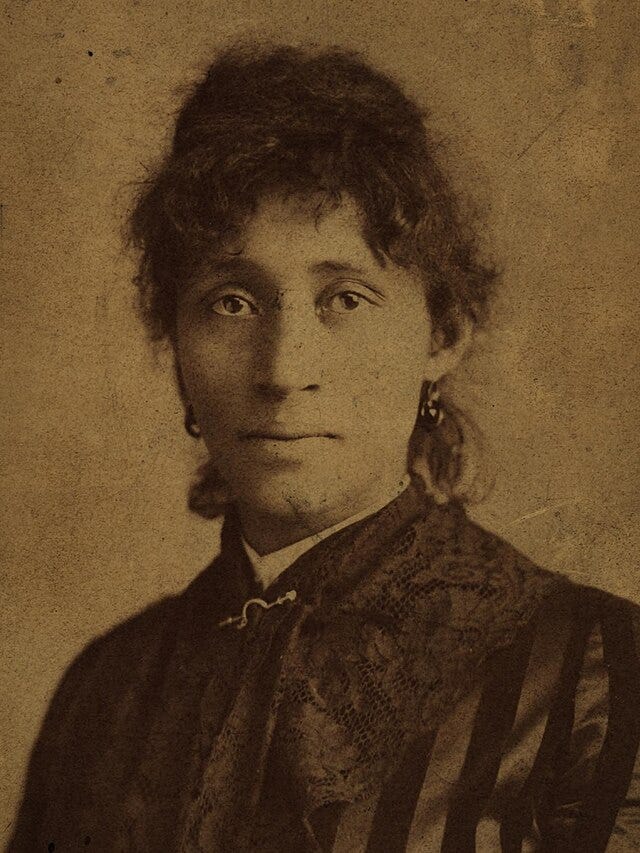
On January 17, 1915, the radical Lucy Parsons led an unemployed march of 10,000 workers in Chicago. Despite being suppressed by the police, the size of the march impressed the city’s more establishment reform organizations and inspired a second march led by them that ended up in a sizable jobs program for the city’s workers. This kind of direct action organizing marked Parsons’ long career as a radical and organizer.
Chicago workers were having a hard time of it in the winter of 1915. While the 1913 recession doesn’t get the same publicity as the Great Depression or Panic of 1893, it still caused serious hardship to workers in an era when employment was often tenuous. When periods of low employment took place, especially in the West and Midwest, where you had large numbers of seasonal and itinerant labor in farming (and logging in the Northwest), huge masses of unemployed people flooded into the cities. The winter of 1915 was also extremely cold, exacerbating the unemployment crisis in Chicago. With all of this combined, you had thousands of homeless people, including increasing numbers of women and children. A crisis was at hand.
Lucy Parsons was a fascinating, if problematic individual. She was born a slave, probably in 1853. Parsons later claimed to be of entirely Mexican and Native American heritage and not African-American. This is almost certainly not true and was likely created by her in Reconstruction-era Texas to escape the political and personal dangers of blackness.
In 1872, she married a young newspaper reporter named Albert Parsons, a former Confederate soldier who now identified as a Republican supporter of Reconstruction. Albert Parsons was white, and he and Lucy had to flee the South because of their interracial marriage. They went to Chicago, where they became involved in the growing socialist political scene there. Much of this was run by German immigrants, some of whom had fled to the US to escape political repression in Germany. Despite the immigrants’ indifference and often even hostility to the Americans they saw as saps and suckers for capitalism, Parsons managed to get in with these Germans, particularly as he began embracing anarchism.
Lucy was right there with him in this political journey. She wrote for several socialist and anarchist newspapers in the 1880s. Her life changed forever when Albert was arrested after the Haymarket bombing and unjustly charged with conspiracy to murder, for which he was executed. Being the activist wife of a Haymarket martyr brought her great personal tragedy but certainly also gave her a lot of political credibility. A tough person who would not back down from any fight, Parsons was also ideologically rigid and held Victorian gender norms, so when younger women such as Emma Goldman challenged gender and sexual norms as part of their critique of society, Parsons vocally opposed them as taking away from the core class struggle.
Parsons attended the founding convention of the Industrial Workers of the World in 1905 and was arrested many times for distributing seditious literature, inciting a riot, and other charges frequently used during this era to repress organizers. Unfortunately, this toughness also led her to have her own son committed to an insane asylum because he wanted to join the military in 1899 and she thought that would undermine her image as a radical. That’s … not great parenting there.
But Parsons knew how to organize a public protest. She decided to hold an unemployment march. Chicago had no shortage of radicals so she was able to get organizers to put it together. They printed up handbills and passed them around the city. About 15,000 people showed up at Hull House, headed by Jane Addams, who was sympathetic to this movement. This was the first time that Ralph Chaplin’s legendary labor song “Solidarity Forever” was publicly sung, as he had only finished writing it two days earlier. The speeches at the rally were relatively tame. They unfurled banners that read “Hunger” and “Give Us This Day Our Daily Bread.”
The march had barely started when the cops cracked down with their batons and firing shots over the heads of the protestors. This was an entirely peaceful protest that had nothing radical about it except for who was in charge. Parsons and 20 others were arrested, and overall, the protest itself didn’t add up to much thanks to the cops. The next day, the local papers used incredibly overheated rhetoric. One paper ran a headline that stated, “I.W.W.’s Start Riot at Meeting in Hull House. Led by Widow of Haymarket Anarchist, Smash Windows and Maul Cops.” Really, you should never believe mainstream media coverage of labor movements, then or now, especially when they report negatively on unions. At the bail hearing the next day, Hull House workers said what really happened, but the police just lied about it.
But what Parsons did was get the local liberal and union community to take unemployment seriously. Parsons herself led another march on January 31. Addams didn’t really approve of this, seeing the public relations victory of the January 17 march, but Parsons didn’t care. This was more radical, even though the Socialist Party and the IWW didn’t bother showing up. Yet it still attracted a lot of people.
Seeing the success of the march and concerned about unemployment generally, yet another march was scheduled for February 12. This had the backing of not only Jane Addams, but also the American Federation of Labor and the Socialist Party, which was pretty moderate in its actions, despite its name. Parsons was of course there as well. The city of Chicago was never going to acquiesce to a woman they hated; when she died, the city confiscated her library because they were scared of what she had in there. But they would deal with Addams and the AFL. After that march, which also had tens of thousands of people attending, the city agreed to a temporary employment program that would build sidewalks, shovel snow, and fill pot holes.
In the end, it is usually radicals who lead moderates, despite all the denigration those radicals face from said moderates. That is largely true then and it is largely true today.
FURTHER READING:
Jacqueline Jones, Goddess of Anarchy: The Life and Times of Lucy Parsons, American Radical
James Green, Death in the Haymarket: A Story of Chicago, the First Labor Movement, and the Bombing that Divided Gilded Age America
Brigitte Anne Koenig, American Anarchism: The Politics of Gender, Culture, and Community from Haymarket to the First World War
Wonkette will always be free, with no ads and no paywall. If you’d like to help us keep going forever, the Paypal button below will let you donate any amount of your choice, one-time or monthly!
***This had the backing of not only Jane Addams, but also the American Federation of Labor and the Socialist Party, which was pretty moderate in its actions, despite its name.***
Sure, those socialists *start* by wanting to increase the minimum wage and have affordable housing, but next thing you know, they're opening groceries in food deserts and making public transportation free. Then having standards for food labeling, and mandating overtime pay. Then outlawing children working in factories, and having public service exams. You see what kind of hell this leads to.
Nice to have someone other than Turnip or Vancey on the first story. Also nice to have a history lesson about someone I have heard about but didn't know much about.