


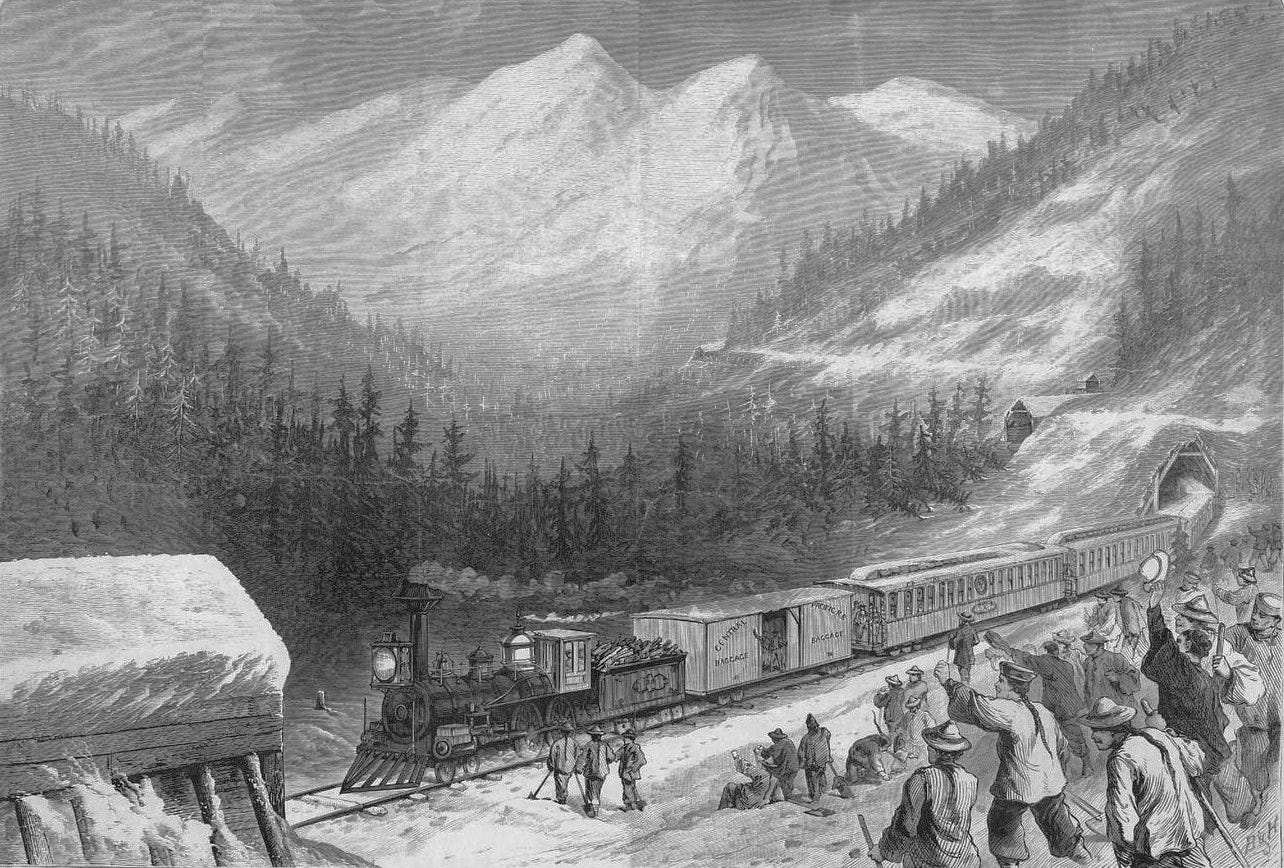
On May 10, 1869, the Transcontinental Railroad was completed when the Central Pacific and Union Pacific lines met at Promontory Point, Utah. The railroad itself was key to the growth of the American nation after the Civil War, but it came at a terrible cost to workers, particularly the Chinese working for the Central Pacific. Examining the treatment of the Chinese shines a light not only on the labor conditions for the most despised group of workers in the United States, but also on the limits of the Republican Party’s free labor ideology, which had no taste for workers’ rights.
While the Union Pacific relied largely on Irish labor, the Central Pacific hired mostly Chinese laborers to build the railroad. There were certain dangers with all railroad construction and the UP did build across the territory of still pretty powerful Native American tribes, but the land itself was slowly rising and without major physical obstacles in the way. On the other hand, the CP had to build across the Sierra Nevada and then through the difficult terrain of Nevada. It was going over the Sierra that tells the most compelling labor history of the Transcontinental Railroad.
The Central Pacific hired James Strobridge as its construction superintendent. It was his job to hire the men and build the road. Strobridge liked to beat his workers with a pick handle. While Charles Crocker, one of the CP top executives, objected to this treatment, Leland Stanford, Collis Huntington, and Mark Hopkins, were fine with it. Stanford, well known in his time as a very stupid human being, founded Stanford University when his son died, one of the great ironies of American history.
In 1865, Strobridge started hiring Chinese laborers, the most easily dominated workers in the country at that time, even more so than the newly ex-slaves. The low wages meant that even the Irish were hard to get. The Central Pacific wanted 4,000 workers and had 800. By 1868, 80 percent of the now 12,000 member CP workforce were Chinese. The Chinese presence was hated in California but was also necessary in the early years to do the work white miners did not want to do, such as cooking and cleaning. When everyday whites left mining after not striking it rich, they saw the Chinese as competition for the white man’s republic they hoped to build in the Golden State.
Few California whites would object then if Strobridge turned his legendary labor methods on the Chinese. And turn on them he did. He only brought the Chinese on when the Irish began demanding higher wages. The CP explicitly divided workers by race, forcing the remaining Irish to take lower wages. They wanted about $50 a month. The Chinese were paid $30 and the Irish $35. The Irish had their food and board provided, but the Chinese had to pay for theirs. The Irish of course blamed the Chinese for keeping wages down. American workers have always been happy to divide themselves by race and employers were happy to facilitate that.
The conditions of work were extremely difficult. Building through the Sierra meant cold, rain, and lots of snow. The Chinese labored on blasting 16 tunnels through the Sierra, an extremely dangerous proposition at any time, and especially during an era when employers had no legal responsibility for workplace safety. It is impossible to know how many Chinese workers died building the railroad, from avalanches, explosions in tunnel building, and other causes. No one kept track because the CP didn’t care. An 1870 story in a Sacramento paper reported that a train carrying the bones of 1,200 dead Chinese workers had passed through town on the way to San Francisco. We can probably see that as a bare minimum of the dead and the number was almost certainly much higher.
As word of the horrible conditions got back to San Francisco, fewer Chinese signed up. Strobridge raised the wage rates for the Chinese to $35, but this was not enough. In late June 1867, thousands of Chinese went on a short strike. They had concrete demands. They wanted $40 a month, a 10-hour day for above-ground work and an 8-hour for tunneling work instead of the 12-hour day they faced, an end to beatings, and the right to quit without harassment from the company.
Strobridge’s response was to stop feeding the workers. Crocker looked into hiring newly freed ex-slaves (at the same time that southern planters were exploring hiring Chinese) to replace them but this was unrealistic. So simply refusing to send supply trains carrying food was the best answer. The Chinese were high in the mountains, far away from home, and with no means of survival. They were at the mercy of the Central Pacific. After a week, the strike ended and they returned to their brutal, deadly work.
Once they crossed the Sierra and started building in the baking hot and dry alkali flats of the Great Basin, the Chinese had enough. Hundreds of workers fled back along the railroad lines to California. Strobridge sent horsemen to round them up just like they would round up cattle. Rope, lasso, forced work. Free labor this was not.
This story suggests the very strong limitations of Republican labor policy and I want to once again push back on the idea that the Republican Party was a revolutionary political party. The vast majority of the nation’s railroad executives were Republicans, many active abolitionists. Many Republicans were perfectly fine with coerced labor so long as it wasn’t the actual conditions of slavery in the American South. That’s because for them, the problem with slavery was not the treatment of Black people, but the effect on white people, making them lazy, violent, and unconcerned with industrial progress. The abolitionists had different views and at least some of them were not horrible toward the Chinese, but they were always a pretty stark minority in the Republican Party. Far more common and growing ever more powerful in the years after the war were people like the Central Pacific executives, who would happily drive labor to the point of death for profit.
The Chinese would go on to build many western railroads, facing discrimination and violence wherever they went. Hatred of the Chinese eventually led to the Chinese Exclusion Act, the first legislative victory for organized labor in American history. Violence however continued and it was only with the rise of Japanese immigration and declining Chinese populations due to the immigration restriction that the violence subsided.
FURTHER READING:
Mark Fiege, The Republic of Nature: An Environmental History of the United States, which is not primarily a labor history, but which contains details of these issues in its railroad chapter and which is worth reading for more on the importance of nature for understanding key events in American history.
Richard White, Railroaded: The Transcontinentals and the Making of Modern America
Beth Lew-Williams, The Chinese Must Go: Violence, Exclusion, and the Making of the Alien in America
Richard J. Orsi, Sunset Limited: The Southern Pacific Railroad and the Development of the American West, 1850-1930
Michael Hiltzik, Iron Empires: Robber Barons, Railroads, and the Making of Modern America
Harry says Happy Mother’s Day to all the cat moms, thank you for treats, scritches, warm cuddles and giving us a place in your home and your heart.
https://substack.com/@ziggywiggy/note/c-256860747?utm_source=notes-share-action&r=2knfuc
An update to yesterday's story about the pile of stuff that was left out for people to take.
Original story here:
https://substack.com/@ziggywiggy/note/c-256485281?utm_source=notes-share-action&r=2knfuc
There are only 2 things left. One book and a jar with weird bits of glass and rocks inside it.
It was all just someone's stuff that could have easily ended up as garbage but instead it found new life.
That's a good thing.