


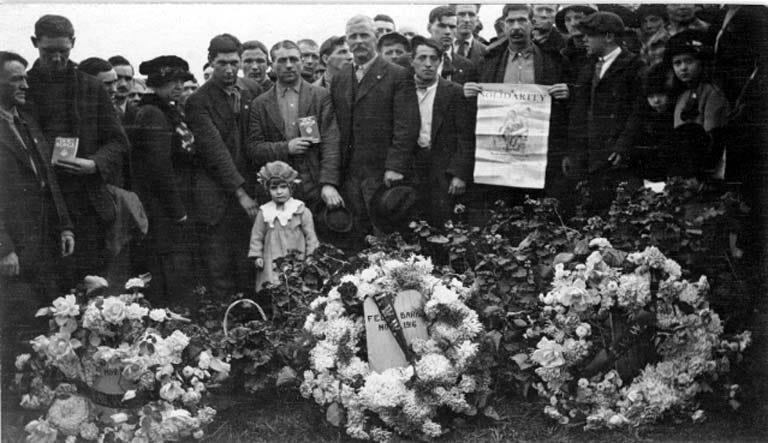
On November 5, 1916, a boat loaded with members of the Industrial Workers of the World attempted to dock in Everett, Washington. Local leaders, determined to stop the IWW from entering their nice little town and influencing their striking shingle weavers, opened fire on the docking boat, killing at least five IWW members, though probably closer to 12 radicals died. Two deputies died as well, shot in the back by friendly fire. Known as the Everett Massacre, this incident was the first of several incidents of organized violence against the IWW in the Northwest during the second half of the 1910s.
Shingle weavers lived a tough life. You could always tell who was new to the job: The newbie had 10 fingers. Shingle weavers created roofing shingles out of raw pieces of cedar. They did so with bare hands and whirring buzz saws without protection. In addition, the saws produced wood dust that workers breathed in. “Cedar asthma” was a common malady. Shingle weavers had been the first workers in the timber industry to organize into unions, going back to the late 19th century.
As 1916 approached, the IWW, while active in the region organizing itinerant loggers, had almost no presence in Everett. Many shingle workers saw themselves as skilled workers and felt closer to the American Federation of Labor than the disreputable radicals, although the AFL had shown very little interest in organizing them. The shingle weavers had gone on strike in the summer of 1916 to receive a pay raise to make up for slashed wages from an industry downturn in 1914.
The shingle weaver strike was almost over when the IWW showed up — only one mill remained on strike. On August 19, 1916, strikebreakers at that mill got into a fight with strikers, beating them up pretty bad. The IWW had only a small presence in the town but capitalized on the newly explosive situation. Wobblies began agitating more, organizing the workers. The town quickly shut down the IWW office, thinking it would get rid of them, but more kept arriving. IWW members were well-known for their incredible physical bravery; knowing they would be jailed, beaten, tortured, or even killed, hundreds would go anywhere to further the struggle.
Everett leaders unleashed their full fury on the Wobblies, even before November 5. Forty Wobblies were rounded up, brutally beaten, and taken to the edge of town where, despite some severe injuries, they were forced to walk along the rail line back to Seattle. Wobblies were used to being kicked out of town. In fact, much of their early publicity came from free speech actions throughout the West as local police forces and industry leaders routinely violated their First Amendment rights.
So when word of the beatings got out, the Wobblies were not going to back down. Instead, they hired a boat, the Verona, which they loaded with 300 of their members to bring the free speech struggle to Everett. By the time the boat arrived, law enforcement had massed at the dock. Snohomish County Sheriff Donald McRae had deputized 200 citizens to stop the “invaders.” McRae yelled out, “Who are your leaders?” The response: “We are all leaders!” At this point, McRae and his deputies opened fire, nearly causing the boat to capsize as the Wobblies fled the assault.
The known dead Wobblies were Hugo Gerlot, Abraham Rabinowitz, Gus Johnson, John Looney, and Felix Baran. There were seven Wobblies missing, probably shot into the water and later fished out and quickly buried to avoid the information becoming public. Naturally, the Wobblies were then arrested and charged with the deaths of the two deputies killed by friendly fire. The authorities chose only one Wobbly, Thomas Tracy, to stand trial for the “murders,” but even in a day where unbiased juries in labor trials were a rare exception, the jury acquitted Tracy due to the complete lack of evidence.
The IWW did not go away after the Everett Massacre. Building upon it and other martyrs to the worker struggle, they made the Pacific Northwest timber industry the union’s prime focus in 1917, bringing the industry to a halt that summer protesting the atrocious living conditions and working environments loggers suffered daily. Eventually, the federal government intervened after the US entered World War I because the strike became a national security issue due to the necessity of Northwestern wood to build airplanes. The IWW wouldn’t go away after that either. In fact, it took another act of violence against radical workers in order to suppress the Wobblies in the Northwest. As it is today, right-wing forces would happily use murderous violence against people trying to make a better nation for the American working class.
FURTHER READING:
Erik Loomis, Empire of Timber: Labor Unions and the Pacific Northwest Forests
Norman H. Clark, Mill Town
Matthew S. May, Soapbox Rebellion: The Hobo Orator Union and the Free Speech Fights of the Industrial Workers of the World, 1910-1916
Carlos A. Schwantes, The Pacific Northwest: An Interpretative History
My great grandfather Frank Bacon was an IWW organizer in the 1910s-30s. He was one of the field marshalls involved with this. Oh and he was also active in the Socialist Party (Yes gang, over 100 years ago there really was an active Socialist Party in the US of A!).
Great Grandpa was one of those swept up in the Palmer raids of 1919...wound up blacklisted so he eventually settled in Ambridge PA where he set up a grocery store that gave credit to millworkers. Oh the America Bridge Company didn't like that so they brought an A&P store into town...that only took mill scrip but Great Grandpa persevered and held Socialist Party meetings in his store to piss the factory owners off...
Ah, the Everett Massacre! We had this in high school Washington State History. They also taught us how we totally crapped on the native residents. Thank god for hippie nuns as teachers.
Thanks for covering this, Erik!