


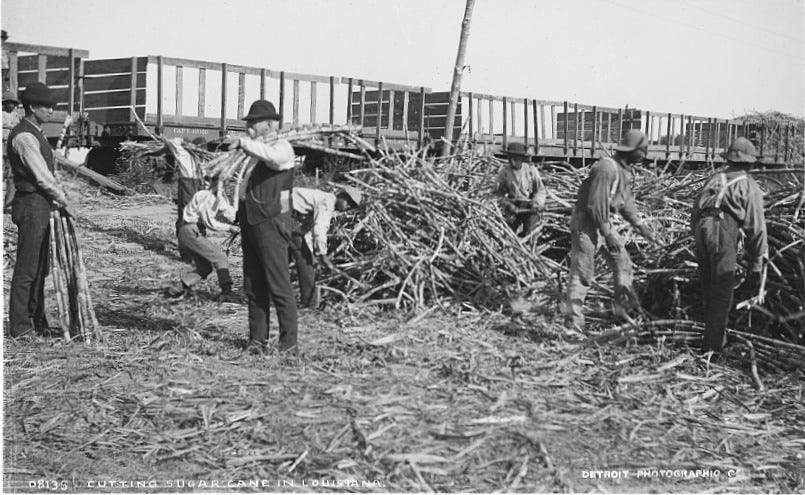

On November 22, 1887, a group of white vigilantes crushed a Knights of Labor-led strike by Black sugar workers in the fields around Thibodaux, Louisiana. Fighting back against the largest Black social movement in the state since the end of Reconstruction, whites killed dozens and perhaps hundreds of Black workers, seeking to retake control of the racial hierarchy, state politics, and labor relations from empowered African-Americans.
Slaves had made up the sugar workforce before 1865 and with the failure of Reconstruction to give Black people meaningful labor rights, the white plantation owners sought to reinstitute conditions as close to slavery as possible. The Louisiana Sugar Planters Association determined to keep wages as low as possible. Workers made about 60 to 65 cents a day, paid in company scrip that kept them dependent upon the white economic structure. But Black workers never accepted white attempts to recreate dependence. They fought back in many ways, including by striking. Beginning in 1880, sugar workers engaged in some sort of protest each year over the conditions they faced.
By 1886, the determined struggle of the Louisiana workers attracted the Knights of Labor. Although the Knights would fall into decline after the Haymarket Riot, in 1886 it was at its height, and the sugar workers welcomed its organizing expertise and national following. In a world where the American Federation of Labor, founded in that year of 1886, would explicitly exclude Black workers (among a lot of others), the Knights being willing to cross racial boundaries is notable and important. Many of the Knights’ local assemblies were segregated, but sometimes they were integrated.
With the Knights’ support, worker organizing increased rapidly. A planter wrote in 1886 that employees “are becoming more and more unmanageable. By degrees they are bringing the planter to their way of thinking in regard to how they should work and no telling at what moment there will be a serious move to compel the planter to comply with any request.”
Workers took serious actions as 1887 went on. As early as January, 15 workers went on strike. For instance, a striker named Adam Elles was arrested and charged with preventing Nelson Christian, a Black Union veteran, from working. As the summer slid into fall and the harvest season approached, whites became increasingly fearful of mass action. Local newspapers began reminding readers of the horrors of Black political action, tying that into larger paranoia of Black-on-white violence that southern whites had connected to mobile and empowered Black labor going back at least a century.
On October 19, the Knights local in Morgan City met to fashion its list of demands for regional sugar workers. This included a raise to $1.25 a day, biweekly payments, and cash pay instead of the company store scrip. Junius Bailey, a former slave who was now president of the Knights’ joint local executive board, sent a letter to the sugar planters that read, “should this demand be considered exorbitant by the sugar planters […] we ask them to submit such information with reason therewith to this board not later than Saturday, Oct. 29 inst. or appoint a special committee to confer with this board on said date.” The sheer existence of such demands and such a letter were outrageous to a white elite who still considered enslavement the rightful status of its labor force.
At its height, up to 10,000 workers were on strike, although there’s no way to actually know and the number may have been created for journalistic shock value. In response, Thibodaux whites organized the Peace and Order Committee. Led by Judge Taylor Beattie, an ex-Confederate, planter, and former member of the Knights of the White Camelia (a Louisiana white supremacist paramilitary organization similar to the KKK), the Peace and Order Committee declared martial law over Thibodaux’s Black population. It also made Black people show a pass to stay in the city, a policy reminiscent of the slave passes that regulated Black movement before 1865.
Over the next two weeks, tensions continued to rise. On November 22, the Peace and Order Committee closed the roads into Thibodaux and decided to end the labor uprising once and for all. Mary Pugh, owner of the Live Oak plantation, said that unless this strike was repressed, “white people could live in this country no longer.” On the morning of the 22nd, the militia walked into town and just started killing Black people. A couple of strikers fought back, wounding two militia members. But the militia went house to house, pulling out Black people and executing them in cold blood. Black workers fled out of the city and the strike effectively ended.
The number of dead remains unknown. At least 35 were killed. But some have estimated that number could be as high as 300. That’s a big disparity. Counting numbers of dead Black people or dead strikers was not exactly a priority of Gilded Age America and so you see significant death toll disparities in cases like this. The aftermath was one of joy for the region’s white elite. The editor of the Thibodaux Star, who had been a member of the murderous militia, wrote of “negroes jumping over fences and making for the swamps at double quick time. We’ll bet five cents that our people never before saw so large a black-burying as they have seen this week.” Mary Pugh wrote, “I think this will settle the question of who is to rule, the n***** or the white man? For the next 50 years but it has been well done & I hope all trouble is ended.” Mary Pugh, obviously, did not use asterisks.
Even after the Thibodaux Massacre, the sugar workers continued to fight. The Knights of Labor proved useless in organizing in the wake of violence; like with Haymarket, this was not what Terence Powderly had planned for. But these workers were politically mobilized and in 1888, despite the repression, Black voters outnumbered white voters. Segregation and Jim Crow was not just about political control. As the whites of Louisiana made very clear as they repealed Black voting rights with maximum violence during the late 1880s and 1890s, this was about keeping labor under control — cheap, exploitable, and within the racial hierarchy.
FURTHER READING:
Rebecca Scott, Degrees of Freedom: Louisiana and Cuba after Slavery
Joseph Gerteis, Class and the Color Line: Interracial Class Coalition in the Knights of Labor and Populist Movement
(The preceding are Wonkette affiliate links.)
OT: Getting a wee bit concerned some on the internet have taken the joke of "trick Trump into signing [insert progressive thing here] by naming it after him" and think it's uh...legit. Seen multiple complaints that Trump would TOTALLY give us universal healthcare if we just called it Trumpcare but Jefferies will get in the way and stop him from giving it to us. Like. Are you really that stupid? The answer seem to sadly be yes!
A depressing but enlightening post, thanks as always Erik.