


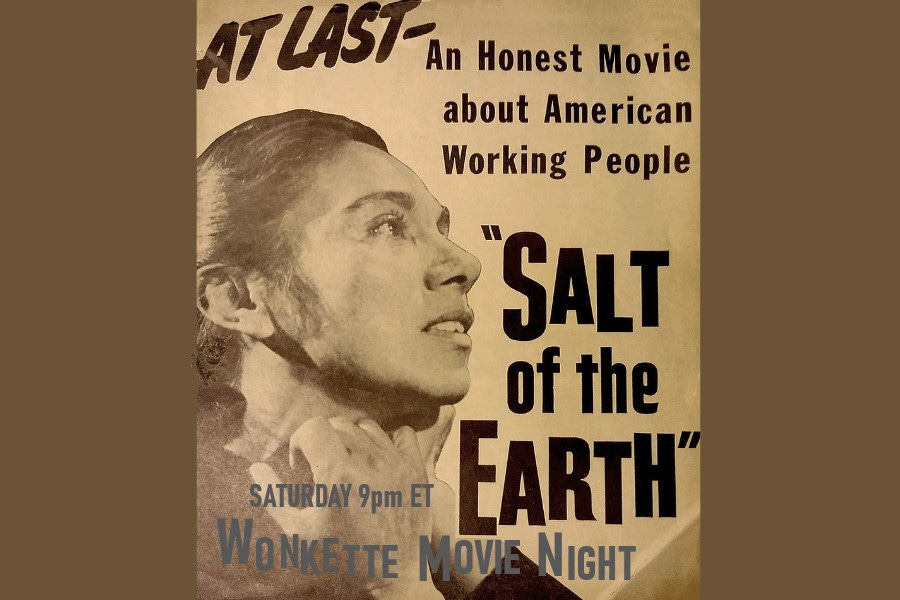
Salt of the Earth was written, directed, and produced by three men who were blacklisted by Hollywood because of their supposed involvement in Communist politics. Michael Wilson, Herbert J. Biberman, and Paul Jarrico still managed to make a thoughtful, independent film without the help of Hollywood. Creating a movie in 2025 with a feminist viewpoint and telling the true story of a strike by Mexican-American miners would create an uproar and battles across social media in today’s world, but they did it in 1954.
The movie opens with this:
“Our scene is New Mexico
Land of the free Americans who inspired this film
Home of the brave Americans who played most of its roles”
Esperanza Quintero explains that she lives on the land where her great-grandfather had grazed cattle “before the Anglos ever came.” She is pregnant with her third child and struggles to care for her family in the company town where her husband Ramon works in the zinc mines. She says that her village was named San Marcos when she was a child, but the “Anglos changed the name to Zinc Town. Zinc Town, New Mexico, USA.”
The miners are represented by a union who work to improve the lives of miners, but the mine that Ramon works in requires they work alone, using dynamite and risking their lives. The union has managed to get teams of two for all the other mines but Ramon’s. Ramon knows why: It is because this mine employs Mexican-Americans and the union wants them to be patient.
The union rep tells Ramon that the bosses do not want equality because it is the strongest weapon they have. That the company can say to its Anglo miners, see you have it better than them. After an accident the miners walk out. They vote to strike and the women decide to join the union meeting, Esperanza says, “I didn’t want to go in, I had never been to a union meeting. But the others said, one go, all go.”
The women demand to be part of this fight for equality with one simple request. Sanitation. They want running water. They want to form a ladies’ auxiliary and do what they can to help. The men push those issues aside and they push the women back into their places.
The miners go on strike and the picket line begins. Eventually the women join them, bringing coffee and food. The union realizes the women are helpful to the cause and create the ladies auxiliary. The women continue their push for something as basic as sanitation.
The company uses the sheriff to beat Ramon and jail him. But the strike continues. Other workers from other unions send in messages of support, money and food to help them survive. But the company gets a Taft–Hartley injunction that requires the miners to stop picketing. If they do not stop, they would be arrested. It seems the company has won.
But the women know that the injunction did not include them, so they could picket in their place. They take to the picket lines in their husbands’ places and some of the men do their best to do the work of their wives.
The sheriff believes the women would “scatter like quail’ when confronted.
He apparently doesn’t know women very well.
The company owns everything so they use the law to evict Ramon and Esperanza and seize all their belongings. But the community had something to say about that. Esperanza gets the last word.
“Then I knew we had won something that they could never take away. Something I could leave to my children, and they, the salt of the Earth will inherit it.”
Salt of the Earth is available with subscription on MGM+, Prime, Sling and Fubo TV. Free on YouTube. Free with ads on Tubi, Plex and Pluto TV.
Salt of the Earth stars Rosaura Revueltas, Juan Chacón, Will Geer, Henrietta Williams, David Bauer, Mary Lou Castillo, and Frank Talevera. Directed by Herbert Biberman.
To make requests and see the movie lists and schedules go to WonkMovie.
The animated short is Wind by Robert Loebel.
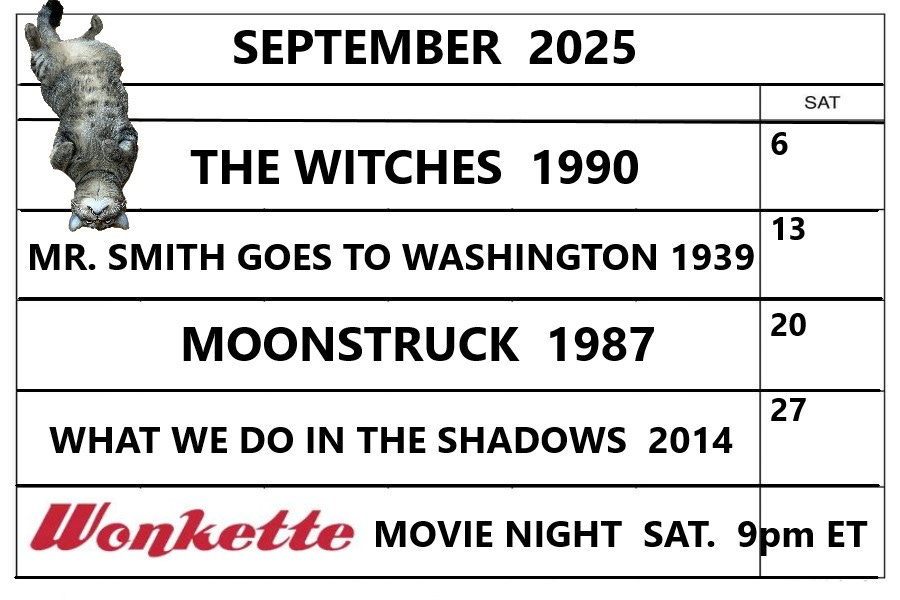
The next Movie Night selection kicks off September with The Witches, the 1990 version with Anjelica Huston of course!
𝐁𝐎𝐍𝐔𝐒 𝐓𝐑𝐈𝐕𝐈𝐀:
Rosaura Revueltas was a noted screen actress in her native Mexico. After this film was distributed, she was accused of being a Communist and deported. She continued to appear in Mexican cinema, but never made another film in the US.
Because blacklisted people were among those who made the movie, the production was fraught with interference by local thugs. The entire cast and crew were met by a citizens' committee in Central (now Santa Clara), New Mexico, where they had planned to film, and were ordered to leave town. The following day they moved the production to Silver City, NM, and were warned to "get out of town... or go out in black boxes."
The producers feared both sabotage and destruction of the film, the exposed footage had to be developed in secret at night by a sympathetic lab technician, with the film delivered in unmarked canisters.
This movie was the only blacklisted film ever in American film history. It was blacklisted in the 1950s at the height of the McCarthyism scourge.
𝐁𝐎𝐍𝐔𝐒 𝐓𝐑𝐈𝐕𝐈𝐀:
Director Herbert J. Biberman, screenwriter Michael Wilson, producer Paul Jarrico, and composer Sol Kaplan made the film largely in retaliation for being blacklisted. Since they weren't allowed to work in Hollywood, they reasoned they'd might as well make a film as pro-Communist as possible, to fit the "crime" for which they had been accused by the Un-American House Activities Committee.