


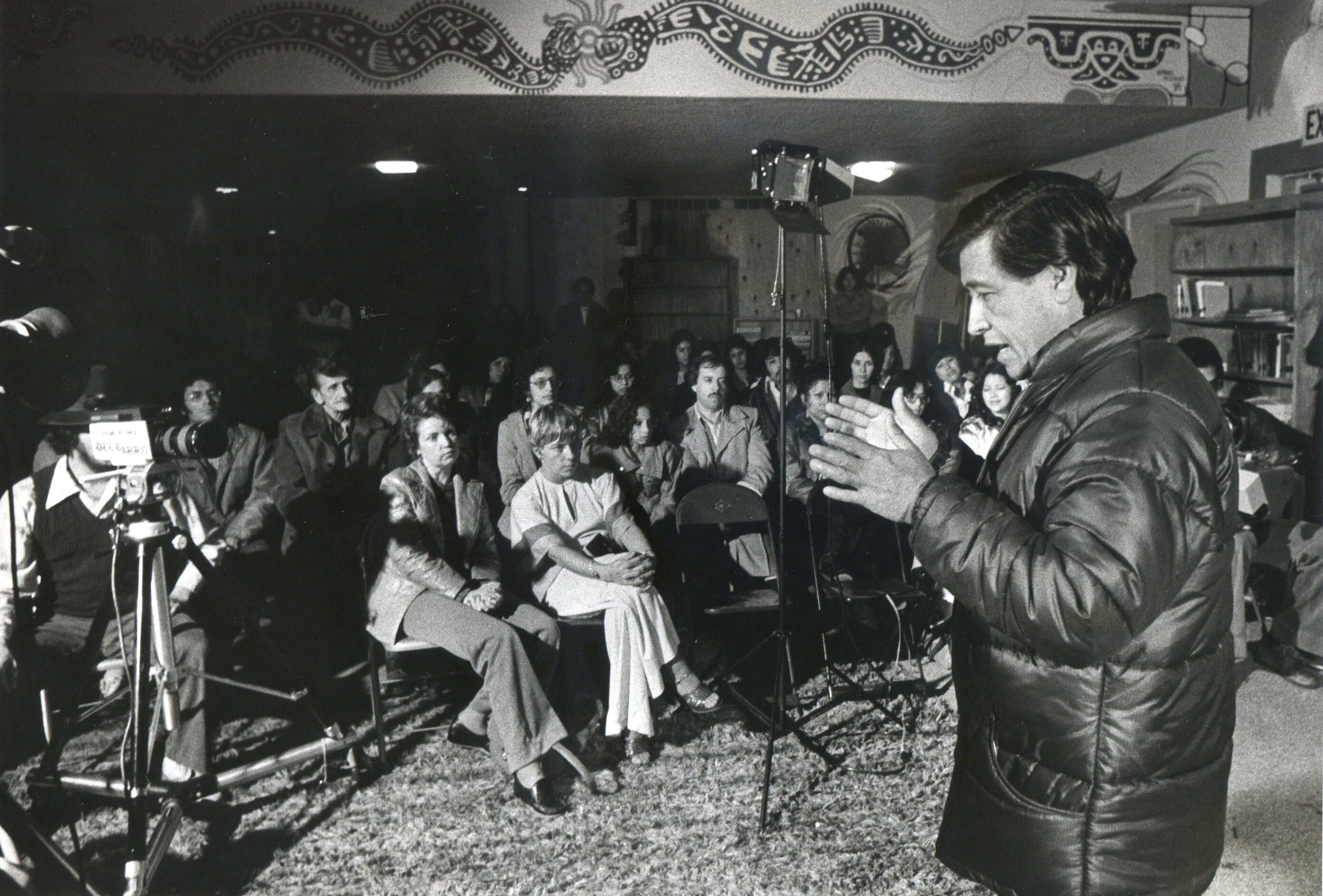
Recently, a friend asked me why it is we don’t have any clear leaders on the Left anymore, why, especially in this particular time of troubles, we are not seeing a few people elevated to the level of icon, to provide a voice for today’s social justice movements and moral clarity for all. “Where is today’s Martin Luther King, Jr?” more or less.
I thought about it for a minute, and eventually landed on the fact that this is something we have kind of just learned our lesson on. Because we do not want to find ourselves in a situation where we have made someone the face and voice of a cause we care deeply about, only to find out that they are secretly a monster. We’ve seen too many people we’ve elevated and admired, men in particular, turn out to be serial abusers, sexual harassers, friends of Jeffrey Epstein or terrible in some other way, to put that kind of faith in any one person. Better we should operate as a movement, so that no individual’s failings can get in the way of the work that needs to be done.
Which brings us to Cesar Chavez.
On Tuesday, the United Farm Workers (UFW) announced that they would not be celebrating Chavez’s birthday this year, on account of some unspecified allegations of “inappropriate behavior by Cesar Chavez with young women and minors.”
Then, this morning, The New York Times published a deeply researched and damning report on how Chavez sexually assaulted at least two young women, and also raped his most prominent ally in the movement, Dolores Huerta, who came forward about this for the first time at the age of 95.
The first victim cited by the Times, Ana Murguia, describes being groomed by Chavez and sexually assaulted by him when he was 45 and she was just 13. The second, Debra Rojas, was 12 when she says Chavez molested her and 15 when he raped her and tried to convince her that they were legitimately in love.
Via The New York Times:
Ms. Murguia and Ms. Rojas, both of whom are now 66, were the daughters of longtime organizers who had marched in rallies alongside Mr. Chavez. He used the privacy of his California office to frequently molest Ms. Murguia, she said. He had known her since she was 8 years old. She became so traumatized that she attempted to end her life multiple times by the age of 15.
“I wanted to die,” she said.
Ms. Rojas said she was 12 when Mr. Chavez first touched her inappropriately, fondling her breasts in the same office where he’d meet with Ms. Murguia. When Ms. Rojas was 15, he arranged to have her stay at a motel during a weekslong march through California, she said, and had sexual intercourse with her — rape, under state law, because she was not old enough to consent (Ms. Murguia said Mr. Chavez molested her but never had intercourse with her.)
In Huerta’s case, she explained in her own statement that she was an adult when she was assaulted by Chavez on two occasions, and kept this secret for years for fear of harming the work they were both doing.
As a young mother in the 1960s, I experienced two separate sexual encounters with Cesar. The first time I was manipulated and pressured into having sex with him, and I didn’t feel I could say no because he was someone that I admired, my boss and the leader of the movement I had already devoted years of my life to. The second time I was forced, against my will, and in an environment where I felt trapped.
I had experienced abuse and sexual violence before, and I convinced myself these were incidents that I had to endure alone and in secret.
She even kept it secret from the two children she bore as a result of the assaults.
Their stories are heartbreaking, even moreso because, on top of having to live with the assaults, they have felt they had to hide them in order to protect the movement and the work Chavez did on behalf of Latinos and farm workers writ large. Especially now, at a time when Latino immigrants are being demonized and face real danger from the Trump administration. Indeed, both Murguia and Rojas say that people pleaded with them not to come forward now, for fear that unscrupulous characters would use Chavez’s actions to further persecute people like them.
Which, of course, they will.
Huerta, in her statement, explained that this is why she never came forward until she learned, as a result of this investigation, that she was not his only victim.
I carried this secret for as long as I did because building the movement and securing farmworker rights was my life’s work. The formation of a union was the only vehicle to accomplish and secure those rights and I wasn’t going to let Cesar or anyone else get in the way. I channeled everything I had into advocating on behalf of millions of farmworkers and others who were suffering and deserved equal rights.
It’s always been an unfortunate irony that, by coming forward about their abusers or by speaking out on behalf of victims, many victims and allies have had to recognize that their own work may be boycotted or skeeved as a result. Condemning the director who sexually harassed or assaulted you or someone else will very likely mean that no one is going to want to watch the movie or TV show he made that you starred in.
But in the case of a whole civil rights movement, the stakes are even higher.
That kind of fear is what abusers like Chavez are able to count on to keep their victims quiet. One of the ways power is exerted over victims in these cases is by instilling in them the fear that, by coming forward, they will “selfishly” destroy something that is deeply important to people and even to the world. They will be taking people’s heroes away from them. This is why it was especially important for these women to remind themselves that everything that was accomplished was accomplished because of a movement and not because of one man.
Via The New York Times:
In the end, they said that the story of Chavez’s movement was their story, too — of the women who marched beside the men, worked in the fields, took care of the children. The movement, they said, was more than one man.
It sure as hell was. There was not just one hero in that movement, there were many, and Chavez’s actions do not take away from that, as Huerta noted in her statement.
The farmworker movement has always been bigger and far more important than any one individual. Cesar’s actions do not diminish the permanent improvements achieved for farmworkers with the help of thousands of people. We must continue to engage and support our community, which needs advocacy and activism now more than ever.
This is not a case of separating the art from the artist. No cognitive dissonance is required to condemn Chavez’s actions and believe that farm workers deserve fair pay and treatment, and it is heartbreaking that any of these women ever had to worry that there was.
On the semi-bright side, unlike Republicans, it is unlikely that too many people on the Left will be scrambling to call these women liars in order to preserve Chavez’s legacy. I haven’t seen anyone doing so publicly, partly because it would be frowned upon and partly because a whole lot of us know all too well that “good politics” does not always keep someone from being a rapist or an abuser. Quite frankly, as horrified as people have been by this news, I haven’t seen too many women who were particularly surprised by it.
We don’t need icons. We don’t need exalted, singular, near Christ-like figures who need to be seen as never doing any wrong for the good of a righteous cause. We need people who are willing to do the work and to work to create the kind of community in which victims feel they can come forward.
In 1954’s Salt of the Earth, a film about Mexican-American labor rights activists, when one of the characters is hit by her union organizer husband, she tells him “Whose neck shall I stand on to make me feel superior, and what will I have out of it? I don’t want anything lower than I am. I am low enough already. I want to rise and to push everything up with me as I go.”
Civil rights movements exist not to exalt individual people, but to help everyone rise. And you can’t do that while pushing victims down.
PREVIOUSLY ON WONKETTE!


Back on August 30 of last year we did Salt Of The Earth for Movie Night if you'd like some more info on it.
https://wonkette.substack.com/p/wonkette-movie-night-salt-of-the?utm_campaign=post-expanded-share&utm_medium=web
I’m actually confused by my own reaction to this. First disappointment that I can’t admit to myself that when I was molested at 17 I blamed myself for wearing a short dress - then not telling my father or brother (or sister) because I feared their retaliation would harm my family…
Then sadness that someone I admired as much as I did Chavez would assault young girls….