


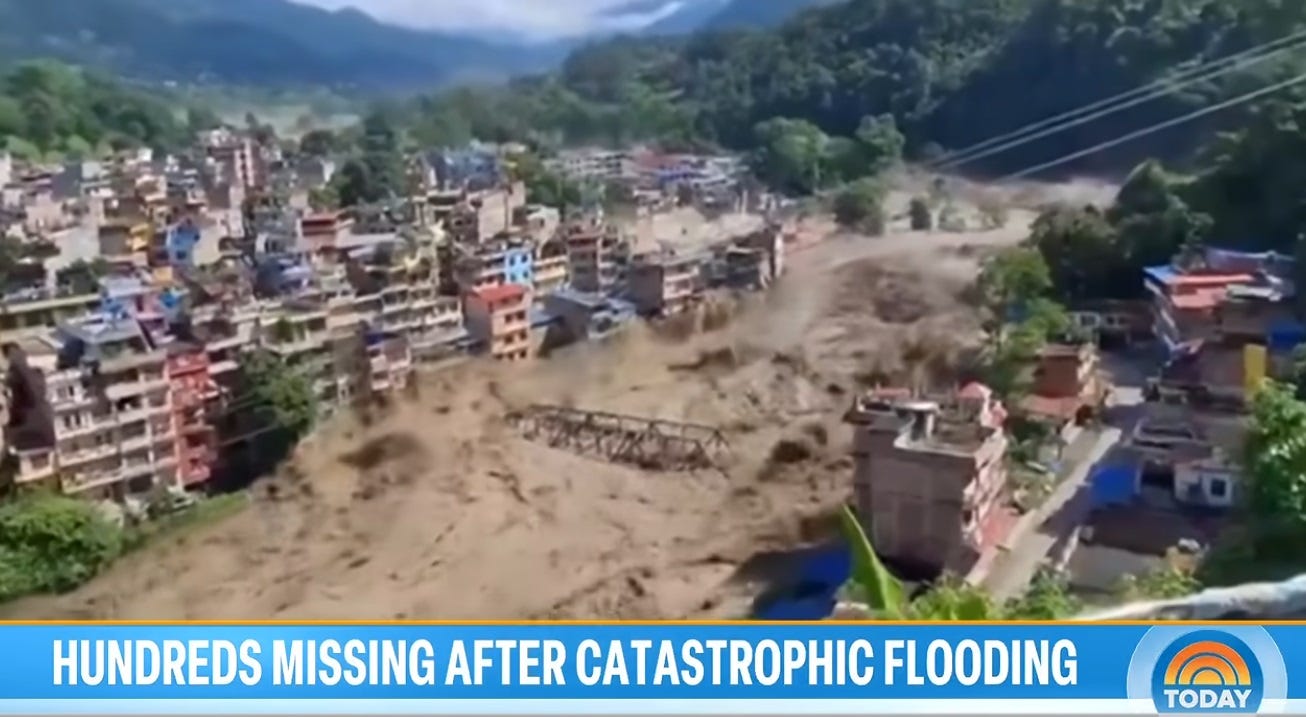
Based on satellite images and seismic data, scientists are saying that the massive flash floods that hit Nepal and Tibet Wednesday were caused by the collapse of a glacier high in the Himalayas, compounded by the collapse of the bedrock that the glacier rested on, as The New York Times reports (gift link):
Glaciologists and geologists had already determined that an enormous chunk of a glacier had snapped off on Wednesday morning. On Thursday, a group of scientists analyzing the events preceding the flooding said that newly available images, captured at a time with less cloud cover, show that an enormous chunk of the mountainous bedrock beneath that glacier had also given way.
“The rock that the glacier was sitting on collapsed,” said Kristen Cook, a geomorphologist at the Université Grenoble Alpes in France. The combined force of the collapse sent millions of metric tons of rock and ice into the valley below, she added.
The combined collapses sent a huge chunk of one side of the Langtang Lirung mountain, about 17,000 feet above sea level, falling down into valleys and rivers below, the ice being pulverized into water that then flooded for dozens of miles, killing hundreds of people, with more than 1,400 missing so far.
The exact sequence of how all that rock and ice smashed into existing rivers, creating walls of water that obliterated bridges and buildings, is still being reconstructed. But it was an enormous amount of energy, creating seismic waves that registered on US Geological Survey instruments as a magnitude 5.2 event — not an earthquake, but a mountain collapse with the same energy. The Times reached for a comparison, suggesting readers think of the landslide as “comparable to 1,000 Empire State Buildings crashing down into the river valley simultaneously.”
The videos are horrifying, and no, you don’t have to watch. Huge buildings being swept away in a moment, a 50-foot high wall of water hitting the border crossing between China and Nepal. Scores of people running away, only to disappear in the chaos of water and mud.
Was it climate change? Too early to assign exact causes, scientists say, but yes, glaciers in the Himalayas and around the world have been shrinking for decades due to higher temperatures, and it’s possible that the mountain was destabilized as the glacier lost mass and the whole thing gave way.
Climate change isn’t just hotter summers and droughts and extreme rainfall and more powerful, faster-growing hurricanes. It’s also releasing elemental forces of collapsing glaciers that can reshape the landscape.
Then again, Al Gore got some details wrong in that movie he made, and he still travels by airplane, the hypocrite, so maybe all of science is only a plot by Democrats, who, as Laura Ingraham said this week, are “coming for your money, your gas-powered car, your air conditioner. Everything you love. Your private health insurance. And they're gonna take it from you, period, end of story.”
Fact check: We want you to keep your AC. We just want it to run off wind or solar energy, backed up by batteries. Even better, we want your air conditioner to come with a big battery in it that will allow it to run when the sun goes down, and even to store energy to keep the grid working smoothly. We’re such monsters.
You can also use the button below to donate an amount of your choice at Paypal, or we have a Patreon too.
But back to the flash floods and the glaciers. The Himalayas are also warming faster than the planet on average; a 2023 report warned that flash floods and avalanches in the Hindu Kush ranges will increase, and that glaciers in the region could lose up to 80 percent of their volume by the end of this century. That’s going to lead to less available fresh water for the more than two billion humans (and their livestock and agriculture) who depend on rivers that originate in the Himalayas.
You know, big picture stuff. The New Abnormal that it’s difficult to wrap our heads around, because the connection between driving across town for groceries and a mountain falling apart half a world away simply isn’t intuitive. And sure, that one drive across town, that one flight to a vacation isn’t the tipping point for climate. It’s that one trip multiplied by millions of us driving and flying around and getting stuff shipped to us and generating electricity with coal and gas and all that.
Other kinds of pollution like gross crap in rivers, or air that makes your lungs sting, those are easy to conceptualize. But we can’t see carbon dioxide when it comes out of tailpipes and smokestacks. It doesn’t change the color of the sky as it builds up in the atmosphere. It’s easy to demonstrate with a classroom experiment that CO2 traps heat from sunlight, but far harder to convince voters that it makes sense to rebuild our energy infrastructure (even when it’s cheaper and healthier for everyone).
Of course that’s largely an American problem. The world outside Trumpistan is going more and more electric, because it’s cheaper and more efficient, and not subject to arbitrary wars started by idiots.
Every one of those trips to the store that are powered by renewable electricity — or made unnecessary by better city planning and reducing the need for cars — helps cut the total damage. That adds up, too. We don’t need to take anyone’s car away if they find it easier to walk to the store.
Really, you can still drive, but maybe vote for someone who knows science is real? We’re locked in to more of this. Maybe we shouldn’t make it even worse.


[NYT (gift link) / AP / Wired / AP]
Yr Wonkette is funded entirely by reader donations. If you can, please become a paid subscriber, or if you’d like to make a one-time (or recurring) donation, you can click this here button.
Content warning: Gross thing I left out of the final draft.
.
.
.
I also tried out this in the draft, but removed it because, I dunno, too soon, too over the top?
Or maybe we need the horror? I'm really not sure, so I think it was better to leave it out.
"Maybe if every time we started the car we heard the screams of people drowning as a wall of water sweeps them away, we’d make the mental connection between our cars and climate disaster. But then, people keep smoking even in countries that mandate cigarette packages carry photos of diseased lungs."
“That’s going to lead to less available fresh water for the more than two billion humans (and their livestock and agriculture) who depend on rivers that originate in the Himalayas.”
One of the few things that India and Pakistan have agreed on is the Indus Waters Treaty which divides the water from the Himalayas between them. Until now, Pakistan is drying up and Modi is being a dick.