



Donald Trump keeps finding new ways to subvert everything that’s supposed to be normal about politics, and right now he’s even disproving the old truism that US presidents don’t have much control over the price of gasoline at the pump. That now needs to be amended to add “… unless they start a completely pointless war in the Middle East, cutting off much of its oil trade.”
Iran has retaliated by attacking other countries’ oil infrastructure, and by blocking shipping in the Strait of Hormuz, though which some 20 percent of the world’s oil supply normally travels. The blockade is also affecting shipments of liquified natural gas (LNG) to Asia, which gets about a fifth of its fossil gas from the Middle East.
On Monday, Trump, that strategic genius who knows more than any general, told Fox & Friends host Brian Kilmeade that there was an easy way to end the blockade: “These ships should go through the Strait of Hormuz, and show some guts. There’s nothing to be afraid of. They have no navy. We sunk all their ships.” Iran attacked three cargo ships near the Strait Wednesday, although we’re fairly certain the captains weren’t taking advice from Trump in any case.
Then on Tuesday, US Energy Secretary Chris Wright added to the confusion by lying in a tweet, claiming that the US Navy had actually escorted an oil tanker through the Strait of Hormuz. The tweet was deleted after about 10 minutes, but the false hope did cause a brief drop in oil prices on the international market, so we’re sure that more attempts to drive prices down by lying will be on the way.
In an attempt by adults in the real world to offset some of the disruption to world oil supplies, the International Energy Agency announced Wednesday that it would release 400 million barrels of oil from its 32 member countries’ reserves, about a third of the total emergency reserves. Fatih Birol, the IEA’s executive director, said that the move was necessary to address supply disruptions that were “unprecedented in scale.”
Oil prices went right on rising anyway, with the global standard “Brent crude” price per barrel going up about 15 percent in trading, reaching over $100 a barrel Thursday, an increase of over 35 percent from before the shiny new war.
Oil analysts explained that the planned release of oil reserves isn’t likely to calm the fears of continued supply shortfalls, because it takes time for the member countries to actually draw down and ship their releases, and the shortfall since the start of the war is already about 200 million barrels, already half of what the IEA countries will release.
Gregor Semieniuk, a public policy and economics wonk at the University of Massachusetts Amherst, told Al Jazeera that traders have already “priced in” the release, but that “if market expectations are that the reserve release cannot make up all the shortfall, it will do little to check prices beyond what it has already done.”
The US will release its share of oil reserves starting next week, a total of 172 million barrels, the Energy Department said Wednesday, although we’d suggest reporters check back to make sure it actually happens. And maybe this time around, when or if oil prices begin easing after Trump’s war ends (if it does), Trump will actually convince Republicans in Congress to replace the reserves. (The Big Blowjobs for Billionaires bill was supposed to provide $20 billion for that purpose, but the GOP was more interested in tax cuts and deporting abuelas.)
The blockade isn’t simply stopping shipments of oil, of course; with no way to export the oil they pump out of the ground, several countries are also running out of storage space for their oil, as the Washington Post reports (gift link).
They are being forced to ramp down operations and may have to shut some facilities altogether until shipping routes reopen. That has a domino effect, as the operations cannot be quickly resumed. Ramping them back up takes weeks, potentially adding to the chaos in oil markets.
And that’s without taking into account the costs of rebuilding oil infrastructure that Iran continues to attack.
It’s not just oil being affected, of course, because when oil prices increase, you get higher costs for everything that requires shipping, from food to air freight. If the blockade lasts long enough, the world could even experience a food crisis, because uh-oh, fertilizer is another chief product of Persian Gulf nations, which ship fertilizer and component chemicals all over the world, including to the USA.
As we keep pointing out, if the US and the rest of the world had actually taken the threat of climate change seriously for the past three decades and sharply ramped up clean energy production, we’d all be less subject to sudden interruptions of oil supplies by now. That’s one reason — along with China dumping its excess production of solar panels into the world market, making them incredibly cheap — that so many developing nations without oil reserves are going for solar backed by battery storage instead of paying through the nose to import more oil.
Trump’s “little excursion” into Iran is also likely to spur more countries to ramp up their own renewable energy supplies, as Europe did following Russia’s invasion of Ukraine. In the short term following the cutoff of Russian fossil gas, some European countries mined and burned more coal, but after the first year of the war, gas and coal use actually declined as solar and wind became a larger portion of the European energy mix. (The fossil fools at PragerU nonetheless made a propaganda video for kids suggesting that climate change was just a scheme to bully kids into shunning beautiful filthy coal.)
Now we have another oil shock, and as Heatmap’s Matthew Zeitlin reports, renewables are looking awfully good, because what if the world’s economy weren’t so subject to a sudden cutoff of oil through one waterway in the Middle East?
“It just shows once again the risk of being dependent on imported fossil fuels, whether it’s oil, gas, LNG, or coal. It’s an incredibly fragile system that most of the world depends on,” Nick Hedley, an energy transition research analyst at Zero Carbon Analytics, told me. “Most people are at risk from these shocks.”
As with Russia’s invasion of Ukraine, the immediate fallback is likely to be a rise in burning coal, particularly in Asian countries dependent on LNG shipments from Qatar. That could reverse, temporarily at least, 2025’s promising declines in coal use by India and China, which have lagged behind the rest of the world in turning away from coal.
The potentially good news, both for climate and for the world economy, is that unlike in previous worldwide oil crises, clean energy — especially solar backed with battery storage — is a price-competitive option, particularly for countries faced with replacing imported gas with imported coal. May as well go with energy sources that can be controlled locally. Again, here’s Zeitlin:
“Countries which are heavily dependent on fossil fuel imports are once more feeling very nervous,” Kingsmill Bond, an energy strategist at the clean energy think tank Ember, told me. “The interesting thing is we have two answers: renewables and electrification. If you want quick results, you put solar panels up quickly.”
None of this is easy or instantaneous, which is why we all should have been doing more for decades before now. As we’ve said before, one of these days when the US decarbonizes its grid and we’re all driving electric nerd cars, gas prices simply won’t matter in elections, but we’re a good 20 to 30 years away from that at a minimum, depending on how thoroughly Trump manages to hold back the energy transition.
Then again, maybe we’re letting our enthusiasm for clean energy blind us to easier, faster solutions to the crisis Trump has plunged us into, like these great proposals from Twitter (link to Bluesky copies) from guys who are apparently 12 years old.
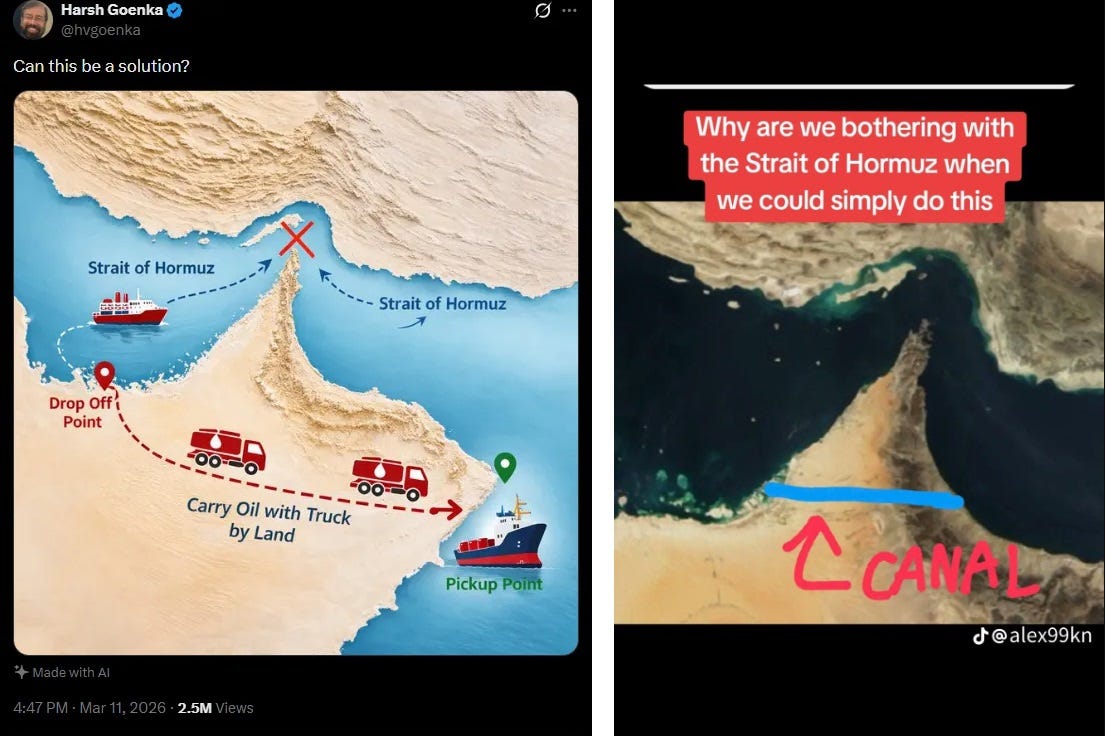
Expect Trump to endorse both ideas over the weekend.


[WaPo (gift link) / Al Jazeera / Politico/ Heatmap News / Grist]
Yr Wonkette is funded entirely by reader donations. If you can, please become a paid subscriber, or make a one-time (or recurring) donation with this here button.
"It's a Dire situation in the Strait, and we're spending all this Money for Nothing."
I've heard the sultans are in full swing.
Love the suggestion to dig a canal through a mountain range by the expedient of using a blue sharpie on a map. Clearly inspired by Trump’s hurricane forecasting expertise. 10/10, no notes.