


While Lil’ [sic] Marco Rubio tried to insist that the kidnapping of Venezuelan President Nicolas Maduro wasn’t a military invasion, but “an arrest operation” — mind you, serving the no-knock warrant required a bit of help from the US Navy and other troops — Donald Trump hasn’t bothered with such fictions. This time, Trump had no trouble saying the oil grab is an open oil grab, although no one even gave him credit for being honest.
Trump was so happy about it, and has a very definite concept of a plan! “We’re going to have our very large United States oil companies, the biggest anywhere in the world, go in, spend billions of dollars, fix the badly broken infrastructure, the oil infrastructure and start making money for the country,” he explained after the operation.
Of course, there might be a few little hiccups, he acknowledged, but honestly nothing that would get in the way. Trump decreed, “We’re going to rebuild the oil infrastructure, which requires billions of dollars that will be paid for by the oil companies directly. […] They will be reimbursed for what they’re doing, but it’s going to be paid, and we’re going to get the oil flowing.”
Who’s going to reimburse the oil companies? You hush, it’ll probably come from all the revenue they’ll get from refining Venezuela’s shitty, dense crude, which only a few US refineries can even handle. Luckily, those US refineries are currently being sold to a billionaire Trump megadonor, Paul Singer! Or maybe “they will be reimbursed” by US taxpayers, because the beauty of the passive voice is that things just happen without saying who made them happen. If things go further south, Trump can just say “mistakes were made.”
Trump Says Many Things He Completely Made Up
Tuesday evening, Trump turned his Venezuelan oil fantasy up to Eleven with a social media post (Bluesky screenshot) claiming that in fact, he’s already made Venezuela agree to hand over some of its beautiful excellent oil, the very best oil:
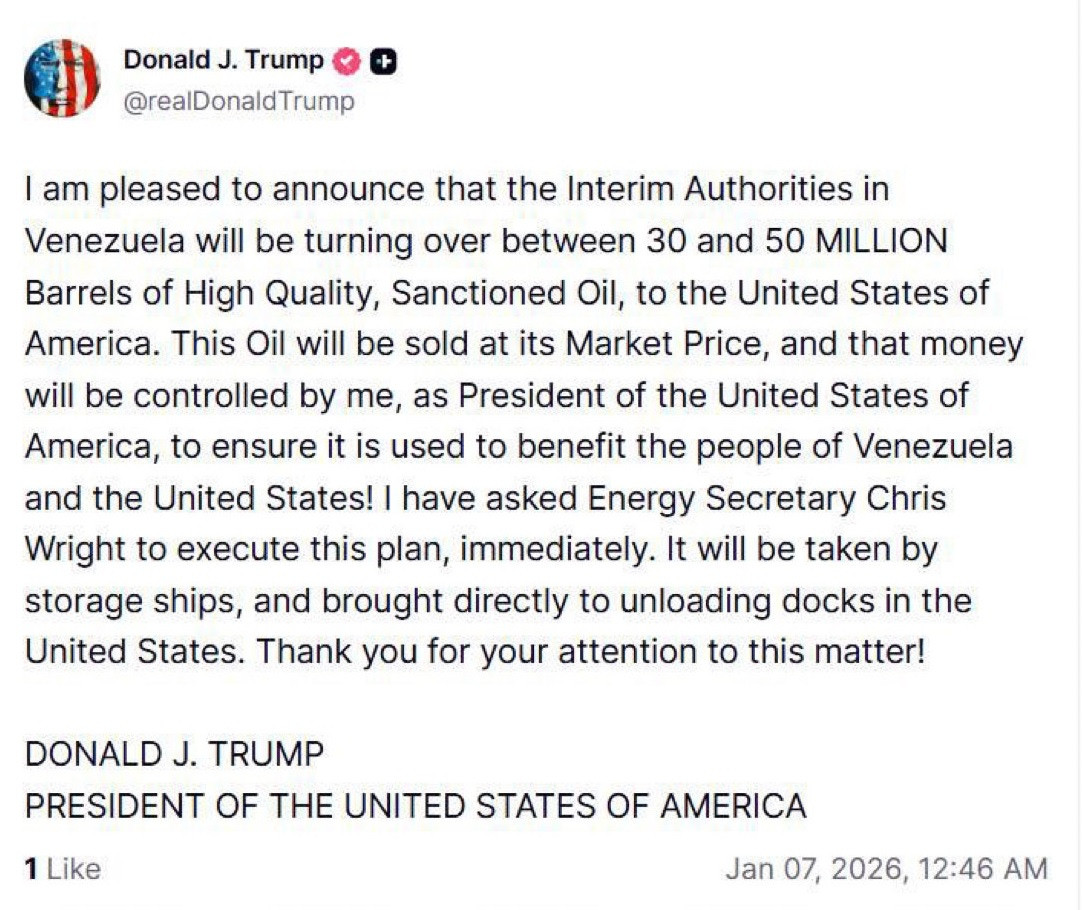
We particularly like the line about “High Quality, Sanctioned Oil,” a huge tell that Trump is just making shit up, because as we’ll discuss in a bit, Venezuelan oil is, like Trump’s mind, thick and sludgy, with a high sulfur content.
Also, no, the president of the United States of America does not have the constitutional authority to personally sell other countries’ natural resources and then dispose of the funds as he sees fit. That may not matter since there’s zero evidence that this amazing deal is real.
We also wondered why Trump would say “storage ship” instead of “tanker,” which led us down an interesting rabbit hole: Just to add an extra level of surrealism, an anonymous “senior administration official” told CNN that “the oil has already been produced and put in barrels. The majority of it is currently on boats and will now go to US facilities in the Gulf to be refined.” Yr Wonkette is not an oil industry expert, but this makes no goddamn sense at all; our cursory searching indicates that this is bullshit, since your average oil supertanker has a capacity of around a million to two million barrels. Physically shipping even 30 million 55-gallon barrels of oil is pretty fucking improbable. But sure, all you need is 30 million oil drums, the pallets to load them on, and a whole lot of “storage ships” that are not actual tankers. (Yes, the senior administration official may have been confused. But even in bulk, that would be a lot of tankers supposedly making their way to US refineries.)
But who knows? Maybe big strong storage ship captains and refinery owners came to him with oily tears in their eyes and told him, “Sir, thank you for securing this beautiful gift of about two days’ worth of America’s oil demand.”
57 Dollars And Nothing On
Trump loves superlatives and big numbers, so you can see why he’d want to get at Venezuela’s oil reserves, the world’s largest, at around 300 billion barrels (with a B). But there’s a much smaller number that could undermine Trump’s Venezuelan oil fantasies: 57, which is how many dollars a barrel of US benchmark crude fetched at the end of trading Friday.
Oh wait, make that $56, the price to which US oil fell Tuesday after his obvious lie. Venezuelan crude, by the by, currently trades at just $55 per barrel (and then there’s the cost of each barrel, apparently, plus the labor to fill each barrel with a hose, one at a time).
As the Washington Post points out (gift link), getting Venezuela’s oil production back to peak levels could cost as much as $100 billion, and unless world oil prices go up a hell of a lot, the investment just doesn’t make a lot of sense. Oil companies learned after the US brought the blessings of democracy to Iraq that it’s kind of important to have stability and a modicum of peace before you risk billions, even to get at huge reserves.
Even here in the USA, oil companies have been holding back from drilling new wells, because there’s so little profit in it. US oil production peaked when Joe Biden was in office and the economy was growing strongly, but some forecasts predict it will actually decline this year.
Industry experts say oil companies wouldn’t be inclined to invest tens of billions of capital rehabbing Venezuelan oil fields without being sure of at least a decade of production. There’s no government in Venezuela to make such a guarantee, and although Trump may promise to secure long-term stability for US oil investments, companies know better than to just take his word for it.
Politico reports that even with more advance notice of the invasion than the US Congress received, US oil companies aren’t exactly champing at the bit to jump into Venezuela, even with the pretext that they could recoup some of their losses from the nationalization of its oil industry 50 years ago.
“They’re saying, ‘you gotta go in if you want to play and get reimbursed,’” said one industry official familiar with the conversations.
The offer has been on the table for the last 10 days, the person said. “But the infrastructure currently there is so dilapidated that no one at these companies can adequately assess what is needed to make it operable.”
Then there’s the basic fact that Venezuelan oil is, to use some technical language, shitty and bad. It’s heavier than the “light sweet crude” produced in most of the US, requiring more processing to become vehicle fuel, at a time when the world’s vehicle fleets are rapidly electrifying, a trend that’s simply not going to reverse, Trumpian dreams of Oil Forever notwithstanding.
China, currently the top buyer of Venezuela’s remaining oil production, has gone all in on renewable energy and EVs to eliminate its need for imported oil. And even in South America (where Chinese EV factories are popping up all over), recently discovered oil fields in Guyana are the hot new draw for oil investment, since its oil is lighter and its taxes are lower than Venezuela’s.
The Energy Transition Is A Peace Movement
It’s actually a very good thing that Venezuela’s heavy crude oil is more expensive and difficult to process, and that US oil companies may just nope out altogether. Not only would that be a Big Black Eye for Trump, it would also be good news for the planet, since Venezuela’s oil is “among the dirtiest oils in the world to produce when it comes to global warming,” according to UC Santa Barbara political science professor Paasha Mahdavi. Like Canada’s tar sands oil, it’s far more carbon-dense per barrel than the oil the US pumps, so putting more of the shit into the air would worsen global warming substantially.
Currently, thanks to sanctions and the deterioration of its oil infrastructure, Venezuela produces about a million barrels of oil per day (BPD), roughly one percent of world production. That’s well below its peak of 3 million BPD in the 1970s. But as Mahdavi points out, even increasing production to 1.5 million BPD would produce 550 million tons of atmosphere-warming carbon dioxide, more than the CO2 emissions of entire nations like the UK or Brazil. So hooray for all the factors that might get in the way of an oil resurgence in Venezuela.
The other thing to keep in mind is that fossil fuels remain a dying industry, and the faster the world transitions away from them, the less incentive there’ll be for imperial adventures aimed at taking smaller nations’ oil. As Bill McKibben says, there may not be any easy way to stop a bully from stealing your lunch money, but “what if lunch was free, and no one was carrying lunch money?”
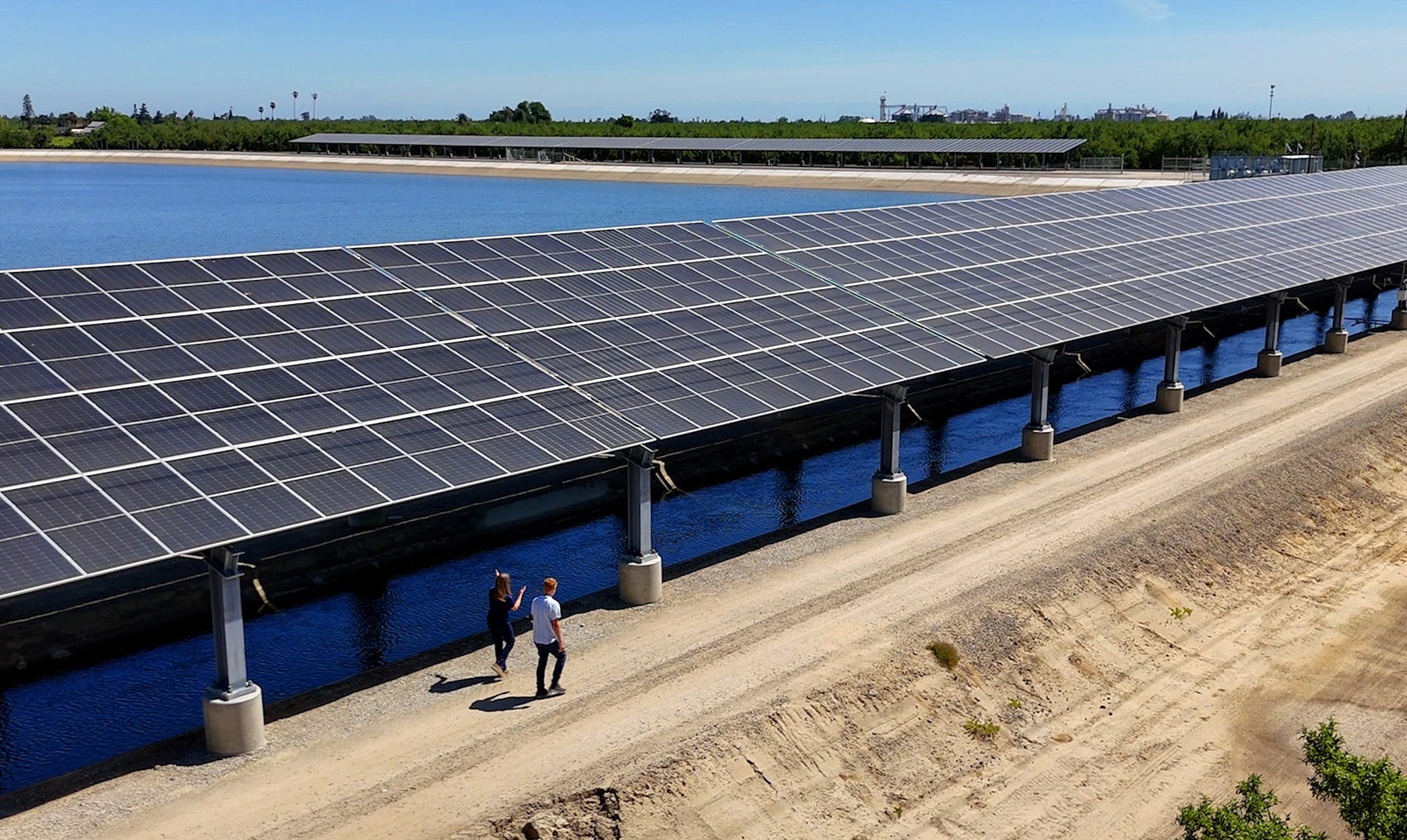
[If] you’re for peace and democracy, then a solar panel is a valuable tool (and a valuable symbol, a peace sign for our age). Every one that goes up incrementally reduces the attractiveness of the oil that underlies so much conflict and tyranny. Right at the moment treaties and charters and constitutions offer limited protection at best; we should work to restore the national and global consensus that makes them valuable, but we should also work to push out the kind of energy that can’t be hoarded or controlled.
Why does Trump hate solar and wind energy so passionately? It’s because they’re somewhat outside his or anyone else’s control. A nation that builds its prosperity on oil makes itself a target; a nation that depends on imported oil to survive makes itself a vassal. A nation (say, China) that rapidly builds out its own supply of energy from the sun—energy that can’t be embargoed or effectively attacked, energy that is by its nature decentralized, energy so spread out that no particular bit of it is all that valuable—is a nation that can go its own way.
Consider the case of Russia’s invasion of Ukraine, adds Rebecca Solnit: One of Vladimir Putin’s assumptions appears to have been that European nations, dependent on Russian fossil gas, would go along without too much complaint. Instead, despite some short-term increases in coal, Europe doubled down on speeding up its energy transition, and renewables keep providing ever-greater shares of the EU’s energy.
To be sure, even if Al Gore had become president in 2000 and moved the US toward clean energy two decades before Joe Biden finally did, that’s no guarantee that we wouldn’t end up with a Trump. He may yet go to war with Greenland to seize its critical minerals, after all. (Those minerals are also prohibitively expensive to get at, in case you see a theme here.)
But just as a wide transition to clean transportation will remove “gas prices” from future presidential campaigns, renewable energy isn’t just good for the planet, it’s also good economics, and far better for the countries using it. As McKibben says, “it’s going to be hard to figure out how to fight wars over sunshine.”



[Politico / CNN / WaPo (gift link) / The Crucial Years / Meditations in an Emergency / NPR]
Yr Wonkette is funded entirely by reader donations. If you can, please become a paid subscriber, or if you’d like to make a one-time donation, this button will convert your petrodollars into green snark.
"Why does Trump hate solar and wind energy so passionately?"
By a remarkable coincidence, I’m working on a bunch of jokes about wind.
They’re currently saved as drafts.
*
Hope you're having a good Dad Jokes Wednesday!
Trump hatches plan to drive the cost of oil below the cost of production. Lib lunatic oil executives balk at plan.