


One reason to feel kind of relieved about things these days is that, in addition to the midterms, we’re also seeing something of an implosion going on in most of the weird right-wing subcultures that have developed over the past few years. Most of the “podcast bros” — the ones that aren’t, you know, in jail — are starting to distance themselves from Trumpism and honestly seem to be too busy bickering with one another to cry about woke all of the time. Even Elon Musk is trying to “I don’t know her” MAGA writ large. Meanwhile, the whole trad wife ethos is starting to peter out as well. For instance, Nara Smith, the one who makes Cheerios from scratch in full-on evening gown,s seems to be going into more of a standard “influencer/model” direction with her Instagram. Hell, even Erika Kirk is out here trying to run TPUSA instead of staying at home like a good Barbara Billingsley (who herself was, in real life, the total opposite of a tradwife, though that’s a discussion for another time).
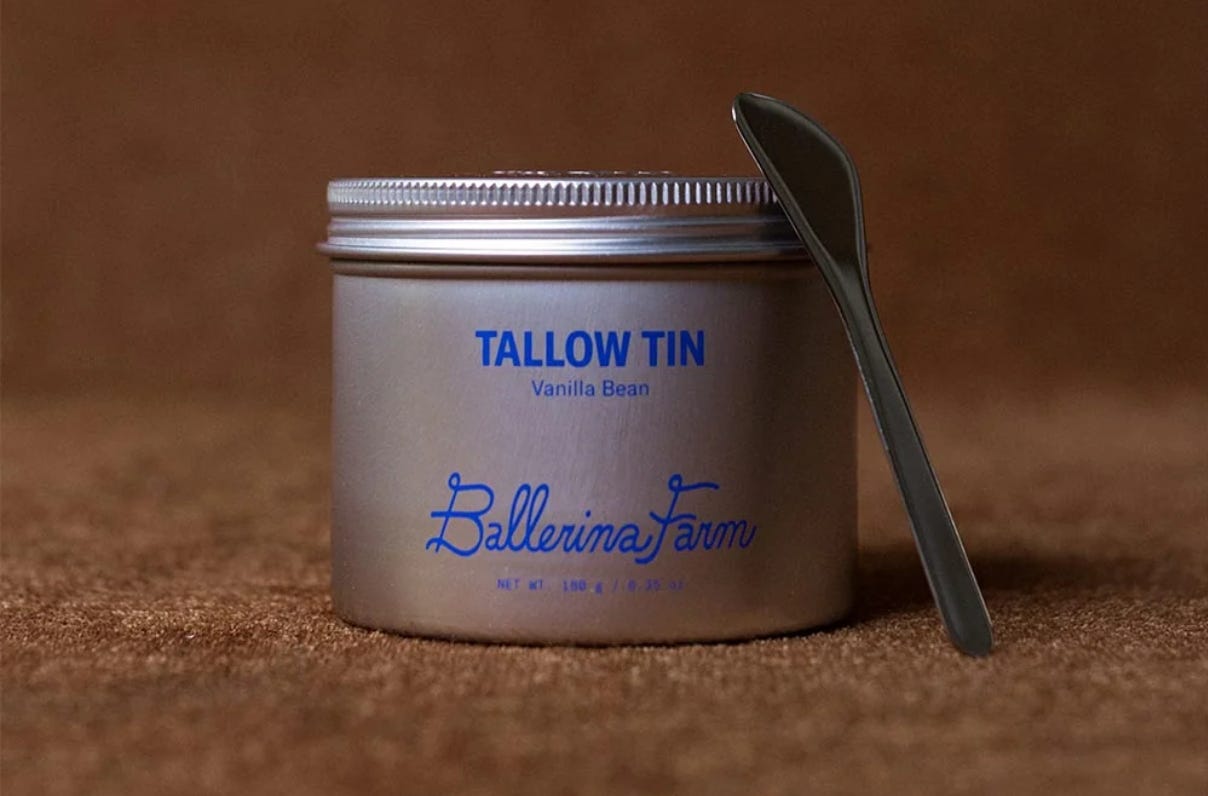
Of course, there’s still Hannah Neeleman, though to be fair, she started distancing herself from the tradwife label back in 2024 when it became pretty clear to everyone that she was running a whole ass business with many employees. She is, however, still very much on the MAHA train, which I guess is why she just came out with her own RFK Jr.-approved body balm.
And what is so MAHA about her body balm? Well … it is made from beef tallow. Because they’re all obsessed with beef tallow and want to use it for literally everything it might be possible to use it for. They want a floor wax and a dessert topping to cook with it and they want to smear it all over their bodies.
Neeleman is selling her “Tallow Tins” on the Ballerina Farms website for $35.70 a pop — regular price $42 — and has already released an “ad” for it on her Instagram.
Sure, because who doesn’t get their skincare advice from … farm electricians who compare it to a baseball glove or a cast-iron pan?
Now, regular readers of Wonkette/my social media feeds might be thinking to themselves “But Robyn, don’t you also put a lot of weird stuff on your face? Like snail mucin and salmon sperm (PDRN)? Didn’t you also get PRP filler, which involved having your own blood centrifuged and then injected into your face? What’s so much weirder about beef tallow? What is the difference here?” Well, I do and I did and that is a fair question. It’s not so much that it’s that much weirder so much as there is at least some clinical proof for the weird shit I use/do (more for the snail mucin than anything) and practically none for the beef tallow.
I also do not buy my skincare from places that have had to shut down their raw milk sales because of e. coli. Or places that sell raw milk, in general. Because that shit is dangerous. Crazy, I know.
Sure. Beef tallow does have some emollient and occlusive benefits (though so do many of the other ingredients in the balm). It’s fat. Of course it’s going to have that. If you smear your face with butter, that would also be emollient and occlusive. However, what we want in an actual moisturizer is for it to be humectant, meaning that it attracts and maintains moisture, and there is no evidence that it does that.
It was also historically used as a balm by farmers, though I’m not sure that farmers famously have really great skin. However, over the past few years, MAHA-type influencers have made a ton of ridiculous claims for the ingredient, very few of which even make any sense scientifically. They have claimed it cures all kinds of skin conditions, including acne, psoriasis, atopic dermatitis, or even that it is a “natural retinol” because it contains Vitamin A, etc. etc. In reality, it could very well exacerbate many of these conditions.
Enthusiasts also frequently claim it is non-comedogenic, though there is no proof of that and given the lipids it does contain, it could also clog the shit out of your pores.
Support for the dermatologic use of beef tallow is currently limited and indirect. While tallow contains fatty acids such as palmitic, stearic, oleic, and linoleic acids, which individually have documented biological effects, little research has evaluated tallow as a whole formulation.
Some fatty acids have potential benefits. For example:
Oleic acid can enhance penetration of topical agents and may boost hydration, though it also has evidence of disrupting barrier lipids and provoking inflammation.
Linoleic acid has been shown in clinical and in vitro studies to decrease microcomedone size and suppress inflammatory cytokines.
Palmitic and stearic acids support stratum corneum lipid recovery in ex vivo models.
However, these same fatty acids may also worsen acne or irritate sensitive skin. Palmitic acid can promote inflammatory cytokines (IL-6, IL-8) in sebocytes, and oleic acid may increase transepidermal water loss or contribute to barrier dysfunction. Thus, the overall biological impact of tallow remains unclear and may vary by skin type, concentration, and formulation.
There is also the whole “smelling like beef” problem, which Neeleman says she’s corrected for by adding coconut oil and cocoa seed butter, but I can’t say I’d trust that.
The balm, notably, is preservative-free. Now, it says it’s a water-free balm so it doesn’t technically need a preservative — but if water or steam does get into it somehow, because your hands are wet when you use it or because you keep it in your bathroom, it can become a whole ass bacteria/microbial growth fest and cause you to break out, or worse.
Neeleman specifically mentioned using the balm right after she showers, a situation in which it is bound to get wet. On the website, she specifically says it works best on “clean, damp skin.”
“Every day right after I get out of the bath or shower, while my skin is still warm and slightly damp, I warm a small amount between my fingertips and massage it in. Because suet tallow closely mirrors the oils our skin naturally produces, it sinks right in without feeling greasy,” she told the New York Post in an advertorial.
Yeah, that’s not good. Because, again, if you get water in it, it is going to spoil or grow bacteria. The second part of it is also not correct. Tallow does share some fatty acids that human sebum also produces, but to say it “closely mirrors” the oils our own skin produces is a pretty big overstatement (though at least she didn’t say “bio-identical” as so many others have claimed). There are also other, safer products that contain many of these lipids. Things that are tested, things that are quality controlled.
And that, really, is the biggest problem with this stuff. There is no standard chemical composition of beef tallow — it’s going to vary between different kinds of cows, however it is processed, etc. etc. That matters! When it comes to anything you are putting on your face, that matters.
I know a lot of people who aren’t even MAHA are weird about preservatives, but unless you’re especially allergic to a particular ingredient, there’s really no reason to fear them. That study that made everyone afraid of parabens causing breast cancer back in 2004 was not a very well done study and the rats in the study were exposed to far more parabens than any human will in the whole of their lives. As with anything, it’s the dose that makes the poison. I, personally, would not put anything “preservative-free” on my face or body. There’s a reason the preservatives are there in the first place!
I also get that people like the idea of “natural” beauty products, and more specifically of using food instead of products made in a lab. I do not. I want the lab shit. I want to know that it’s the same every time I put it on my face. There are natural variations in food products that can lead to them actually being dangerous. Everything has chemicals and when it comes to what you are putting on your body, you want to be sure those chemicals are safe and that they are uniform. I used to know someone who put pineapple on her face as an exfoliant until one day she got an especially acidic pineapple and ended up red for a week.
Want to send us money in an entirely different way? Click here or join our Patreon!
The “clean girl aesthetic” and the concept of “clean beauty” have also long been tied to right-wing politics, and for good reason. The “clean girl aesthetic” is overwhelmingly white and very much idealizes Western beauty ideals (while, naturally, also stealing a whole lot of shit from the Black and Latina cultures it frequently excludes). The whole “clean beauty” thing is about as anti-science as you can get, as it literally means nothing. There are no standards, there are no rules for what one can call “clean beauty.” You can literally call any beauty product “clean beauty,” including rendered beef fat. That feels very Republican to me, personally. They love things for which there is literally zero scientific backing.
Skincare expert James Welsh has a great video explaining the links between “clean beauty” and the far Right, and I highly recommend checking it out (and also listening to him on skincare in general).
I feel that these things, too, are on their way out (along with the “quiet luxury aesthetic,” which can die in a minimalist, beige fire), and I hope I’m right about that. At least in part because I really do not want to get stuck on the bus on a hot day next to someone who has smeared their body in rendered beef fat.
I use unprocessed crude, straight from the well in my skincare routine. It’s so pure, it’s like putting well-aged dinosaur juice on your face. Primordial beauty!
My dog used to be very standoffish and shy. Now that I am using beef tallow moisturizer, she can't stop with the affectionate kisses!