



Donald Trump’s administration seems intent on making sure that not only is our government the dirtiest ever, but also that our energy supplies keep pace in filthiness, as Republicans do all they can to hold back the transition away from fossil fuels much of the rest of the world is at long last pursuing. (That link right there is one of our “all is not lost” stories today; if the other stuff here gets you down, read it at least!)
Let’s dive in with another climate roundup of the bad things happening on our warming planet, the ugly things Trump and company are up to, and the good stuff that just may help humanity and other inhabitants of this rock find our way out of the climate fire. Even if that order is rude to Sergio Leone.
The Bad: It’s Hot In Herrre (And Out Therrre)
At least two people are dead after thunderstorms and flash flooding in the Northeast. Is it climate change? All weather is being affected by climate change now, especially extreme rainfall, because a warmer atmosphere carries more moisture. That’s just science. [ABC News]
A new UN report finds that sand and dust storms due to climate change are leading to roughly seven million premature deaths annually worldwide, triggering lung and heart disease, and reducing crop yields, which in turn leads to hunger and migration. Some 330 million in 150 countries are affected, which is something American leaders might want to consider before pretending there are no long-term risks from pushing fossil fuels. [Al Jazeera]
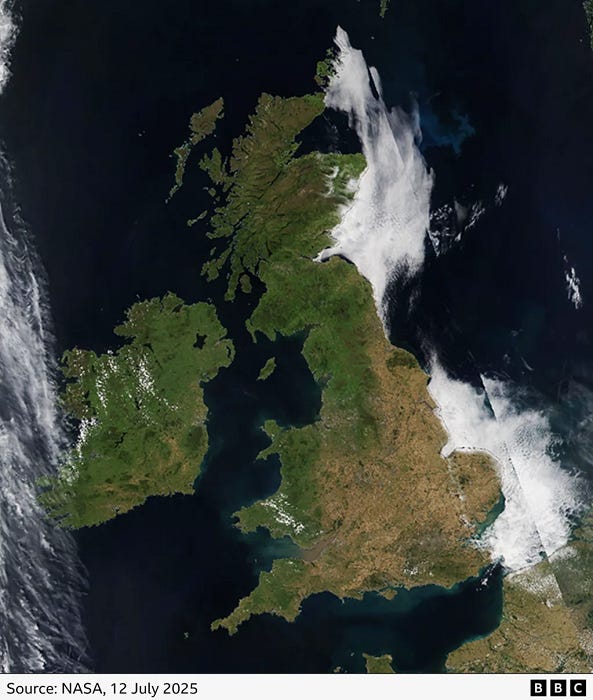
Hot weather in the UK has been hellish for farmers, forcing them to keep cattle in barns during the day. A farmer in Cornwall, Kate Hoare, told the BBC that her dairy cows have been unable to produce much milk as a result, saying, “A cow's ideal temperature is about 5C [41F], we've been up to 33C [91F], it's insane.” The drought has dried up pastures, forcing farmers to feed their dairy cattle grain they’d normally save for winter feed. England’s Environment Agency has so far declared four of the country’s nine regions — the East and West Midlands, the North West, and Yorkshire — to be officially in drought, and subject to restrictions on water use, and much of the rest of the country is in “prolonged dry weather,” the stage just below drought. The BBC reports that “The dry conditions can even be seen from space, with much of England much browner than usual.” [BBC / BBC / BBC]
The New York Times reports that climate change is making summer vacationing in southern Europe — and living there — an Endless Bummer. One of the activists in Spain who last year publicized efforts to fight overtourism (and tourism’s jet-fueled carbon emissions) by squirting tourists with water guns says that this year, “we used the water guns on ourselves.” Heat is killing people, and beaches are washing away all over Spain. The national government is investing in green energy and in systems to predict heat waves, and in training healthcare workers to help people in heat distress. Barcelona is protecting vulnerable residents, but also investing “1.8 billion euros, more than $2 billion, to make buildings greener, expand green spaces, install 200 shade structures, and replace some pavements with dirt to better absorb and repurpose rain water.” If buildings melt, they could just slap a “designed by Antoni Gaudí” sign on ‘em, too. [NYT (gift link)]
And here on our continent, a new climate study predicts that climate will drive stronger, more destructive nor’easter storms, and not solely in the nor’ part of the East, bringing more flooding, high winds, and heavier snowfall to much of the East Coast. Help them! Help the bomb cyclone-adiers! A second new study details the interactions between rapidly increasing warming in the Arctic and extreme weather in North America, including those nor’easters. That link was already known, but this study for the first time shows that “stretched polar vortex events events are overwhelmingly associated with extreme cold and heavy snowfall in the Eastern U.S.,” which may help improve weather modeling and improve forecasts. Oh, but wait for the next subheading. [Inside Climate News]
The Ugly: Trump Again Makes Everything Worse
The National Oceanic and Atmospheric Administration (NOAA) developed highly specialized weather models that successfully predicted the difficult-to-forecast storm that caused the deadly flash floods in Texas. The likelihood of dangerous storms, in fact, was clear enough that the National Weather Service office in San Antonio released its first notice of potentially heavy rain on Sunday, June 29, five days before the storm. Another 20 alerts went out prior to the definitive 1 a.m. flash flood warning on July 4. (But tragically, the “warning coordination meteorologist” who would normally coordinate with local officials had been fired by DOGE). So in this case, the forecast was accurate but ignored. Now the bad news: the 2026 NOAA budget proposal eliminates funding to maintain the weather models, and will close down the National Severe Storms Laboratory that’s dedicated to improving forecasts of severe thunderstorms. Thanks a lot, Trump. [Heatmap News]
On Friday, the State Department fired the last dozen or so staffers who used to work with other nations on climate change agreements, because the administration no longer believes in either climate change or other countries. [WaPo (archive link)]
Early this month, the government shut down the websites that host the National Climate Assessments, the big quadrennial reviews of the state of the climate that are written by America’s top climate scientists. (That’s the review that Trump tried to hide in 2018 by releasing it the day after Thanksgiving.) One small problem with memory-holing the Climate Assessments, though: they’re mandated by a 1990 law, which also requires the reports be made available to the public. The administration said that, to comply with the law, the reports would be hosted on the NASA website instead, but on Monday, NASA said that won’t be happening either, insisting that by giving the reports to Congress every four years, the government had met its legal requirement, so no, the reports no longer get a website, losers. (The most recent report, from 2023, is available at a separate site, and it and earlier reports can be dug up at NOAA’s library; search by “fifth national climate assessment” or previous numbers.) [AP]
The Good: Yes, There’s Still Good Climate News!
The Big Ugly Bill, as you probably know, killed off tax credits for buying or leasing electric vehicles, but the credits will still be available through the end of September, so if you’ve been thinking of going electric like I did, and won’t shut up about, now’s a good time. I’ll be taking my first long electric road trip (no Kool-Aid or acid) to Seattle for this Sunday’s meetup, and I’ll write more about that and about the EV deals next week. [Heatmap]
But whaddya gonna do with all those EV batteries when the cars die, greenies, bury them? Probably not! In addition to the still-developing tech for recycling them cleanly, batteries that are degraded to a point that they’re no longer great for cars can still hold a lot of charge, and when connected together, can store energy for the grid and/or data centers. The US’s (maybe the world’s) biggest storage project using repurposed EV battery packs — 792 of ‘em — is now online in California, connected to a solar array and providing 24/7 electricity to a very smol data center. [Canary Media]
In what’s becoming a regular category of news these days, the EU generated more electricity (22.1 percent) from solar than from any other part of its energy mix in June, topping nuclear (which powers most of France) for the first time ever, and far outpacing fossil fuels. Thirteen member states set new monthly solar records. And in California, two-thirds of the state’s electricity came from zero-carbon sources (which includes both renewables and nuclear) in 2023, the most recent year for which full stats are now available. [Euronews / California Governor’s Office]
And finally, that good news we teased in the first paragraph: The Trump administration may be trying to drag the US back into the 1950s — it will fail at that, but while failing, it will do real damage — but the rest of the world is all in on the energy transition. In China, for the first time ever, wind and solar capacity overtook coal and gas in the first quarter of 2025, according to a new report. China is still the top carbon polluter, and still building dirty energy plants, but the trend is in the right direction. Also, some time this year, EVs in China will be outselling internal combustion cars in the new car market. On top of the solar energy news in the EU just above, Ireland followed the UK’s lead from last fall and shut down its final coal power plant. And worldwide, for every dollar going into fossil fuel investment, $2 is going into clean energy, efficiency, and grid upgrades. [Canary Media / Bloomberg (archive link)]


Yr Wonkette is funded entirely by reader donations. If you can, please become a paid subscriber, or if you’d like to support green reporting with your own green, here’s your button!
In semi-regular watching of Matt Ferrell's "Undecided" YouTube series, I've learned that there are some innovators out there that are looking for new methods of battery-making, including those that use materials that are more available and easier to recycle than the industry-standard lithium-ion. All these companies of course face the obstacles that ever startup does, getting funding, testing and adaptation, but I'm hopeful that the tech will evolve as our collective needs for batteries increase.
If interested in the nitty-gritty, you can find Ferrell's channel here: https://www.youtube.com/@UndecidedMF
Hey, you know what makes civilization possible? Agriculture. You know what makes agriculture possible? A stable climate...