

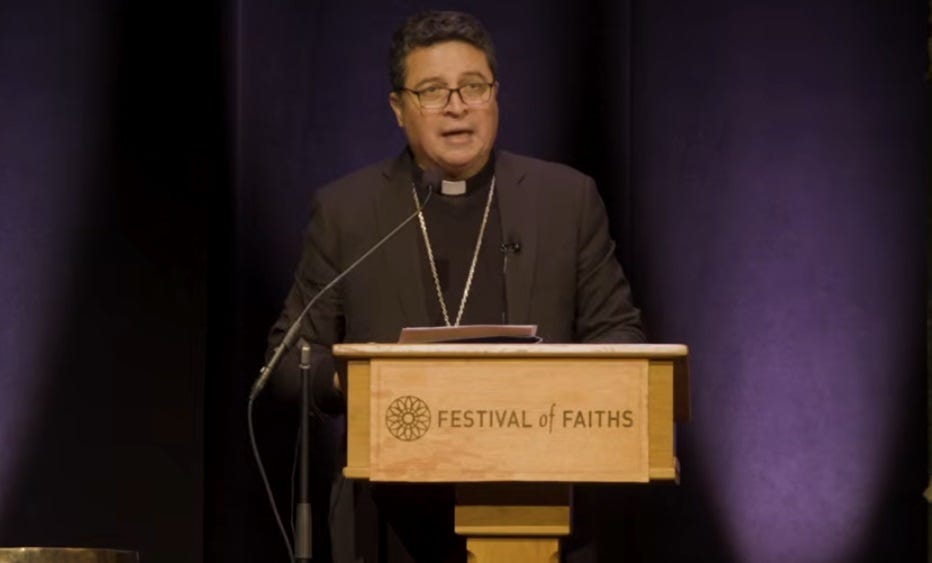
Pope Bob from Chicago on Friday promoted Bishop Evelio Menjivar-Ayala, who came to the US illegally in 1990 when he was 18, to become the archbishop of the Diocese of Wheeling-Charleston in West Virginia. Menjivar-Ayala in 2023 became the US’s first Salvadoran-born bishop, and in his current position as auxiliary bishop of the Washington Archdiocese has called on Americans to oppose Trump’s mass deportation / ethnic cleansing agenda.
The Washington Post reports (gift link) that, in a lovely bit of symmetry, Menjivar-Ayala will be replacing Bishop Mark Brennan, who years ago helped Menjivar-Ayala get his green card: “At the time, Brennan headed the priest-recruiting office for the Washington Archdiocese and saw Menjivar as a promising candidate who needed to fix his immigration status.”
It’s quite a journey for someone who as a teenager paid coyotes to smuggle him across the border in the trunk of a car, then applied for asylum and eventually became a citizen in 2006. Here’s Menjivar-Ayala speaking about his experiences at a 2025 conference in Louisville, Kentucky.
It’s no coincidence that Pope Leo XIV has elevated someone whose thoughts about borders are so different (and poetic!) from those of the current US bossman:
A border can serve as a dividing line that limits and excludes or it can become a meeting place where people exchange products, ideas and customs, giving birth to new possibilities.
Borders can either lock us in or open us to new horizons. It all depends on how we approach them.
Prefer a non-Substack subscription? The button below will take any amount of your choosing at Paypal — let us know if you want the newsletter subscription too! they’re separate! — or we have a Patreon too.
In an interview with US Catholic last August, Menjivar-Ayala recalled his youth in El Salvador, where he was a witness to the brutality of the US-backed government paramilitaries. He tells about meeting survivors fleeing a massacre along a river where he and his mother were planning to fish:
But we saw a group of people hurrying across the river, carrying bundles. And we said, “What’s going on?”
Up above, about 200 meters further along, was the suspension bridge—a hammock bridge, as we called it, because there were no cars, it was only for people to cross on foot. The guerrillas and the civilians were coming from one side, and the military troops were crossing from the other side. And we heard a big bombardment going on up above. And then we realized what had happened to the village up there: They had all been massacred.
In 1982, his own family was forced to leave their farm, given just three days’ notice and not allowed to take anything with them. In 1990, following the Salvadoran Army’s November 1989 massacre of six Jesuits and two women (a housekeeper and her daughter) in San Salvador, Menjivar-Ayala, then 19, decided to flee to the US to join his sister, who was already here.
He made two unsuccessful tries before he and his younger brother, 17, and two cousins tried again, but were caught and jailed in Mexico, as he told the Washington Post’s Karen Tumulty in 2023 (gift link), shortly after Pope Francis named him an auxiliary archbishop for the Archdiocese of Washington. After two days in jail, they
paid a mordida — a bribe — to get released. Then, by arrangement with a smuggler, they stuffed themselves into the trunk of a car driven by an elderly American. When they felt the car stop and heard the man crank up the music on the radio, it would be their signal to be still and silent.
That is how they got past the teeming port of entry at San Ysidro, Calif., between Tijuana and San Diego. The four young men spent hours in that trunk before reaching Los Angeles, where Menjivar’s sister and a new life were waiting. In a mountainous village in El Salvador, his mother, who had been lighting prayer candles for their safety, offered up a Mass of thanksgiving.
He did what work he could get, and after two years moved to Maryland, where he worked as a janitor and doing construction while working on his English and completing a GED. He applied for asylum and began volunteering as a youth minister at his church in Hyattsville, Maryland. The parish sponsored him for a green card, as he told US Catholic last August: “At that time, that was still possible: If you had a paid religious job, you could get a religious visa. None of that exists anymore.”
(We’re happy to say that then-Bishop Menjivar-Ayala turned out to be wrong, though he was right at the time of the interview: In a rare bit of non-horrible immigration news, last fall the program was renewed by Congress and even improved a bit.)
All along the way, he was helped by people who saw a human being, not an “illegal alien,” and by 1995 he was studying for the priesthood at St. John Vianney College Seminary in Miami, in a bilingual program. He did pretty okay, as Tumulty reports:
He showed such aptitude there that upon receiving his bachelor’s degree in philosophy, he was sent for further studies in Rome, where he received a master’s degree in theology before being ordained a priest in 2004.
From there, he advanced consistently through a series of pastoral roles and positions inside the Washington archdiocese; among other things, he served as a member of its “Child Protection Advisory Board,” created in response to the horrible sex abuse scandal in the Catholic Church.
Throughout his career, he has worked with immigrant communities from all over the world, and insisted that all people deserve to be treated with dignity. In his last sermon at his church after becoming a bishop, he said, “We cannot say that we love God if we do not love those who are closer to us. […] Empathy, my brothers and sisters. Empathy — putting ourselves in the shoes of others — is to realize our common humanity.”
Menjivar-Ayala regularly invokes Bishop (and now saint) Óscar Romero, who was assassinated in San Salvador in 1980 for talking too much like Jesus when it came to helping the poor and protecting the oppressed.
In an Easter op-ed for the National Catholic Reporter last year, as Trump’s mass-deportation machinery descended upon immigrant communities and declared anyone without papers to be the “worst of the worst,” Menjivar-Ayala wrote:
Tragically, this onslaught is instead being met with silence by many — or even approval. To those of you who are silent or think this does not involve you, to those of you who are not troubled by this — or worse, who applaud it — particularly those who are Catholic, I ask you: Do you not see the suffering of your neighbors? Do you not realize the pain and misery and very real fear and anxiety these unjust government operations and policies are causing? Is your conscience not disturbed? How can you stay quiet? In the final teaching of his public ministry, Jesus warned that we will be judged on how we respond to others in distress (Mt 25:41-46).
Just like a common US senator who should be executed for telling soldiers to refuse illegal orders, Menjivar-Ayala urged federal officers and others working in the government to remember what Óscar Romero said in his final homily, the Sunday before he was murdered. Romero called on government agents to “reclaim your conscience and to obey your conscience rather than the command to sin. […] I beg you, I beseech you, I order you in the name of God: stop the repression!”
Menjivar-Ayala also appealed directly to federal agents and support staff, telling them,
“What you are doing is worth nothing if it is stained with unjust cruelty. That is not what America stands for. You too can and should speak out against this terror and infliction of suffering on people. You can refuse to be involved in oppression and these grievous assaults on human rights and dignity.
“True, if you do, there may be adverse personal consequences. Óscar Romero certainly paid a price for speaking against the state of siege in his country. It might even mean leaving your job, but that is better than being complicit with evil.”
It’s certainly not a coincidence that, in his last post to Twitter before becoming pope, then-Cardinal Robert Prevost cited Menjivar-Ayala’s op-ed and its call to “see the suffering of your neighbors” and to speak up against it.
As we’ve said before, you don’t have to be a believer to recognize the truth of what this Pope and this new archbishop are saying. In these terrible times in America, we can’t think of a better voice to be elevated to prominence.
A-fucking-men.


[WaPo (gift link) / National Catholic Reporter / US Catholic / WaPo 2023 profile (gift link)]
Yr Wonkette is funded entirely by reader donations. If you can, please become a paid subscriber, or make a one-time (or recurring) donation with this here button.
Cakes Jr has done a pretty good job on the cake for Mr Cakes' birthday on Monday. The only things left to do now are make the Amaretto whipped cream to top the cake with, dip some morello cherries in melted chocolate, and make some tempered chocolate shards for decoration. That's tomorrow's job.
In another positive note, apart from her having a little trouble with the springboard cake tins, she managed to have a relatively stress free experience, which meant I also had a relatively stress free experience. By the time she was covering the cake in chocolate fudge frosting we were actually having a good laugh. She was complaining that the frosting was too wet and I told her she sounded like Ben Shapiro. This led to me explaining the whole Ben Shaliro/WAP thing to her and resulted in her screaming "OMG! DOES MY CAKE HAVE AN STD?!?" before practically falling off her chair laughing. She then decided the aforementioned cake was what Mrs Shapiro could only dream her sex life was like. Teenagers are fun.
I told her you filthy fuckaducks would probably get a kick out of her cake baking antics.
Harry has great cat form. He could be a sculpture.
https://substack.com/profile/155618292-ziggywiggy/note/c-252765540?utm_source=notes-share-action&r=2knfuc