


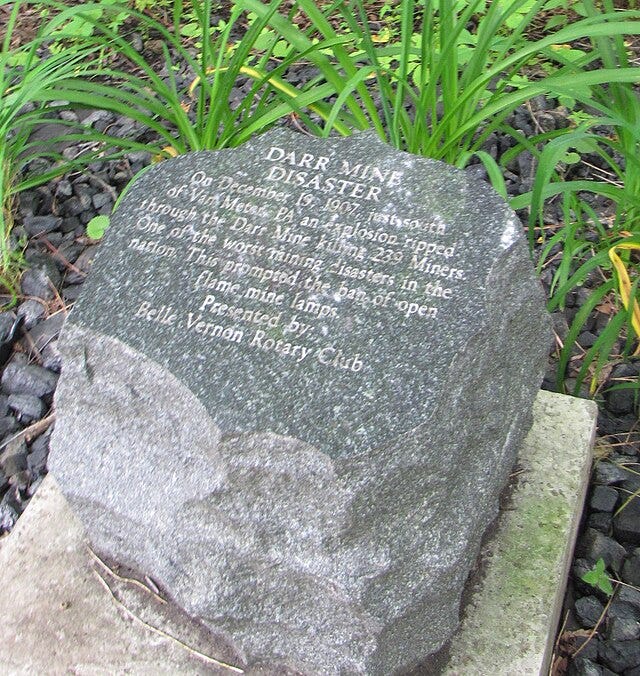
On December 19, 1907, the Darr mine near Smithton, Pennsylvania, caught fire and exploded. The dead numbered 239, many of them children. This was the largest workplace disaster in Pennsylvania history.
The Darr mine, located southeast of Pittsburgh, was typical of the Appalachian mining country during the early 20th century. The workforce was a polyglot group of workers from around Europe. While native born Americans made up a percentage of the workforce, many were from Europe, particularly from what are today Greece, Poland, Germany, Austria, Hungary, and Italy. Smithton was a small town that developed around coal mining and related industries like coking. The workers there faced similar terrible conditions to miners around the region. Long days meant that workers only saw the light most of the year on Sundays. Pay was low and workers had little control over their lives.
About 400 workers labored in the Darr mine under unsafe working conditions that put workers’ lives at risk every day. Coal mining was an incredibly dangerous profession. A mere few days earlier, the nearby Naomi mine had exploded, killing 34 workers. Many of the unemployed workers from that mine quickly found jobs at the Darr, unfortunately as it turned out.
At about 11:30 a.m. on December 19, 1907, the Darr mine exploded. It absolutely destroyed everything and everyone in the mine. The report of the Pennsylvania Department of Mines in the aftermath noted, “Persons in the vicinity of the mine describe the explosion as an awful rumbling followed by a loud report and a concussion that shook the nearby buildings and was felt within a radius of several miles. […] The explosion had been so terrific in its force that the inspectors were convinced upon a superficial investigation that it would be impossible for any of the entombed workers to be rescued alive.”
The official cause of the explosion was that miners had entered a location that the fire marshal had cordoned off the previous day while carrying open lamps. In fact, it’s hard to know just what happened. But in any case, 239 miners died, the worst mining disaster in Pennsylvania history. The only reason more workers did not die was that the Greek miners took the day off to celebrate the Feast of St. Nicholas. Otherwise, the death toll likely would have cleared 400.
Over half the dead were native English speakers, an unusual occurrence during this period, more typical of 19th century mines, although again, this is in part because the sizable population of Greeks had all taken the day off. Town residents rushed to the mine, but there was not much they could do except dig out the bodies, a process that took days. One worker survived, a miner named Joseph Mapleton who was near the entrance. He had only minor injuries and took part in the failed rescue attempt that followed.
The company blamed the miners. Of course, many challenged blaming the miners for the explosion. Some blamed the lack of inspections, others the general lack of safety and specifically the lack of ventilation. One theory was an accidental dynamite blast. But in any case, the fundamental reason was that early 20th century mine owners simply did not care about workplace safety. Nor did they have any reason to as they rarely if ever suffered any meaningful consequences if workers died on the job. This was the Gilded Age after all, and employers could do almost anything they wanted to their employees. Wage slaves indeed. The coal company did ban the head lamps in the mine. But they were not held liable for the deaths. In fact, nothing meaningful happened because of these deaths. Critics of mine safety did issue a report that was deeply critical of the lack of ventilation in the mine, as well as most mines throughout the bituminous country, but again, nothing concrete came of it. Later experimentation showed high levels of damp in the mine, even after the explosion.
As was so typical of the many coal mining disasters of this period, a couple of hundred dead workers didn’t change many hearts, even as it slowly led to reforms. Rural Pennsylvania was far away from centers of power, and wealthy people didn’t much care about people they couldn’t see. It would take Triangle to start getting Americans to take workplace safety seriously, but it would take a whole lot more than that to create even moderately effective regulations for coal mine safety. Even in the very recent past, negligent employers such as Don Blankenship have killed workers.
(Blankenship once sued Wonkette for mistakenly calling him a felon after he did prison time in connection with the deaths of his workers; Wonkette would like to studiously note here that Blankenship was only imprisoned for misdemeanors. Also, thanks again, West Virginia ACLU.)
The Darr fire was simply one incident in the deadliest month in US mining history. In December 1907, over 3000 miners died on the job. Darr was only the second largest single incident, as over 300 miners died in the Monongah mine in West Virginia on December 6. Many more died in ones and twos and by the dozens, thousands of workers in one industry perished in one terrible month.
Ultimately, this region of Pennsylvania would see many of the worst events in American labor history, from the Homestead strike outside of Pittsburgh to the Donora Smog of 1947, where US Steel murdered people through pollution a mere 15 miles west of the Darr mine site. Today, our use of coal is still disastrous to both people and nature. No wonder Donald Trump wants to double down on it.
FURTHER READING:
Erik Loomis, Out of Sight: The Long and Disturbing Story of Corporations Outsourcing Catastrophes.
Andrew Arnold, Fueling the Gilded Age: Railroads, Miners, and Disasters in Pennsylvania Coal Country
William Graebner, Coal-Mining Safety in the Progressive Period: The Political Economy of Reform
Perry Blatz, Democratic Miners: Work and Labor Relations in the Anthracite Coal Industry, 1875-1925
America is a cold motherfucker.
Maybe that's how we're exceptional.
Couple hundred dead miners. Oh well, should have gotten a better job.
Classroom full of dead kids. Oh well, guess you should have been properly trained in combat.
Babies having their mamas torn away. Fuck you, you should have come legally. Oh, you did. Well, fuck you. You shouldn't have been born brown.
Nothing bad that happens to anyone else will ever inconvenience us enough to change the laws or make things better.
If the republican'ts have their way, children will be working in mines again.