


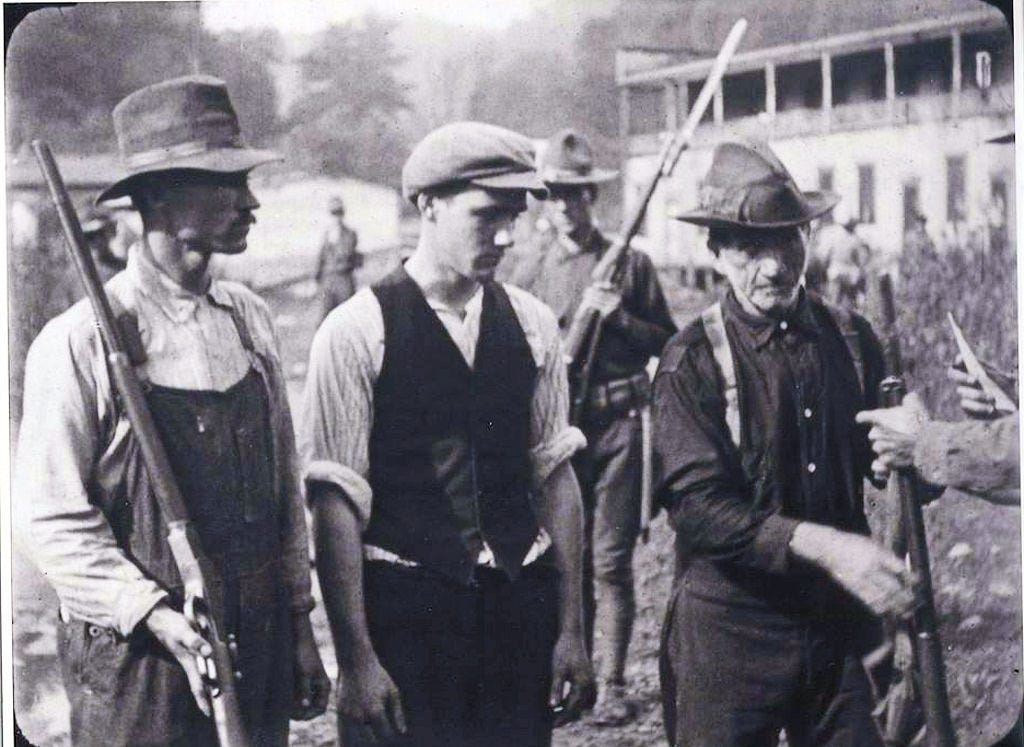
On August 25, 1921, 10,000 miners and their supporters went to war with 3000 coal mine executives and their hired thugs — the largest labor insurgency in American history and the largest civil uprising since the Civil War began — in Logan County, West Virginia. The Battle of Blair Mountain is one of the least-known major events in American history. We should know much more about it!
In 1921, the coal companies still ruled over West Virginia like a medieval fiefdom, having almost total control over workers’ lives. They issued company scrip to shop at company stores, evicted workers from company housing if they went on strike, brutally crushed union attempts to organize the mines, and murdered union organizers. They hired goons to intimidate miners and spies to infiltrate union organizing efforts. The United Mine Workers of America struggled to maintain a hold in West Virginia; in fact the UMWA throughout Appalachia had a rollercoaster of a membership for decades, with numbers skyrocketing after rare victories and collapsing after the inevitable oppression that followed.
Such a widescale rebellion took place in the aftermath of an event far more famous thanks to the John Sayles film detailing it, the Matewan Massacre, when Baldwin-Felts thugs got into a gun battle with the worker-sympathetic law enforcement officers of the town of Matewan. In 1921, the coal industry got their revenge on Mingo County Sheriff Sid Hatfield, who had participated at Matewan, by murdering him on the steps of the McDowell County Courthouse in Welch. That was on August 1. On August 7, the UMWA issued a petition of workers’ demands, including the arrest of Hatfield’s murderers, to West Virginia Governor Ephraim Morgan. Morgan rejected them out of hand and workers’ anger grew.
On August 20, armed men began gathering in Kanawha County outside of Charleston, and by August 24, 13,000 miners had arrived fully armed and ready to demand justice. While alarmed politicians began working toward compromise, Logan County Sheriff Don Chafin wanted blood. Supported by the Logan County Coal Operators Association, Chafin hated the UMWA and wanted to eliminate them from his country entirely, preferably with the maximum shedding of blood.
The coal operators provided Chafin a hired army of 3000 people to oppress the miners. At the request of Governor Morgan, President Warren Harding sent General Henry Bandholtz to West Virginia on August 25. Bandholtz told union leaders the army would “snuff them out” if they did not end the march, leading many prominent UMWA figures — including Mother Jones — to urge the end of the action to prevent fatalities. Although on August 26, many of the miners agreed to return to their homes, that wasn’t good enough for Chafin. His men began shooting union members as they returned to their homes, with families caught in the crossfire.
When news of Chafin’s duplicitous and murderous violence reached miners, they exploded. Several days of fighting followed between Chafin’s army and the miners. The coal operators hired private planes to drop homemade bleach bombs and other munitions on the miners. The US military clearly showed itself on the side of the mine operators. General Billy Mitchell ordered US army planes to conduct aerial surveillance of the difficult terrain and report back to the mine owners, possibly the first time that planes were used by the US army against American civilians. Over the next week, about 30 of Chafin’s troops died as did probably about 100 miners.
The Battle of Blair Mountain ended when Harding sent in US troops to put down the revolt. Fearing massive death, UMWA leader Bill Blizzard ended the revolt on September 2 and told his members to return to their homes, which they did, attempting to hide the guns in the dense mountains. Every now and then, some old guns from the battle are discovered today. As normal during the pre-New Deal period, UMWA membership followed the fortunes of organizing, with membership plummeting from 50,000 to 10,000 after the suppression of the uprising.
In the aftermath, 985 miners were indicted and tried for charges including murder and treason against the state of West Virginia (who knew you could commit legal treason against a state). The charges against most were dropped. A Baptist minister and his son who led a party that killed three members of the coal companies’ army did serve three years in prison, before a new governor, Howard Gore, pardoned them. Some argue that while the Battle of Blair Mountain was a total loss for the UMWA, the attention it garnered about the lives of coal miners helped build support for the major labor reforms of the New Deal, of which no one benefited more than the United Mine Workers of America.
Some years later, Chafin was arrested on corruption charges and served time in federal prison for bootlegging. A true man of law and order there.
Why is the Battle of Blair Mountain so unknown, in comparison to other big labor events of the period? It’s a combination of reasons. First, the coal companies and their lackey West Virginia politicians worked very hard to keep news of this under wraps, even into the present. The state long refused to acknowledge the existence of this event with even a basic historical marker, although that has finally been rectified. I’m not sure that even today the event is taught in West Virginia history courses in schools, even though it is one of the most important things to ever happen there.
Second, it was a total defeat for the union, although that hasn’t stopped other major losses like Homestead and Pullman from becoming iconic events.
Third, it was rural West Virginia and not urban Chicago or Pittsburgh. We rarely think about rural people or rural issues in anything more than the abstract. West Virginia is isolated and you have to really work to get out to Blair Mountain, whereas anyone in New York can wander over to the site of the Triangle Fire and the giant factories of Michigan and Ohio and Pennsylvania serve as visual representations of the struggles of labor past. Blair Mountain has none of this. In fact, the site was nearly blown up by yet another mountaintop removal operation destroying Appalachia for immediate corporate profits, but the courts intervened in the early 2010s. It should be a national park.
FURTHER READING:
James Green, The Devil Is Here in These Hills: West Virginia’s Coal Miners and Their Battle for Freedom
Charles Belmont Keeney, The Road to Blair Mountain: Saving a Mine Wars Battlefield from King Coal
Robert Shogan, The Battle for Blair Mountain: The Story of America’s Largest Labor Uprising
(The preceding are Wonkette affiliate links; we get a good commission.)
"You can never get enough books in the hands of enough kids"
Dolly
Dolly Parton's Imagination Library gifted more than 332,000,000 books since it was first created 31 years ago.