

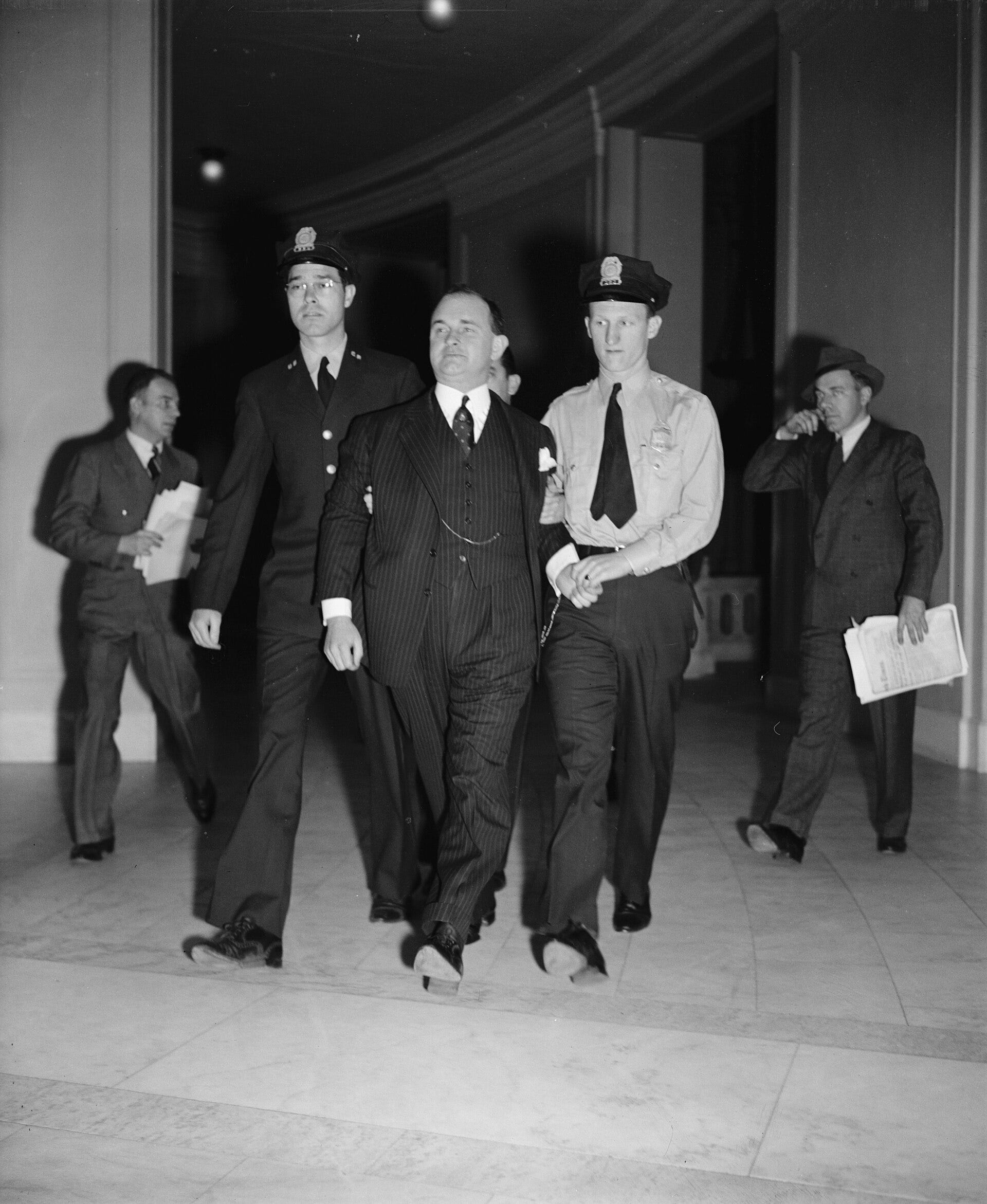
On August 10, 1935, members of the Transport Workers Union (TWU) descended on the New York courthouse to demand the release of their leader Mike Quill, arrested after being jumped by anti-union thugs. This moment helped vault the transit workers into being one of the most militant unions in the growing American labor movement, based on the workers’ shared Irish identity. It also made Quill one of the iconic labor leaders of mid-20th century America.
Most of the New York subways were privately operated in the 1930s. The city ran some of it, but there were two companies also involved: the Interborough Rapid Transit Company and Brooklyn-Manhattan Transit Corporation. The urban transportation industry was as anti-union as any in the nation, and like those industries, they had formed toothless company unions in the 1920s to supposedly give workers a voice without giving them any power at all. There were a few skilled worker unions on the BMT, but they represented only a handful of workers.
Again, many of the transit workers were Irish, and no small number of them were immigrants. Probably half of the New York transit workers in the early 1930s were born in Ireland. This was a hard, low-paying job that new immigrants could get and also get for their family members coming over. The trolley and bus companies were even more Irish-dominated, maybe three-quarters Irish-born. And while we think of the peak of Irish immigration as escaping the famine in the 1840s and 1850s, which is true, Irish immigrant remained quite consistent for another century. The 1924 Immigration Act did not negatively impact Irish immigration, because it was set quotas based on the 1890 census that favored northern and western Europeans, so it was still pretty much open borders for the Irish.
It wasn’t just the rank-and-file workers who were Irish. It was true of much of the newly forming union leadership as well, including Mike Quill. He had played a small role in the Irish Republican Army as a teenager, mostly as a dispatch rider between 1919 and 1921. He came to the United States in 1926. His Uncle Patrick and his brothers Patrick and John were already there. He got a job on the trains, working as a ticket agent.
The Communist Party had been attempting to organize transit workers since 1933. But because these workers didn’t really labor in large workplaces, mostly working by themselves, building up effective organizing was hard. In April 1934, Mike Quill and six others met in a cafeteria at Columbus Circle, along with Communist Party members, and talked about the need to form a real union. As they said, they wanted to fight “the misery, the labor spies, the blacklists, the firings, the yellow‐dog contracts, the discrimination.”
Quill and the other TWU members, happy to work with the communists, effectively deployed their ties of Irish nationalism. In fact, the TWU name built on the Irish traditions of Jim Larkin and James Connolly, who had formed the Irish Transport and General Workers Union 20 years earlier. Explicitly connecting the new leftism with Irish republicanism was a way to build ideas of solidarity within the workforce, giving them a common identity as workers to rally around. The CP was able to recruit mostly from those who had ties to Irish nationalism. Quill for instance was not a leftist in any real sense when he came to the US. But influenced by his life in Ireland, he started making connections between the Irish struggle and that of workers globally, not to mention himself.
The TWU built upon the longtime militancy of urban transportation workers and was ready to take advantage of the new conditions of the New Deal to demand their rights. These were workers who really needed unionization. At times, they might work 70 to 84 hour weeks. Quill was willing to take on the very real physical threat of being a lead organizer. Making yourself publicly known was a great way to get beaten up or worse. But Quill decided it was a risk worth taking. He was the guy handing out flyers and doing the public work that was really dangerous at that time. The CP convinced Quill and a few others to infiltrate the company union in order to recruit there, which he initially resisted, but which proved to be an effective strategy in industries with large company union structures, including steel.
In July 1935, the nascent TWU began pushing the envelope. On July 9, six squeegee workers, who cleaned the glass of the trains, refused to use more difficult and heavy 14 inch squeegees instead of the standard 10 inch ones. They were fired. The workers were ready for this and mobilized to protest the termination of their comrades. Two days later, after a strike, the workers were reinstated. The organizing continued.
On August 10, as Quill and other leading TWU men — Herbert C. Holmstrom, Thomas H. O’Shea, Patrick McHugh and Serafino Machado — were about to enter union headquarters, company thugs appeared and beat them up. The New York Police Department, happy to work with the companies, then arrested the union leaders for inciting a riot, even though they had done nothing of the sort. But the workers were ready to act and immediately descended upon the courthouse, collecting their own money to bail them all out. They were released within the day. The courts threw out the charges. And this incident became organizing lore in the TWU.
Over the next few years, 30,000 workers would gain union contracts thanks to the militancy of the TWU and the new organizing framework of the New Deal. It became one of the first unions to join the CIO. It took a few years to build up the union, but by the end of the 1936, it pretty much dominated the IRT and was moving on the other companies. They had to contend with growing opposition from the Catholic Church, which was not opposed to unionism per se, but was very strongly opposed to any union with communist ties, which the TWU very much had at this time.
On the other hand, with Dorothy Day using her column in Catholic Worker to tell workers to join the TWU, the church’s message was divided. Moreover, there was a lot of anticlericalism among the Irish workers at this time because the church had been opposed to violence in the republicanism movement, disgusting many. By the summer of 1937, the TWU was winning election after election in the new labor regime ushered in by the National Labor Relations Act. It soon moved beyond New York and began organizing transit workers in other cities.
Quill built upon these victories to become one of the most important labor leaders in New York. He organized both non-Irish transit workers in other cities and Irish workers in other industries who had nothing in common with the transit workers except for a shared Irish nationalism and identity. He distanced himself from the communists he ran with as a younger man when it was no longer useful for him, and when communism threatened his beloved union. But he maintained an emphasis on militancy within the union. Using his thick Irish brogue to its full extent and combining that with a harsh wit, many a politician learned the hard way not to mess with the TWU. For his last act, he took on and defeated New York Mayor John Lindsay in the 1966 strike and then died immediately after.
FURTHER READING:
Erik Loomis, Organizing America: Stories of Americans Who Fought for Justice
Joshua B. Freeman, In Transit: The Transport Workers Union in New York City, 1933-1966
L.H. Wittemore, The Man Who Ran the Subways: The Story of Mike Quill
As of this morning, the WNBA has been mentioned on Fox News 163 times since last Monday.
During that same timeframe, they have only mentioned Max Miller's name 5 times.
https://bsky.app/profile/justinbaragona.bsky.social/post/3msqeo3bsck2n
OT: Flooring guy coming this morning to replace a section of flooring.
Mrs. C: "Is the floor clean? We should probably vacuum it."
They are literally REPLACING THE FLOOR
"The stove needs to be cleaned."
He is a FLOORING GUY
That is all.
(I did not say those things because you learn not to say such things.)