


The University of Texas system’s Board of Regents voted unanimously Thursday to approve new rules that require its universities to make sure sheltered Texas college students can finish a degree without having to learn about “unnecessary controversial subjects,” if you know what that means and we bet you do. (It means anything having to do with gender identity, sexuality, or the million other culture war things wingnuts have been freaking about for the last decade or so. We miss the old days when the fights were only about evolution!)
The rules also require that faculty make clear in their syllabi what topics their courses will cover, with a requirement that they not vary from the plan. Instructors must “eschew topics and controversies that are not germane to the course.” In the regrettable event that any controversial issues are absolutely necessary to mention in order to teach a subject, instructors must take a “broad and balanced approach” to teaching about them.
But really, wouldn’t it be safer to just avoid that icky stuff altogether, to avoid upsetting students (and really, parents) who are absolutely certain that Donald Trump and Gov. Greg Abbott made LGBTQ+ people illegal already? Just say that Oscar Wilde was a confirmed bachelor and move on.
Derp In The Heart Of Texas
So what topics do the new rules forbid, exactly? That’s the really fun part! As the Texas Tribune notes,
The policy does not define what qualifies as “controversial” or what constitutes a “broad and balanced approach.” Opponents warned that leaving those terms undefined would force administrators to interpret them case by case, pressuring professors to avoid difficult material rather than risk complaints.
During the public comment period prior to the vote, all 10 of the speakers opposed the policy. Which, as we say, passed unanimously all the same.
Those who spoke included several UT faculty members — making clear they were speaking as private citizens — pointed out that the vague rules invite trouble and censorship. UT Austin physics prof. Peter Onyisi noted that within the field of physics, the age of the universes is an uncontested fact, even though a number of religious traditions hold that saying the universe is around 13.8 billion years old is not merely controversial but an attack on their faith.
“Are we going to be expected to teach the controversy regarding fundamental principles of science? If the answer is no, then which controversies are being referred to in this document?” Onyisi asked the board. “Which office will decide the range of opinions that can be held in good faith as defined by this document? Will they be experts in the relevant disciplines or will they just seek to avoid unpleasant publicity?”
Board Chair Kevin Eltife offered the galaxy-brained explanation that in today’s politically-charged climate of today’s modern society, a lack of specifics may be just the right idea, saying “We are in difficult time. Vagueness can be our friend.”
Reporters did not note whether Mr. Eltife steepled his fingers and grinned ominously as he said that.
Right after the vote, Eltife gave some of the game away with some operating instructions for UT Chancellor John Zerwas and Executive Vice Chancellor Dr. Archie L. Holmes Jr., who not only have excessively long titles but also brought the censorship proposal to the board for approval.
“I’d like to, with the blessing of our full board, direct the chancellor and Dr. Holmes to continue working with our institutions to ensure compliance with this item, as well as all federal and state guidance related to gender identity,” Eltife said. “We want to thank Dr. Holmes for all of his hard work on this. He’s done incredible work.”
In an interview with Inside Higher Ed, UT-Dallas computer science prof Ravi Prakesh warned that with so many things being left open to interpretation, “faculty are going to self-censor and take out many things from their classroom teaching” just to stay on the safe side. He added that “when students ask questions, faculty might say, ‘I don’t want to go there because it could get me into trouble.’”
Well sure, Dr. Prakesh, that’s the whole point of a chilling effect.
Prakesh noted that his class on the internet and public policy has discussed Texas AG Ken Paxton’s threats to sue porn websites if they don’t add age verification methods. Paxton hasn’t pushed sites to add age verification; instead, most now just block their content from being seen in Texas — at least for the few seconds it takes for users to turn on a VPN, making their computers seem to be in California or elsewhere.
His students’ opinions on the matter varied. Some said they didn’t think the government should be involved in regulating internet pornography; others said, “‘Well, pornography is the product of and results in the exploitation of women, children and other groups, so this restriction by the attorney general is a good thing,’” Prakash said. “And then another group of people were horrified. They thought, ‘I thought we were going to learn about the internet, and here we are talking about pornography.’”
While it might not be a technical lesson about the internet, it’s a “very interesting issue in the intersection of technology and public policy,” he said. “If you take all of these things out, it dumbs down their education.”
But again, isn’t dumbing down higher education what Texas is all about?
The UT system board’s No Controversies, Please policy is just the latest attack on academic freedom in the name of protecting students from ideas that rightwingers object to. The Texas Tech system in December began requiring professors to report whether their course content “advocates for or promotes” race, gender, or sexual identities, with the aim of cancelling any classes that might. The Regents for Texas A&M similarly told instructors they mustn’t “advocate race or gender ideology, or topics related to sexual orientation or gender identity,” without the express permission of university administrators and possibly the commissioner of baseball. That led a wave of sudden first-week class cancellations and a weird crackdown on a philosophy prof who taught the corrupting dialogues of Plato.
Florida Will Not Allow An Ignorance Gap
The stupidity is far from over, and not limited to Texas. Ron DeSantis’s “war on woke” marches on in Florida, where instructors teaching “Introduction to Sociology” at state colleges were told they must follow a state-provided syllabus, using a state-bowdlerized online textbook.
Florida International University sociology professor Zachary Levenson posted screenshots of some of the directives sent to state college instructors this week. Levenson noted that university instructors must also comply with the state-imposed content restrictions, although they apparently get to write their own syllabi, the lucky duckies. Instead of the pre-written curriculum sent to colleges, the Board of Governors conveyed the diktat in phone calls to universities.
Like any good fundamentalist theocracy, the directives are heavy on the Thou Shalt Nots:
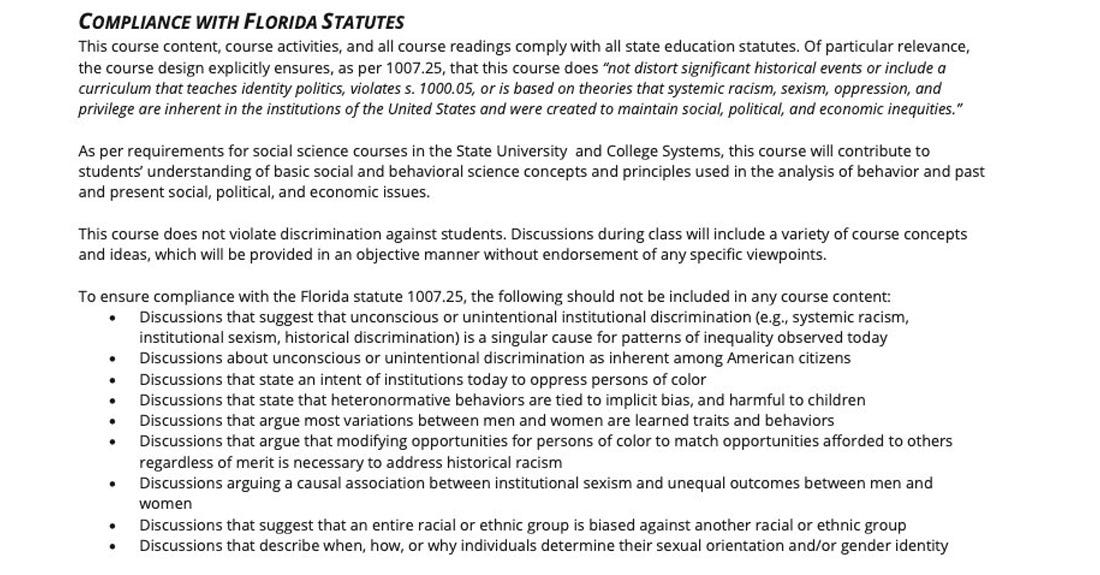
The syllabus and textbook both slash out entire categories of material that the course covered in previous years. As the Independent Florida Alligator explains, the textbook really went through the wood chipper:
The state-approved textbook is 267 pages — compared to about 665 pages in the original Openstax Introduction to Sociology 3e edition. […]
Faculty say the new version removes entire units on media and technology, global inequality, race and ethnicity, social stratification, gender, sex and sexuality. According to Inside Higher Ed, it also eliminates a section addressing the government-led genocide of Native Americans.
In Florida, it seems, broad categories of many things that are central to understanding human societies are no longer topics in sociology, at least not until you take upper division or graduate level classes, possibly in another state.
See also this chilling report from public media outlet WLRN on the academic Sophie’s Choice process that resulted in the cuts to the textbook. Dawn Carr, a FSU sociology profs on the work group, called it “the most unpleasant task I’ve ever had to take on in my entire career,” noting that if sociologists hadn’t participated in the slash job, there would be no textbook at all, and Florida colleges and universities would have to stop offering Introduction to Sociology altogether.
And now, in both Florida and Texas, get ready for even more lawsuits to start flying as groups like the ACLU, PEN, and academic professional organizations try to hold back these ridiculous assaults on the First Amendment. But also brace for more rightwing attempts to stomp out academic freedom and to bully college students and faculty into conformity. This shit won’t last forever, but it’s going to be a hell of a fight.
We are in a difficult time, and vagueness is being weaponized.


[Texas Tribune / Inside Higher Ed / KXAN / Daily Nous / Independent Florida Alligator / Inside Higher Ed]
Yr Wonkette is funded entirely by reader donations. If you can, please become a paid subscriber, or if you’d like to make a one-time (or recurring) donation to help us keep YOUR mind free, here’s your button!
I would just like to let all you filthy fuckaducks know that I am much more on top of things this weekend, and that I have edited and scheduled the usual suite of Wonket posts for today and tomorrow.
In other words, I have met the absolute minimum expectations for doing my job, and damn right I expect applause, and possibly a Nobel Peace Prize, the end.
The red states are destroying their public university systems, which are crown jewels of America.
All the best professors at these institutions are going to flee to places where they can freely conduct their teaching and research, and the UT campuses will just become ITT Technical Institutes offering classes in TV and VCR repair.