


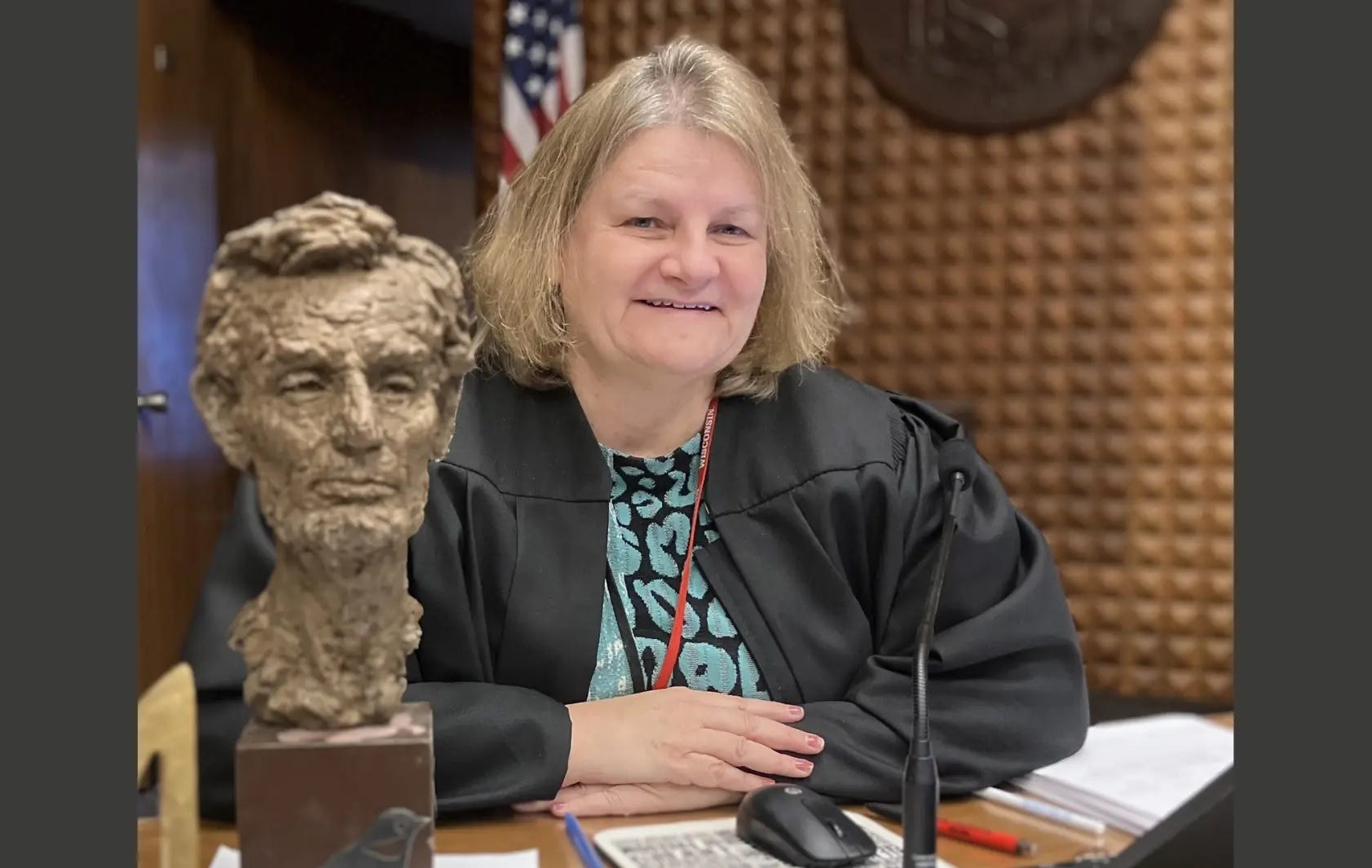
A federal jury in Wisconsin yesterday convicted Milwaukee County Judge Hannah Dugan of one felony count of obstructing federal agents back in April. However, she was acquitted on a second misdemeanor charge of “concealing a wanted person.” This was a case that never should have made it to trial, but the Trump administration made it a priority because local judges need to be coerced into full cooperation with Trump’s ethnic cleansing agenda. And if that requires show trials, well here’s one verdict already.
Just to review: In that April incident, Eduardo Flores-Ruiz, a Mexican national in the US without papers, was in Dugan’s court for a hearing on a misdemeanor charge of battery in a domestic violence case, because the Constitution still requires due process, at least for now. Knowing that he’d be in the courthouse, an ICE “arrest team” in plain clothes followed Flores-Ruiz from his home to the courthouse to arrest him. He was among the first wave of immigrants that ICE agents started grabbing as soon as they left court hearings, following the reversal of a longstanding DHS policy not to do deportation arrests at courthouses, churches, hospitals, or schools.
To justify and normalize this fascist conversion of courthouses from places of impartial justice into traps where non-citizens can be picked off more easily, ICE claims that courthouse arrests are safest for everyone, because civilians are all screened for weapons before they enter.
The agents didn’t enter Dugan’s courtroom because they had only an administrative warrant, not a signed judicial warrant for Flores-Ruiz’s arrest. After she spoke to them in the hallway, where she asked them to speak to the chief judge, Dugan returned to her courtroom while two agents waited at the door to arrest Flores-Ruiz as soon as his hearing was over. Instead, Dugan allowed him and his public defense attorney, Mercedes de la Rosa, to leave through the courtroom’s jury door, into a private hallway that emerged onto the public hallway, 12 feet away from where the ICE goons were waiting. To get to the elevator, Flores-Ruiz and de la Rosa walked right by them, then rode the elevator down to the lobby with a third member of the arrest team.
Only after Flores-Ruiz left the courthouse did the ICE goons move to arrest him; he ran, and after a short chase they grabbed him.
Somehow, the jury agreed that, without actually interfering with the ICE team, and despite the fact that the thugs chose not to grab him in the hallway or anywhere else, Dugan had nonetheless “obstructed” his arrest. What a nutty world!
The prosecution’s case hinged on the claim that Dugan deliberately tried to prevent the arrest of Flores-Ruiz because she placed her personal opposition Trump’s immigration policy above the law, and that moreover she had actually intended to help him escape altogether. That’s kind of difficult to square with what actually happened, but prosecutors claimed that Dugan asked the agents to see the chief judge not because the courthouse’s policy was still only in draft form, but as a strategy to split the brave goons up! Further, they said that instead of intending Flores-Ruiz and de la Rosa to exit the private hall into the public hallway, she wanted them to go to the opposite end of the private hall and then down a staircase that would take them to a side exit of the courthouse.
That claim seemed to fall apart when de la Rosa testified Wednesday that after showing her out the jury door into the jurors-only hallway, Dugan directed her to the door at the end of the hall, out into the public hall. On direct examination by the prosecution, she said she recalled Dugan telling her to “Go down the hallway, and go out.” To get to the inner stairwell, they would have had to turn left, and on cross-examination by defense attorney Steven Biskupic, de la Rosa maintained that Dugan hadn’t directed her toward the stairs.
“Did anyone tell you to go downstairs?” Biskupic asked.
“No,” de la Rosa replied.
Before Flores-Ruiz’s arrest, de la Rosa said she wasn’t aware that there was a stairwell. She was new to the public defender’s office, and she said it was her first time in the hallway.
“Did anyone communicate to you that there were stairs?” Biskupic asked.
“No,” de la Rosa answered.
“Did she ever indicate that you should turn left?”
“No.”
When asked whether she made any effort to run or flee from the hallway, de la Rosa quickly said “no,” laughed slightly, then added: “I’m not good at running.”
But apparently that didn’t convince the jury, which after deliberating for six hours convicted Dugan on the felony count and acquitted her on the misdemeanor, and that’s the American criminal justice system for you.
That acquittal on the lesser charge of concealment may play a role in an appeal, though, as Biskupic said during a post-trial press conference. Basically, if Dugan wasn’t guilty of concealing Flores-Ruiz, and she didn’t get in the way of the agents who let him walk past them without doing anything, where’s the obstruction?
“The case is a long way from over,” Biskupic told reporters.
He suggested the juror’s split verdict was puzzling and said some elements of one charge against Dugan were the same as the elements needed to prove the other.
“How can you find (her) guilty there and not guilty on the first?” Biskpuic asked.
Dugan could face up to five years in federal prison if the conviction holds, but legal experts said that seemed unlikely. Then again, until this year it was virtually unheard-of for a sitting judge to face federal obstruction charges for actions taken in their own courtroom, and the administration definitely wants to whip the judiciary into submission.
Wisconsin Public Radio reports that
prison time in Dugan’s case would be virtually unheard of given the allegations in the case and Dugan’s lack of a criminal record, University of Wisconsin-Madison Law Professor John Gross told WPR.
Gross called the case “incredibly unique.”
“Judges rarely face criminal charges,” Gross said. “Generally speaking, (judges are) people who are pretty outstanding members of the community.”
But these are days when outstanding people are treated as common criminals, and a convicted criminal is at the head of the government.
Dugan will not be allowed to serve as a judge any longer, because Wisconsin law prohibits persons with felony convictions from holding office. Maybe she should run for president.


[NPR / All Rise News / Wisconsin Public Radio]
Yr Wonkette is funded entirely by reader donations. If you can, please become a paid subscriber, or if you’d prefer to make a one-time donation, here is your button!
Yr moderator here: The commenting rules remain in place. Or we can just close the comments.
https://www.wonkette.com/p/rules-for-commenting-radicals
So now that she's been convicted of a felony, she's clearly qualified for the highest elected seat in the land.
Dugan 2028