


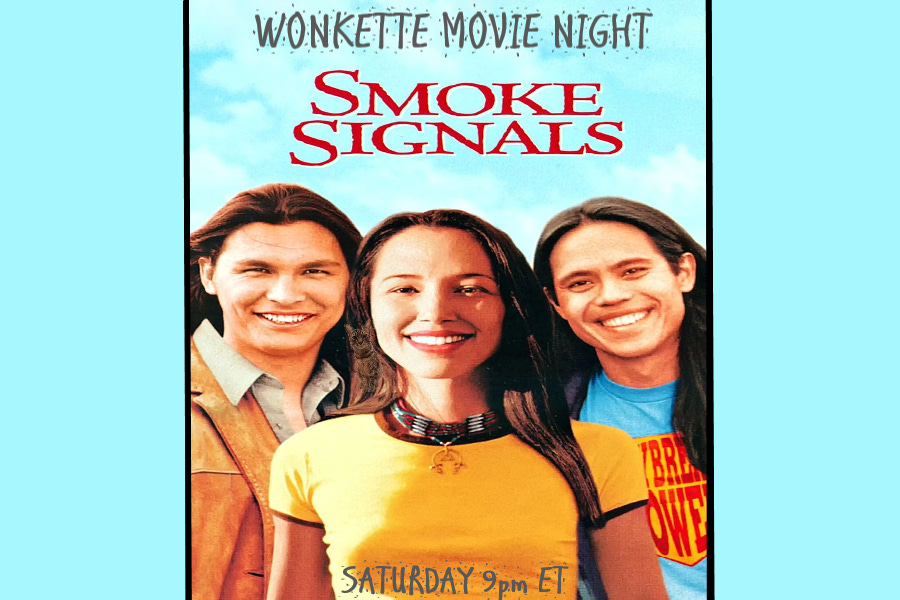
Smoke Signals was written, directed, and produced by Native Americans. It was filmed on the Coeur d’Alene Indian Reservation in Idaho using a cast of Native American actors and reached a large audience globally. It is also funny, sweet, thoughtful, and beautifully filmed.
The film’s screenplay was written by Sherman Alexie, based on his collection of interconnected short stories, The Lone Ranger And Tonto Fistfight In Heaven. The short stories are built around the lives of Victor Joseph and Thomas Builds-the-Fire, the two characters who are at the heart of tonight’s movie.
Arnold, Victor’s dad, saves an infant Thomas from his burning home, a fire that kills Thomas’s parents. The two young men, having grown up as neighbors, are connected but view Arnold through different lenses. Thomas views him as a hero while Victor sees Arnold through his failings.
The death of Arnold, who has been living in Arizona, sets Victor and Thomas off on a journey of discovery as they head to Phoenix to collect Arnold’s ashes. They each see their selves and their heritage as differently as they viewed Arnold. Once the road trip reaches its conclusion, secrets and truths will be revealed, allowing both men clarity and better understanding of all of their lives.
The movie won two Sundance Film Festival Awards: the Filmmaker’s Trophy for Chris Eyre, and the Audience Award.
SFGate wrote about Smoke Signals,
Chris Eyre, a Cheyenne from Klamath Falls, Ore., directed the film with heartening sensitivity toward the plainspoken lyricism of the characters. Beautiful in both its brevity and its vision of contemporary Indian culture, the film abounds in easygoing humor. “Smoke Signals” is, at heart, about the meaning of family and connections, but it also clicks as an on-the-road adventure with Victor and Thomas playing off each other.
Cody Lightning is Victor. In 2023 he made a mockumentary about himself making a sequel to Smoke Signals, titled Hey, Viktor!
Salon interviewed Cody Lightning at the premier of Hey, Viktor! and he had this to say about his movie,
“There are many aspects to any culture, not just Indigenous culture. For me, that’s a joke in the film. A lot of people have a fantasized version of what Indigenous culture is — that is ceremonies and medicine and healing and community. And yes, that is a huge part of who we are. But like any other ethnic background, there is dysfunction, there are hardships, there is alcohol and drug addiction, there is everything. The dysfunctional aspect is not [representative of] Indigenous culture, but that is what myself, as a writer/director, wants to portray in the projects I am writing, acting in and directing.”
Smoke Signals stars Adam Beach, Evan Adams, Irene Bedard, Gary Farmer, Tantoo Cardinal, Cody Lightning, Elaine Miles, and Michelle St. John. Directed by Chris Eyre.
Smoke Signals is available for free with ads on Pluto TV and YouTube. $3.99 in the usual places.
To make requests and see the movie lists and schedules go to WonkMovie.
The animated short is Tuurngait by The Tuurngait Team.
Our next Movie Night selection is The Iron Giant, available with subscription on Howdy (free trial available). Free with ads on YouTube. $3.99 in the usual places.
It is finally happening. I'll be heading into surgery within the next 30 minutes.
See you all on the other side.
𝐁𝐎𝐍𝐔𝐒 𝐓𝐑𝐈𝐕𝐈𝐀:
In a 1998 interview with Filmmaker Magazine, Chris Eyre spoke about the way he wanted to depict Native Americans in the film: "It's crazy that there's never been a movie that has been the voice of Indians. It's always about how the over culture wants to portray Indians, and it's usually in the romantic vein -and I definitely don't want to go there. The romantic stuff grosses me out! There's Native America, and then there's America's Native America. America's Native America is this place that mainstream America holds in a romantic place. Indians could be dead and gone and there would still be Indian-head icons on fruit boxes and Cherokee this and Cherokee that. I want to get away from the romantic stuff. Indian people are like anybody -complicated people."