


In 1969, homosexual acts were illegal in every state except Illinois. That summer, New York City police raided the Stonewall Inn, a popular gay bar in Greenwich Village.
The documentary opens against black and white images of NYC and the Stonewall Inn. The film intersperses interviews of some of the people who were there with archival footage. It also delves into the horrific treatment members of the gay community endured including institutionalization, shock treatments, lobotomies, and medical experimentation.
This was a “system of oppression” that could not hold. Everything they tried to crush the gayness away would be what caused the Stonewall uprising to erupt. Writer Lucian K. Truscott IV described that moment when the gay community said no,
The whole house of cards that was the system of oppression of gay people started to crumble.
The film explores the religious, legal, and political aspects in the fight where gay people demanded to be treated as human. As the 1960s saw significant changes happening all over the country, NYC’s Greenwich Village became a mecca for gay people — and as the community grew, the support of knowing you were not alone set in motion what would become the first brick thrown.
There is another part of the story. The popular story of the gay rights movement tends to lack women’s voices. I suspect that is just a thing for all women’s voices.
As explained by Polly Thistlethwaite and the CUNY Graduate Center in “Where Were The Lesbians In The Stonewall Riots? The Women’s House of Detention & Lesbian Resistance”:
Lesbians caught up in frequent bar raids, charged with prostitution or drug use, or cornered by the mob or the police who controlled queer turf, well understood that entrance to the House of Detention meant brutal, repeated cavity searches (‘exams’ deployed to demean and to control), vermin-infested cells, filthy beds, overcrowded spaces, inedible food, and countless humiliations.
Women were held for violations unavoidable in 1960s New York queer life.
Standing in a queer bar or on a street corner could land a woman in jail. So could a stop-and-frisk if police claimed not to find three required pieces of gender conforming clothing.
I wanted to focus on one of these women, Stormé DeLarverie; from the NPS:
Some people believe that DeLarverie started the Stonewall Uprising. The story goes that a “mysterious butch lesbian” was being arrested for violating the three-piece clothing law, and she either yelled for the crowd to do something or punched an officer herself, which encouraged others to start fighting back.
I knew Stormé DeLarverie in her later years, when she was the bouncer for the famed Cubbyhole, a very popular lesbian bar and my favorite watering hole. Stormé was an amazing human and protected the bar from tourists just looking to gawk or creepy stupid dudes thinking they could get themselves a lesbian. You always felt safe at The Cubby. Talking with Stormé gave me hope, she was fearless, unafraid to be exactly who she was. She told me she had been at the Stonewall rebellion, but she didn’t give details. Imagine how surprised I was to recently discover some of those details.
DeLarverie called herself the “guardian of the lesbians in The Village.” She patrolled the streets of Greenwich Village with a concealed rifle, making sure all the lesbians and the street kids were safe. If she saw any “ugliness,” she’d shut it down immediately. She continued doing her rounds every night, even as an octogenarian — recounting in a 2002 interview, “You don’t do [ugliness] around me. Just don’t try it. You’re apt to wind up with your ass on the floor.”
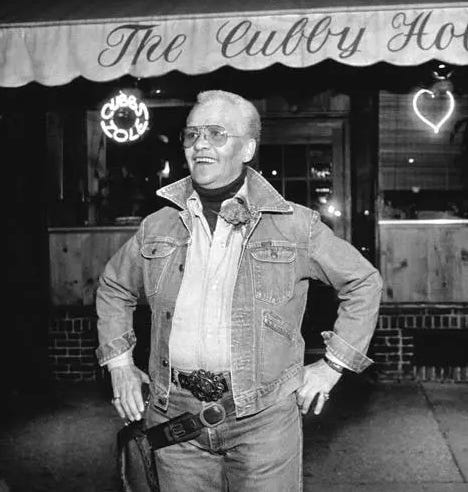
From 2001, A Stormé Life.
The cop hit me and I hit him back. I walked away with an eye bleeding but he was lying on the ground.
The Stonewall Uprising reminds us that a community can come together to fight an oppressive force, that a spark can set in motion significant change. It seems more important than ever that we remember that. Let’s be more like Stormé.
Stonewall Uprising stars Danny Garvin, David Huggins, Virginia Apuzzo, William Eskridge, Martin Boyce, Raymond Castro, Jerry Hoose, Tommy Lanigan-Schmidt, Dick Leitsch, Seymour Pine (NYPD Deputy Inspector), Yvonne Ritter, Fred Sargeant, Martha Shelley, Lucian K Truscott IV, and Doric Wilson. Directed by David Heilbroner and Kate Davis.
Stonewall Uprising is available for free on the Internet Archive and on Prime for $2.99. Available with a library card on Kanopy.
To make requests and see the movie lists and schedules go to WonkMovie.
The animated short is LGBT+ Heroes: Stormé, Sylvia & Marsha - The Stonewall Riots from the kid friendly Pop ‘n’ Olly.
Additional reading:
The Village Voice: Why Are All The Lesbian Bars Disappearing?
Library Of Congress: This Day In History June 28. The Stonewall Uprising of 1969
The LGBT Community Center: Stonewall Forever
National Geographic: Why the Stonewall Uprising Became a Turning Point in American History
Next week’s Movie Night selection falls on July 4th and we will be watching Jaws as is our tradition. Available for free with ads on OKRU; with subscription on Starz and YouTube Prime; $3.99 in the usual places. Hey Fukui, get that anchor blazer ready!
Prefer a non-Substack subscription? The button below will take any amount of your choosing at PayPal — let me know if you want the newsletter subscription too! PayPal won’t automatically sign you up for the newsletter! — or we have a Patreon too.
𝐁𝐎𝐍𝐔𝐒 𝐓𝐑𝐈𝐕𝐈𝐀:
The Mafia ran gay bars in NYC in the 1960s.
It was an unlikely partnership. But between New York’s LGBTQ community in the 1960s being forced to live on the outskirts of society and the Mafia’s disregard for the law, the two became a profitable, if uneasy, match.
The State Liquor Authority and the New York Police Department regularly raided bars that catered to gay patrons. Where the law saw deviance, the Mafia saw a golden business opportunity. A member of the Genovese family, Tony Lauria, a.k.a. “Fat Tony,” purchased the Stonewall Inn in 1966 and transformed it into a gay bar and nightclub.
To operate the Stonewall and its other gay bars, the Mafia bribed the NYPD to turn a blind eye to the “indecent conduct” occurring behind closed doors. They also blackmailed wealthy gay patrons by threatening to “out” them.
BTW I have another personal connection story related to this.
I rented the second floor of a home in NJ. The owners were Lana, a 70 ish transgender witch and her ex-mafioso husband Fred.
I believe they were in witness protection.
Fred had been a bag man, he collected the mob's fees, he met Lana at one of these gay bars.
There is so much more to this story, OMG have I lived an interesting life.
For those of you keeping track at home Harry has now caught and killed 3 mice.
He is having the time of his life.
The last one arrived about 30 minutes ago.
I heard a meow and he is lounging on the floor staring at his latest (non-moving) conquest.
He decided to pick it up again when I went to get it.
I had to repeat my new catchphrase:
Harry, put the fucking mouse down. Drop the mouse Harry.