


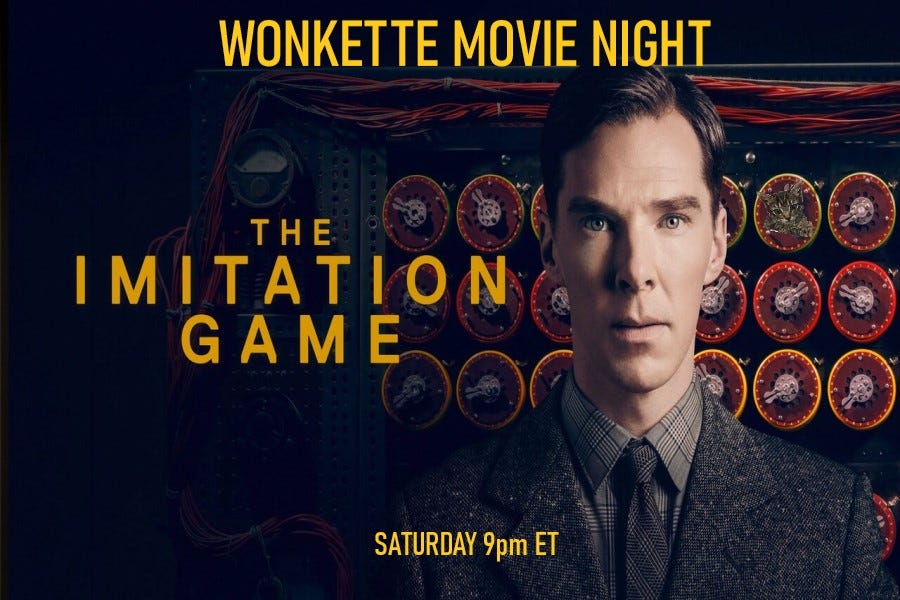
The Imitation Game was adapted from Andrew Hodges’s 1983 biography of Alan Turing, Alan Turing: The Enigma. The film is a dramatized telling of Turing’s work on finding a way to break the Enigma machine that the Wehrmacht was using to move encoded messages during WW2. Although the movie has been criticized for including events that did not happen in real life, it still garnered eight Academy Award nominations, and won the Oscar for Best Adapted Screenplay.
The story of a mathematician whose brilliance in cracking Enigma is believed to have ended the war two years earlier than without his involvement and saving approximately 14 million lives. And then the British government chemically castrated him because of TEH GAY.
Turing was aided by a woman who was not even allowed to work with the men, but still was a driving force in helping him break the unbreakable. Without Joan Clarke it is possible Turing would not have succeeded. Still waiting for her movie! In 1946 she received an appointment as a Member of the Order of the British Empire.
Here is a bit of a BBC interview with Joan Clarke where she explains,
“But although it was a surprise, I really didn’t hesitate in saying yes, and then he knelt by my chair and kissed me, though we didn’t have very much physical contact.
“Now next day, I suppose we went for a bit of a walk together, after lunch. He told me that he had this homosexual tendency.
“Naturally, that worried me a bit, because I did know that was something which was almost certainly permanent, but we carried on.”
So a gay man and a woman, underappreciated, burdened by bigotry and misogyny, still gave all they could give to stop the war and improve the world. Alan Turing is considered to be the creator of what would become our laptops and smartphones and yet the people that his brilliance saved, killed him.
The film served as a reminder of how homosexuality was treated in England as a criminal act, and 49,000 gay men were convicted under the same law that caused Alan Turing to take his own life. In 2015, Benedict Cumberbatch, Stephen Fry, and Rachel Barnes, Turing’s great-niece, started a fight to get those men pardons. In 2013, Queen Elizabeth II pardoned Alan Turing but no one else.
By 2017 the Alan Turing law (Policing and Crime Act) finally allowed the pardons for those men convicted in England and Wales.
The Imitation Game is available with subscription on Hulu. Free with ads on Daily Motion. $3.99 in the usual places.
The Imitation Game stars Benedict Cumberbatch, Keira Knightley, Matthew Goode, Allen Leech, Mark Strong, and Charles Dance. Directed by Morten Tyldum.
To make requests and see the movie lists and schedules go to WonkMovie.
The animated short is The Other Me from ESMA, directed by Théo Clenet, Clara Lorente, Cédric Malet, Alexandre Mazelly, Alexia Oylataguerre, Rémi Portes Narrieu, and Grégoire Soghomonian.
On Thanksgiving, is it just you and the cats? Just you and the family that is currently making you crazy? Just want to hang out with friends for a bit and watch a movie? Wonkette has got you covered and all cats (and dogs of course) are welcome.
THANKSGIVING MATINEE 5 p.m. ET:
Alice’s Restaurant is available for free on YouTube. Also available for free on this YouTube channel.
Then we end November’s flicks with Back To The Future on Nov. 29. Back To The Future is available for free on the Internet Archive. $3.99 in the usual places.
Here comes December!

Thanks all! I will be here Thanksgiving, being here for those who need this place . I know who my real family is, it is RIGHT HERE.
𝐁𝐎𝐍𝐔𝐒 𝐓𝐑𝐈𝐕𝐈𝐀:
Benedict Cumberbatch confessed that in one of the final scenes of the film, he couldn't stop crying and had a breakdown. It was, as he said, "Being an actor or a person that had grown incredibly fond of the character and thinking what he had suffered and how that had affected him." In an interview with USA Today, Cumberbatch said of Turing's Royal Pardon, "The only person who should be pardoning anybody is him (Turing). Hopefully, the film will bring to the fore what an extraordinary human being he was and how appalling (his treatment by the government was). It's a really shameful, disgraceful part of our history."
"If any young person ever felt like they aren't quite sure who they are, or aren't allowed to express themselves the way they'd like to express themselves, if they've ever felt bullied by what they feel is the normal majority or any kind of thing that makes them feel an outsider, then this is definitely a film for them because it's about a hero for them," Cumberbatch stated at the European Premiere of the film at the London Film Festival, October 2014.