


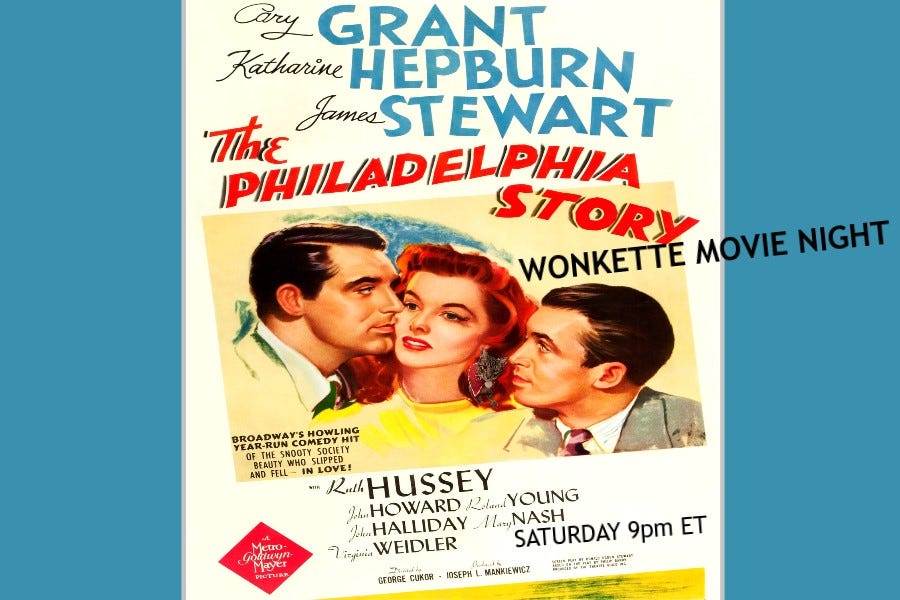
Katharine Hepburn is a total badass woman.
I love her even more after reading the background on this movie. She was a fearless woman who battled gross misogyny and knew her worth. She had to fight the moneyed men who controlled Hollywood even as a wealthy man helped her to win that battle.
Box office poison.
That was a label attached to Katharine Hepburn in 1938 on a list created by cinema owner Harry Brandt. He placed it as an ad in The Hollywood Reporter, it started with all caps,
WAKE UP! HOLLYWOOD PRODUCERS
Practically all of the major studios are burdened with stars—whose public appeal is negligible—receiving tremendous salaries necessitated by contractual obligations. Having these stars under contract, and paying them sizeable sums weekly, the studios find themselves in the unhappy position to having put these box office deterrents in expensive pictures in the hope that some return on the investment might be had.
Reading the list today makes you think this guy was too focused on profit, because it includes some of our greatest stars.
Mae West, Edward Arnold, Greta Garbo, Joan Crawford, and Katharine Hepburn to name a few. Interesting that 4 of the 5 actors that Brandt named were women.
In order to escape the awful moniker and give her career a restart she starred in, invested her own money in, and declined a paycheck (getting a % of the profits instead) for a Broadway play. Written by Philip Barry specifically for Hepburn, The Philadelphia Story opened at the Schubert Theater on March 28, 1939, where its run lasted a year and 417 performances.
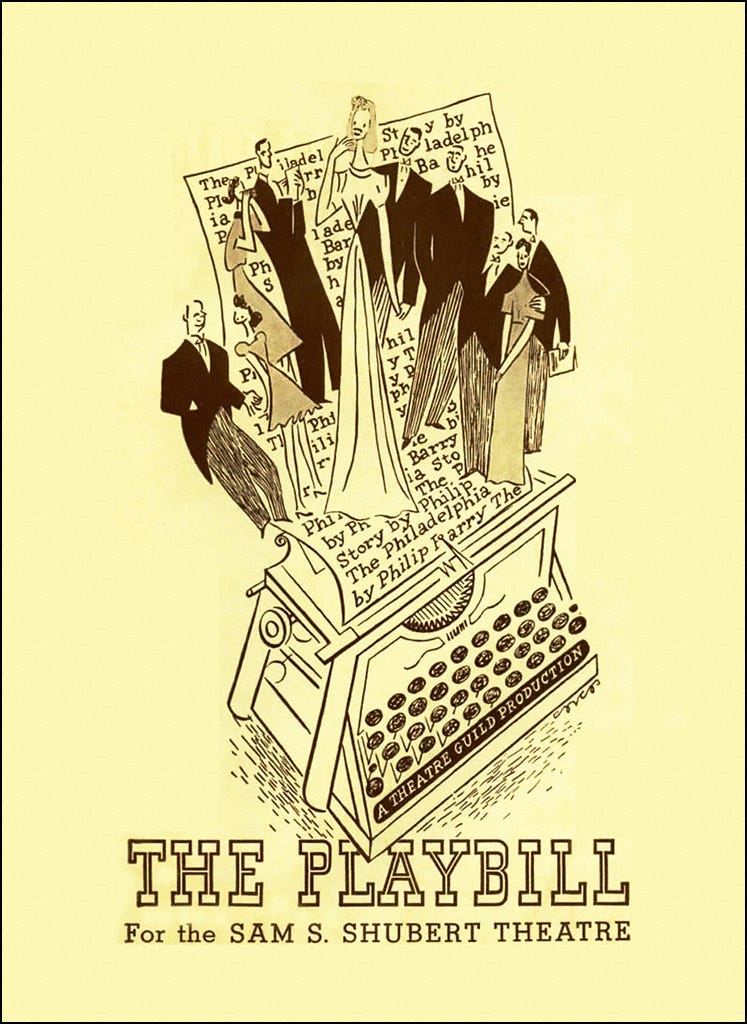
She wanted to turn the play into her big film comeback. Howard Hughes stepped in and purchased the film rights which he then gifted to Hepburn. Hepburn showed she had more than just terrific acting chops, she also had a keen business sense. She sold the rights for a quarter of a million dollars to Louis B. Mayer, head of MGM. She also demanded and received total control over the producer, director, screenwriter and casting decisions.
The story was based around the affections of a divorced woman; her upcoming marriage to a man that was befitting of her social standing, her attraction to another man, and her ex somehow finding his way into the mix. The film trope of a “comedy of remarriage” was widely used in the 1930’s and 40’s as a way of navigating around the Hays code, which banned representations of adultery.
With the top three stars being Hepburn, Grant, and Stewart we are given a dream team of sharp humor and actors at the their best. Including the beautiful physical humor that Hepburn and Grant were so talented at, as recalled by cameraman Joseph Ruttenberg,
She enjoyed him pushing her through a doorway in one scene (so she fell over backward) so much that she had him do it to her over and over again. There was a scene in which she had to throw Cary out the door of a house, bag and baggage, and she did it so vigorously he fell over and was bruised. As he stood up, looking rueful, Kate said, “That’ll serve you right, Cary, for trying to be your own stuntman.”
The Philadelphia Story did exactly what Katharine Hepburn wanted it to do.
The box office earned more than three times what it cost to make.
It was nominated for 6 Academy Awards, winning 2.
A 1940 review by Herb Golden in Variety said,
For Miss Hepburn this is something of a screen comeback. Whether it means she has reestablished herself in pictures is something that can’t be said from this viewing for she doesn’t play in “The Philadelphia Story”; she is “The Philadelphia Story.” The perfect conception of all flighty but characterful Main Line socialite gals rolled into one, the story without her is almost inconceivable. Just the right amount of beauty, just the right amount of disarray in wearing clothes, just the right amount of culture in her voice – it’s no one but Hepburn.
In 1956 the movie was remade as the musical High Society starring Grace Kelly, Bing Crosby, and Frank Sinatra.
It continues to be a loved classic film with a 100% rating on Rotten Tomatoes, where they have chosen it as number one on their list of Best Romantic Comedies of All Time.
The Philadelphia Story stars Katharine Hepburn, Cary Grant, James Stewart, Virginia Weidler, Ruth Hussey, John Howard, Mary Nash, and Roland Young. Directed by George Cukor.
The Philadelphia Story is available for free with ads on Plex and Tubi; free on OK RU; $3.99 in the usual places.
To make requests and see the movie lists and schedules go to WonkMovie.
The animated short is Ducks by AJ Jefferies. This is a what the fuck did I just watch kind of video.
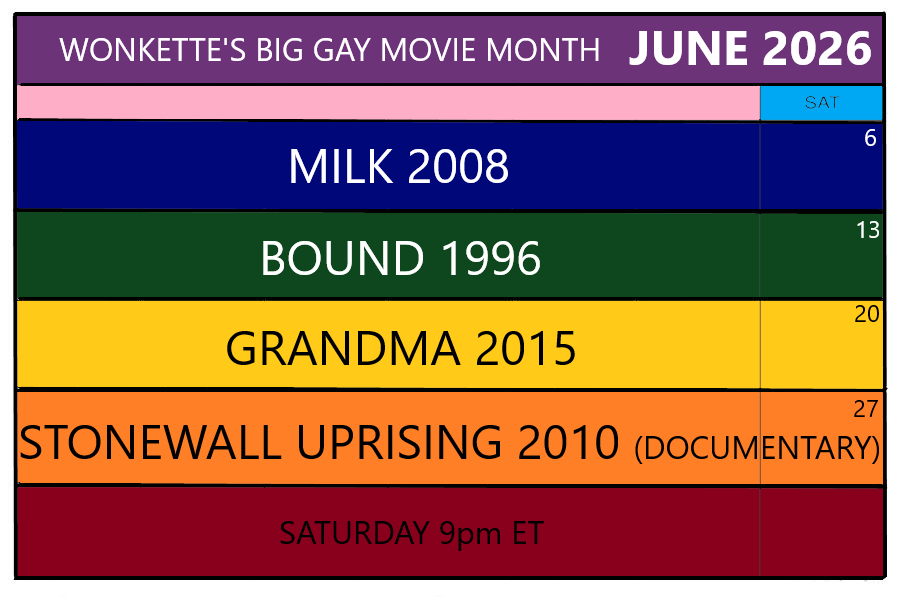
Next week’s Movie Night selection starts Wonkette’s Big Gay Movie Month with Milk, available for free with ads on Dailymotion. $3.99 in the usual places.
Prefer a non-Substack subscription? The button below will take any amount of your choosing at PayPal — let me know if you want the newsletter subscription too! PayPal won’t automatically sign you up for the newsletter! — or we have a Patreon too.
𝐁𝐎𝐍𝐔𝐒 𝐓𝐑𝐈𝐕𝐈𝐀:
On Broadway, Katharine Hepburn played opposite Joseph Cotten (in the role played by Cary Grant in the film), Van Heflin (the James Stewart role) and Shirley Booth (the Ruth Hussey role). Anne Baxter played the younger sister. The play ran for 417 performances, making nearly $1 million at the box office. It then went on tour for another 250 performances and an additional $750,000 in box-office receipts.
At the final performance of "The Philadelphia Story" on Broadway, Katharine Hepburn stopped the stagehands from lowering the curtains at the end of the show, so that "the final curtain will never fall on 'The Philadelphia Story.'"
𝐁𝐎𝐍𝐔𝐒 𝐓𝐑𝐈𝐕𝐈𝐀:
During the scene where James Stewart hiccups when drunk, you can see Cary Grant looking down and grinning. Since the hiccup wasn't scripted, Grant was on the verge of breaking out laughing and had to compose himself quickly. Stewart (apparently spontaneously) thought of hiccuping in the drunk scene, without telling Grant. When he began hiccuping, Grant turned to Stewart, saying, "Excuse me." The scene required only one take.
In honor of the film I am also drunk.