



Sixty years ago yesterday, on September 8, 1966, a groundbreaking new television show debuted, bringing a bold new perspective to network television, a vision of the world that was very different from the usual run of family sitcoms, variety shows, and westerns. While it never made the top of the ratings, it spoke to the zeitgeist of the 1960s, a time of rapid social and political change.
No wonder people still remember ABC’s That Girl, starring Marlo Thomas, for its portrayal of a single young woman in New York who was out to make a life and career for herself, without spending all her time focusing on winning a man. Pretty innovative stuff!
Also on the same night, on NBC, another series premiered. It had a Vulcan with pointy ears, an irascible but witty doctor, a multiracial crew, and a starship captain who chewed scenery and romanced green ladies. (Lore has it that while producing the pilot episode “The Cage,” network engineers kept “correcting” the Orion lady’s green-painted skin to Anglo flesh tones because they thought the green was a film processing error. Additionally, the Orion lady — in those screen color tests, but not the actual pilot — was Majel Barrett, Gene Roddenberry’s wife, who also played Nurse Chapel and voiced the Enterprise computer in both the original series and Next Generation. In the pilot, Susan Oliver played the green Orion lady. [Updated to clarify who was which green Orion lady])
That first episode, “The Man Trap,” was the one with the crazy shape-shifting salt vampire thing that pretended to be a pretty lady. The original show was a product of its patriarchal time, yikes.
Nerd Icon George Takei reminded us Tuesday about that series premiere, and we all went “aww” and/or “damn, I’m old.”
Also, every media outlet in the Alpha Quadrant felt compelled to say that after 60 years Star Trek continues to live long and prosper.
Hey, remember that time Nerd President Barack Obama met Nichelle Nichols in the Oval Office and it looked like the future was really here? Sigh. Nichols tweeted that Obama told her that when he was a kid, he had a huge crush on Lt. Uhura.
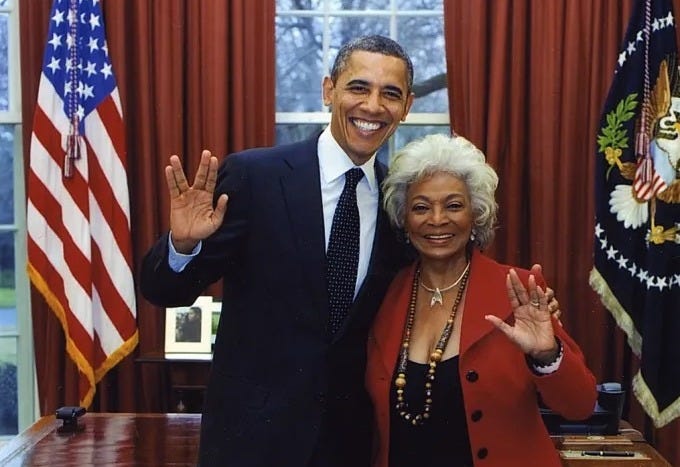
Not unrelatedly, when Nichols wanted to leave the show because she’d tired of only opening hailing frequencies, Martin Luther King Jr. changed her mind, telling her she couldn’t quit, because Uhura’s presence sent a message to racists on Earth in the 1960s: “we all know they cannot destroy us because we are there in the 23rd century.”
And to think that rightwing idiots in the second decade of the 21st century complain about current Star Trek shows being “too political.”
You can also use the button below to donate an amount of your choice at Paypal.
From the very beginning, Star Trek was political, with its tales of a racially diverse crew in a post-scarcity future that was in many ways Kennedy’s New Frontier, but in space, the final frontier. The world of Star Trek is such an appealing fiction because by the time the Enterprise is zipping around the galaxy, humanity has overcome many of its worst problems, like scarcity, poverty, bigotry, nationalism, and even war, at least on Earth. (And no religion too. Mostly. You know, except for the end of “Bread and Circuses” (1968) where Uhura explains the space-Romans aren’t suppressing people who worship the Sun, but rather, the Son.)
In Star Trek creator Gene Roddenberry’s version of the future, people would solve problems rationally, with liberty and justice and human rights for all, for the most part. Like that later NBC sci-fi show The West Wing, the good guys win because they have good values and are in a relatively tidy fictional universe where there may be conflict, but those conflicts can be resolved with good will, intelligence, and an appeal to the best outcome for all. You know, mostly.
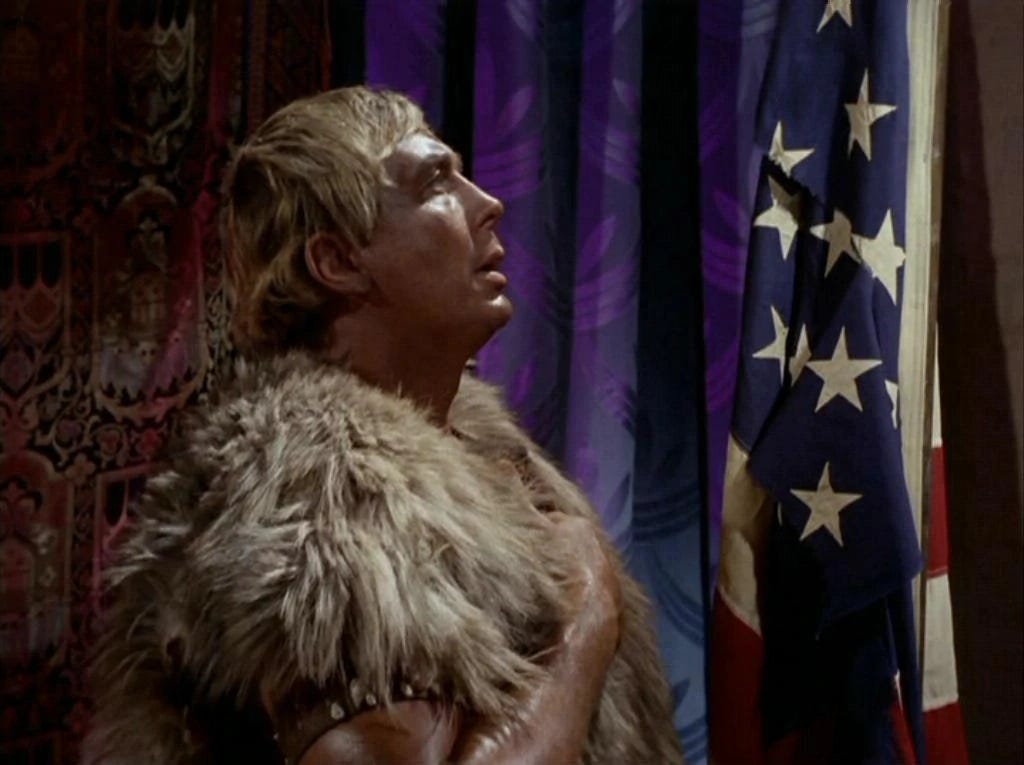
Oh, yes, and sometimes you need the judicious application of force, possibly to prevent the domino effect in southeast Asia, or at least to prevent the Klingons from gaining influence over the pre-technological inhabitants of a little backwater planet named Obvious Vietnam Allegory (“A Private Little War,” 1968).
One of the things I really like about later Star Trek series was their occasional willingness to question and reject the often simplistic imperialist tendencies of the original series, as with Deep Space Nine’s fraught relationship between the Federation and the Bajorans, who had only recently freed themselves from the nasty Cardassians.
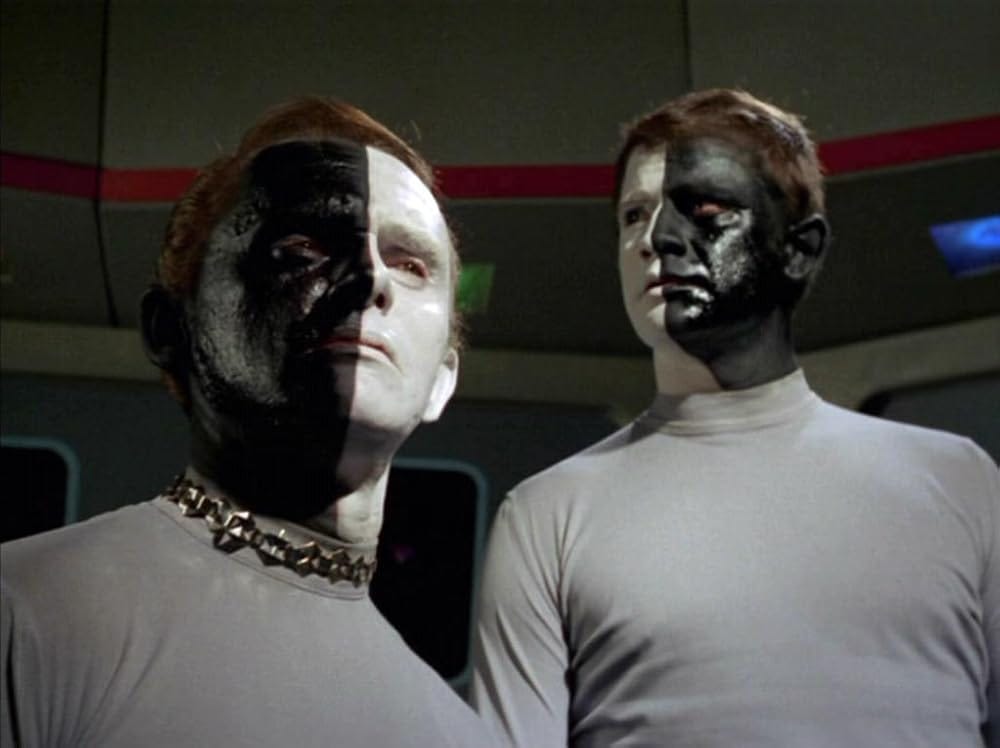
Sometimes the original series’ allegories were thuddingly obvious, as in “Let That Be Your Last Battlefield” (1969), where the last two mirror-opposite survivors from a planet torn by racial war pursue each other to hell because they can’t let go of their bigotry.
Star Trek: The Next Generation hardly did any better with its attempt to allegorize LGBTQ+ liberation in the episode “The Outcast” (1992), which meant well, but was kind of creepy. It posited a planet where everyone is officially genderless, and anyone who identifies as a male or female is considered a sick pervert who must have their mind fixed by a machine that does conversion therapy to them, so they’ll conform. Talk about You Will Be Assimilated!
It would have been a hell of a lot better simply to have some actual LGBTQ+ characters, as later series like Star Trek: Discovery managed without any difficulty. We’re also very fond of the animated Star Trek: Lower Decks, which feels like the truest Trek of all because it just jumps into all the Star Trek mythology and gleefully goofs around with it like fans on a three-day bender. Its main character, Beckett Mariner, is joyfully and uncomplicatedly bisexual (“I’m always dating bad boys, bad girls, bad gender non-binary babes, ruthless alien masterminds, bad Bynars”) and nobody gives a crap.
Getting back to the original series, there was also the weird realpolitik of 1967’s “City on the Edge of Forever,” a time-travel fable written by Harlan Ellison, in which during the Great Depression Captain Kirk has to stop Dr. McCoy from saving the life of Edith Keeler, a Dorothy Day-style humanitarian and peace activist whose pacifist arguments — in the timeline where she doesn’t die — were so persuasive that the US stayed out of WWII, leading to an Axis victory and therefore no US space program, and thus no Federation or USS Enterprise. To set things right in the future, the pacifist literally has to die.
(This theme is also played with, delightfully, in Desmond Warzel’s hilarious 2011 short story “Wikihistory,” where neophyte time travelers must be stopped, over and over, from killing Hitler. Read the FAQ, people!)
The original series can be faulted for what sometimes feels like a simplistic embrace of imperialism, where the Federation’s enlightened high-tech heroes share happiness with other planets, once their technology develops to the point that their space programs develop warp-drive capacity. There’s a Prime Directive not to interfere with civilizations as they develop, but Kirk flouts it routinely so he can win the day and save the sympathetic lesser cultures.
This is where I have to mention Ted Cruz, sorry about that. Back in 2015, Cruz, who is really, really bad at pop culture, told Wonkette O.G. Ana Marie Cox in a New York Times Magazine interview (gift link) that for his money, Captain Kirk was way better than Next Generation’s Captain Picard, because Kirk was a man’s man, with passion and intelligence, while Picard was all cold intellect and rule-following.
When Cox noted that Next Generation’s politics tended to be “more touchy-feely in its politics than the original,” Cruz really started losing the plot:
No doubt. The original “Star Trek” was grittier. Kirk is working class; Picard is an aristocrat. Kirk is a passionate fighter for justice; Picard is a cerebral philosopher. The original “Star Trek” pressed for racial equality, which was one of its best characteristics, but it did so without sermonizing.
Um. Excuse us, Senator Cancun, but aren’t you forgetting something?
Cruz also said he thought that “Kirk is a Republican and Picard is a Democrat,” and while that’s a little weird, we suppose the argument might hold even better today than in that 2015 interview. Kirk certainly recognized the rule of law and the Prime Directive, but he was happy to bend the rules at every opportunity if it gave him an advantage. So yeah, that scans at least partly with the Party of Trump, although Kirk still remained anchored to basic decency and an identifiable moral code.
Trump and his party are a bit more like the Ferengi, governed only by the Rules of Acquisition, although even they would probably find Trump off-putting and gauche.
We could almost certainly go on all day with our rambling nostalgia quest about Star Trek and politics, but suddenly we are run over by a shuttlecraft, the end.
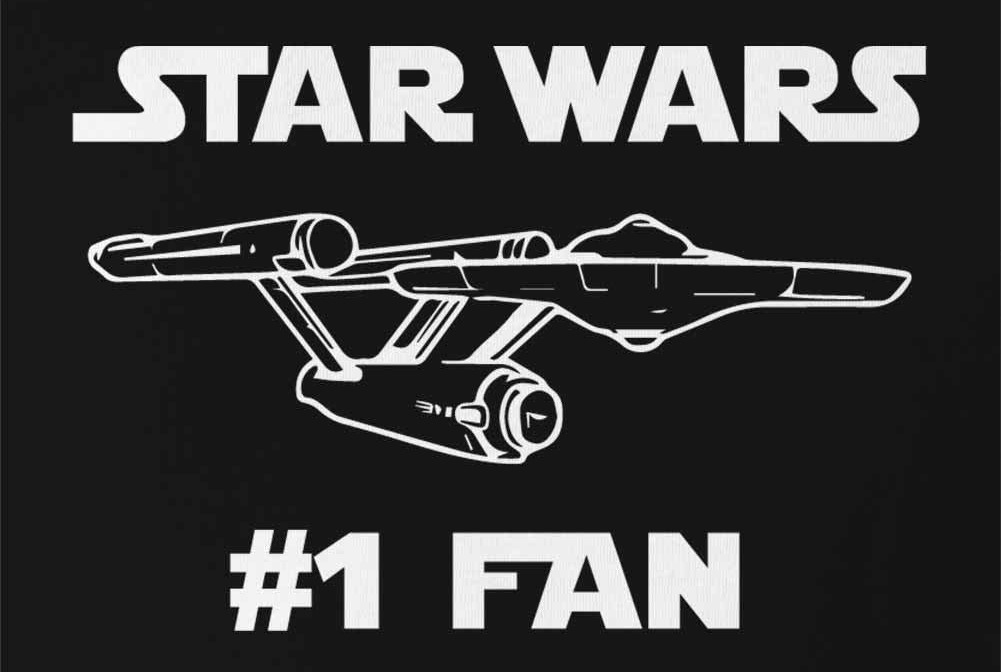
Also, this remains our favorite T-shirt design ever. May the Force be with you as you live long and prosper. So say we all. Come with me if you want to live. I have a bad feeling about this. Game over, man, game over. Bite my shiny metal ass.
And now it is your OPEN THREAD.


Yr Wonkette is funded entirely by reader donations. If you can, please become a paid subscriber, or if you’d like to make a one-time (or recurring) donation, you can click this here button. Make it so.
Alternative top photo caption: "RUN FOR YOUR LIVES, BADGEY'S BACK!!!"
We did Star Trek IV as a Movie Night on Aug. 13, 2022. It was the 17th movie night.
That was back when Robyn wrote the movie night announcement so there is no background on the movie like I do now. But the movie poster does include babby Axl.
Movie Night has come a long way!
https://wonkette.substack.com/p/wonkette-movie-night-star-trek-iv?r=2knfuc&utm_campaign=post-expanded-share&utm_medium=web