


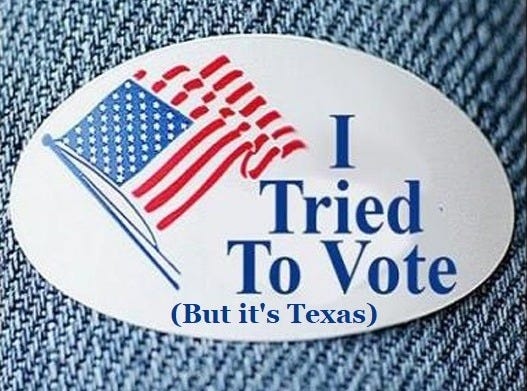
In Texas Tuesday, the Republican majority on the Tarrant County Commission voted to cut the number of 2026 midterm polling places by about a third, compared to the number that were approved in 2022. The vote came after the commissioners ignored testimony from more than 100 community members, the majority of whom opposed reducing the number of voting sites.
In the 2022 midterms, Tarrant County had 316 polling places on Election Day and 50 for early voting. That’s down to 224 Election-Day sites and 47 early-voting locations this year, despite the fact that over the last four years, the county has added more than 70,000 registered voters to its official tally. Now they’ll have to cram into fewer voting sites.
Democratic Senate nominee James Talarico, locked in a close race with some crimey Republican asshole, said the polling place reductions are aimed at making voting just a little harder, telling reporters before the vote, “The most powerful people in this county, the most powerful people in this country, don’t want us to be able to vote easily.”
That’s a real worry in Tarrant County, which in the past has trended Republican, but has been going purplish lately. Voters in the northern part of the county went heavily for Democrat Taylor Rehmet in his landslide special election win in January, flipping a district that hadn’t elected a Democrat since 1991. And in March’s primaries, Democratic turnout was far higher than usual, so it’s only reasonable that Republicans on the county commission would want to do their part to depress possible voting for Talarico.
At Tuesday’s meeting, multiple speakers said the county should be increasing voting sites as the population booms, not cutting them, and called attention to the loss of polling places in neighborhoods with largely Black and Brown populations. Resident Cynnamon Hall pointed out that the 76104 zip code now won’t have a single polling site, telling the commissioners, “If you accept this, you’re basically saying that our votes don’t matter. All votes matter. Vote ‘no’ on this.”
Instead, the three Republicans refused any changes to the proposed list, voting at about 5 p.m. to adopt it. Following the vote, members of the audience chanted “Shame! Shame!” despite the clear demonstration that Republicans have none.
The move came the week after Texas also suspended, without notice, the registrations of more than a million voters who may or may not have changed addresses or gotten married, just to be cute.
This is where we remind you that once upon a time before the Roberts Supreme Court gutted the Voting Rights Act in 2013, states and counties with a history of racial discrimination had to get “preclearance” from the Justice Department before changing voting procedures, to ensure protection of minority voters’ rights. But Roberts said we’re past all that unpleasantness now.
You can also use the button below to donate an amount of your choice at Paypal.
The truncated list of voting sites was proposed by Tarrant County Elections Administrator Clint Ludwig, who claimed the changes would save the county money and be super fair, so you all settle down now. Ludwig said the sites that were retained from earlier elections were those with the highest turnout, near bus stops, and “evenly distributed” to make sure sites weren’t within a mile of each other, a criterion that sounds reasonable until you remind yourself that a mile is a hell of a distance if you don’t have a car, especially if you need a wheelchair, or if there’s a freeway or other barrier between you and your “nearest” polling place.
Ludwig insisted, with the calculated blandness of a Republican congresscritter explaining that Medicaid cuts will only affect lazy people who don’t deserve healthcare, “I’m confident that what is proposed is going to give everybody that wants to vote the opportunity to vote.” Translated into plain English, that means voters should just shut up and be thankful they’ll be allowed to vote — and to study the bus schedules carefully.
No big surprise that the deleted polling places included one at UT-Arlington, which had a polling place for early voting 2022 and for the general election in 2024. As Fort Worth TV station WFAA reports in some darn good local coverage, that means the “nearest polling place for students now is the Tarrant County sub-courthouse in Arlington, about a mile away — a roughly 25-minute walk.” College students are both far more likely to vote for Democrats and to not own cars, in an amazing coincidence.
Alisa Simmons, one of the two Democratic commissioners, introduced an amendment to restore UT-Arlington and two campuses of Tarrant County College to the list of early-voting polling places, but as with other amendments, it was voted down by the three Republican commissioners.
Ludwig, the smiling thug who devised the pared-back site list, insisted that those campus sites were expendable because they were within a mile of other sites that had somewhat higher turnout in the past, see what a nice efficient technocratic reason that is? If students are too lazy to walk 25 minutes because the polling place is no longer right there on campus, do they even deserve the franchise?
Still, voters affected by the cuts pushed back, for the little good it did.
Emeri Callaway, vice president of the Tarrant County Young Democrats, urged commissioners to restore the sites Ludwig proposed cutting, especially the [Maverick Activity Center] at UTA. They spoke of college students across the county calling the organization “panicking” about where to vote.
“This should not be a controversial issue to add these locations. It should not be partisan,” Callaway said. “Do not make it hard for students of Tarrant County to vote on their campuses.”
Well, do they want to vote? If these soft pampered elitist kids really wanted to vote they’d stop whining and get walking, and don’t the kids these days all have cars or those goddamned e-bikes they menace decent people with?
Online supporters of the scheme have latched on to Ludwig’s “turnout” claim, pretending that the only sites lost were like ghost towns, with only the wind and tumbleweeds blowing around, so what’s the big deal?
Roderick Miles Jr., the other Democratic commissioner, protested the Republican majority’s transparent move to make voting more difficult by comparing it to Jim Crow-era poll taxes.
From the dais, Miles showed attendees the framed poll tax receipt of his wife’s great-grandmother, who he described as a housewife and mother of 10 who “understood how important her vote was, and the voice and the power it came along with.”
“Just know that you are creating poll taxes, modern day poll taxes, for people to go and vote and do what they have the right to do,” Miles said, addressing Republican colleagues. “You may not see it, and I can’t help you see, but it is what it is.”
Tarrant County Judge Tim O’Hare (Texas calls elected county heads “judges” even though he’s really just the chair of the county commission) whined back that Miles was being totally unfair with the comparison, because the bad old days are gone and despite the best efforts of Republicans, not all Jim Crow voting barriers have yet been revived.
“There is no poll tax, and the problem with your analogy is there was no early voting then,” O’Hare griped. “It was a terrible time in America. That’s not what we have today. You keep pushing that narrative.” Then, presumably, he wept big tears and wiped them on a genuine souvenir “Bull Connor for Sheriff” handkerchief, we assumed in a constitutionally protected bit of satirical hyperbole, the end.


[Texas Tribune / AP / The Texan / New Republic / Fort Worth Star-Telegram]
Yr Wonkette is funded entirely by reader donations. If you can, please become a paid subscriber, or if you’d like to make a one-time (or recurring) donation, you can click this here button.
The fuckers could reduce the number of Texas polling place to fucking ONE.
I'd crawl over broken glass to get there and vote BLUE!
Fuck 'em. They're getting what's coming to them no matter what they throw at us.
Fuck 'em!
I am looking forward to a 13-member Supreme Court upholding the 2029 Voters' Right Act--a landmark decision written by Chief Justice Ketanji Brown Jackson.