


The US Supreme Court yesterday killed off most of what remained of the Civil Rights Act of 1965, that had protected minority groups’ right to vote as guaranteed by the Constitution. The ruling in Louisiana v. Callais gutted Section 2 of the law, which prohibited measures like race-based gerrymandering that significantly weakened the votes of minority groups, and is expected to lead to a widescale elimination of Black members of Congress in coming years, as white Republican legislators redraw voting maps to ensure that no minority communities have enough votes to win elections.
The governor of Louisiana, Jeff Landry, has already said he’s “delaying” the state’s primaries, which were supposed to begin Saturday, as in “two days from now.” We’re sure it’s fine.
The decision, written by Samuel Alito and joined by the other five Republican-appointed justices on the Court, strips away protections from voting discrimination unless plaintiffs can prove those measures were put in place with the express intent to discriminate. In typical Alito fashion, the decision doesn’t technically declare Section 2 of the VRA unconstitutional; instead, the opinion simply sets a nearly impossible bar for enforcement.
Remember, in 2019 the Supreme Court already allowed gerrymandering for partisan advantage, so unless legislators openly state they’re redrawing districts to discriminate against minorities — in a notarized document with 27 eight-by-ten color glossy photographs with circles and arrows and a paragraph on the back of each one explaining how the map will harm minority voters — then the presumption has to be that the redistricting is for partisan advantage, and the challenge will fail.
Republicans heard the Court’s message loud and clear, and several immediately vowed to wipe out pesky Black-majority districts, framing the move as a celebration of freedom. Sen. Marsha Blackburn (R-Tennessee), who’s leaving the Senate to run for governor, gleefully twote (Bluesky link) that the Tennessee Lege should immediately eliminate the single blue district left in the state, to wipe out representation for Those People. Democrats, of course, because she couldn’t possibly mean anyone else.
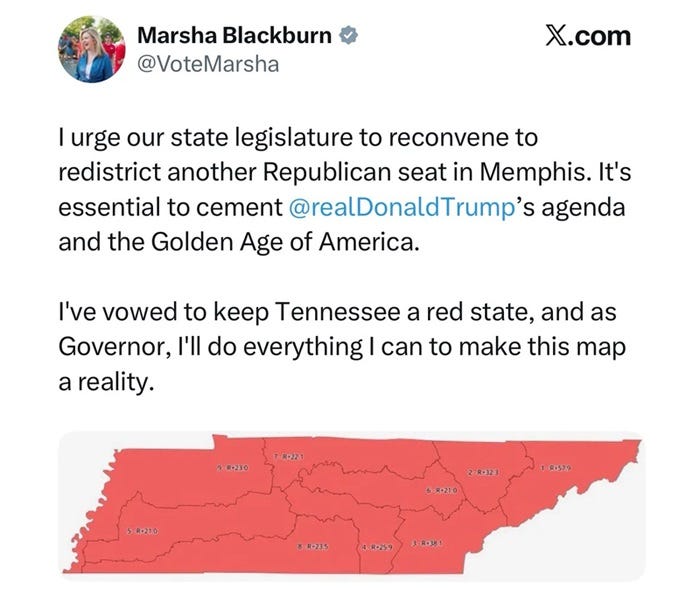
She appears to have misspelled “white” as “golden.”
In addition, Louisiana, the state where the case originated, immediately suspended its primary elections scheduled for May 16 — with early voting supposed to begin this weekend — insisting the Court’s decision meant it had to eradicate at least one majority-Black district before voting could go forward. After all the Court said it’s illegal now to let Black voters elect members of Congress, so what could the state do? And what will the state do? Are they redrawing the district RIGHT NOW, for this weekend? The case has been bouncing around the courts since 2022, and back in 2024, the Supremes even upheld that district, but Things Are Different Now, you understand.
Prefer a non-Substack subscription? The button below will take any amount of your choosing at Paypal — let us know if you want the newsletter subscription too! they’re separate! — or we have a Patreon too.
Catch Section-2
It’s worth noting, if only for your use on trivia night, that the VRA itself never set any such requirement to show intent. In fact, to reverse a 1980 Supreme Court finding, Congress explicitly updated Section 2 in 1982 to prohibit laws or district maps simply for having the effect of diminishing minority representation, whatever the “intent” may have been. If it’s discriminatory, then it shouldn’t be allowed. The majority opinion yesterday basically restored that 1980 decision’s insistence on intent — but when combined with the 2019 decision removing partisan gerrymanders from judicial review, it makes proving intent far harder.
It’s some catch: Red states can now argue that they’re drawing new district maps for the purpose of electing Republicans, not to wipe out Black or Latino representation, even if that’s the effect. In fact, the Alito opinion makes clear that since partisan gerrymanders are off-limits to the Court’s review, judges mustn’t risk interfering with them at all.
In her dissent (page 45 of the decision’s pdf), Justice Elena Kagan was moved very deeply by the absolute simplicity of this logic, and let out a respectful whistle, writing, “Today […] the majority straight-facedly holds that the Voting Rights Act must be brought low to make the world safe for partisan gerrymanders.” Alito presumably grinned and agreed, “It’s the best there is.”
Just How Bad Is It?
It’s every bit as bad as it looks, according to voting rights experts like UCLA Law professor Rick Hasen, who called the ruling a “disaster for American democracy” (Slate gift link). Hasen argues the decision is
the culmination of the life’s work of Chief Justice John Roberts and Samuel Alito, who have shown persistent resistance to the idea of the United States as a multiracial democracy, and a brazen willingness to reject Congress’ judgment that fair representation for minority voters sometimes requires race-conscious legislation. It gives the green light to further partisan gerrymandering. It protects Alito’s core constituency: aggrieved white Republican voters.
In fact, as a young Justice Department lawyer, John Roberts was given the assignment to lead the Reagan administration’s efforts to stop Congress from passing that 1982 revision to the VRA that eliminated the intent requirement. He failed then, and for the past 40 years minority voting rights have been protected. Roberts has to feel especially chuffed today, because yesterday’s ruling means he finally won.
And oh, what a legacy his war on the Voting Rights Act will leave! His 2013 decision in Shelby County v. Holder wiped away the VRA’s requirement that states with a history of discrimination must get preclearance for new voting laws, to make sure they weren’t discriminatory. Roberts explained that was really unfair and unnecessary in our enlightened times, because racism is a thing of the past. And to prove it, Republican-governed states in the wake of Shelby got right to work passing new voter-suppression laws that carefully didn’t mention race, so they were all just fine.
As Kagan wrote in dissent, the bastards really got what they wanted: “Today’s decision renders Section 2 all but a dead letter.”
She also dared to make a prediction about how well Republican-governed states will uphold the gains of the Civil Rights movement, since now everything is wonderful and color-blind:
I will be interested to see […] whether time will vindicate the majority’s view that the ‘great strides’ made in African American office-holding, ‘particularly in the South,’ will hold up after the issuance of this opinion,” she wrote. “My own guess is not.”
Again, please refer to Marsha Blackburn’s tweet earlier in this story.
As Nikole Hannah-Jones argued yesterday in a brilliant, enraging thread on Bluesky, this isn’t just about one case from Louisiana, it’s part of a far more wide-ranging effort to undo the last century or so:
We must understand the racist political rhetoric, the erasure and attacks on Black history, the reinstalling of Confederate names and monuments, all go hand-in-hand as the Court and Congress legitimize the taking of political rights and the end of multiracial democracy itself.
So much of modern rightwing GOP politics is an ongoing reaction to the Civil Rights Movement, and the bastards really do seem intent on repealing everything since Brown v. Board of Education as they can.
What’s Next?
The worst effects of the Callais decision are likely to come at points after this year’s midterms, if only because many states have already held their primaries or are holding right now. (Louisiana, of course, demonstrates that last-minute ratfucking is always an option). The decision could affect Florida’s brand new ratfucked redistricting, for starters. The Lege adopted a new partisan gerrymander Wednesday despite a state constitutional amendment banning partisan districts, but flunkies for Gov. Ron DeSantis insist the entire amendment is nullified because it included a separate provision protecting minority voting.
And as Hasen points out, while there’s time for states to get creative with congressional maps, the ruling “could also affect state and local elections, from school boards and city councils to state legislatures.”
An NPR analysis found that, beyond this year, “there are at least 15 House districts now at risk of elimination,” although it’s also possible Democratic states may retaliate in kind.
How the hell do we fix this? It’s going to be goddamn difficult, but keep in mind that Trump’s approval was already at an all-time low before this latest sledgehammer to multiracial democracy. There’s little reason to think Callais will endear him or his party to anyone who isn’t already part of the shrinking GOP base. As we keep noting, a lot of the newly drawn districts have such slim Republican majorities that an electorate sick of all the madness could overcome the unfair lines and vote the bastards out. More widely, people do not like having democracy taken away from them, and its possible the Court’s new extremism will spark an entirely new Civil Rights movement, complete with, finally, a mandate for serious Supreme Court reform that will keep this shit from happening again. That could take more than a few election cycles to build, but Americans really hate being bossed around by bullies.
We’re heading into even more dangerous waters than we were in just last week. But Americans are already primed to kick out Trump and his enablers. There’s nothing good about this Court decision, but it may also turn out to be the straw that breaks the Lion, Rhino, Camel’s back.


[Louisiana v. Callais decision / AP / Democracy Docket / NPR / Mother Jones / Slate (gift link)
Yr Wonkette is funded entirely by reader donations. If you can, please become a paid subscriber, or make a one-time (or recurring) donation with this here button.
Oh, and if anyone wants to play both sides on this shit, remind them that California and Virginia fucking asked voters if they should re-district. Red states just fucking do it.
That is the point...the reason why Taney Court 2.0 was enshrined. Republicans always know to vote for their champions because they have a long game. The elimination of Black electoral ability, and indeed of enfranchisement. Of course those goals are sympatico with their goals of disenfranchising women and sexual minorities.
And remember, Maladministration 2.0 is given its power because of the vast deference to the champions of the unreconstructed in the political and legal systems. Never forget, America's Pilonidal Cyst himself was not ever going to be subject to the plain text of the 14th Amendment. Because the purpose of the Constitution and the very organization of the United States is the suppression of those minorities who were imported and subjugated to build the wealthiest society that has ever existed.
It's important to preserve the racial hierarchy in order for this to work. And for this to work you need numerous unreconstructed state-based regimes of terror.
And that's why I have always said, you're not going to defeat America's Pilonidal Cyst in the courtroom. Even those with Ws against him do not see meaningful consequences or recompense. And there's always efforts to take even those meager consequences away, by more of those agents of deference to the unreconstructed.
The only way forward is to defeat him and his champions wherever they are. And it's going to be even harder but you have to try. If voting were not so powerful they wouldn't go to this extent to stop you from doing it. Think about that.
And Mount up!
Don't Give Up The Ship!