


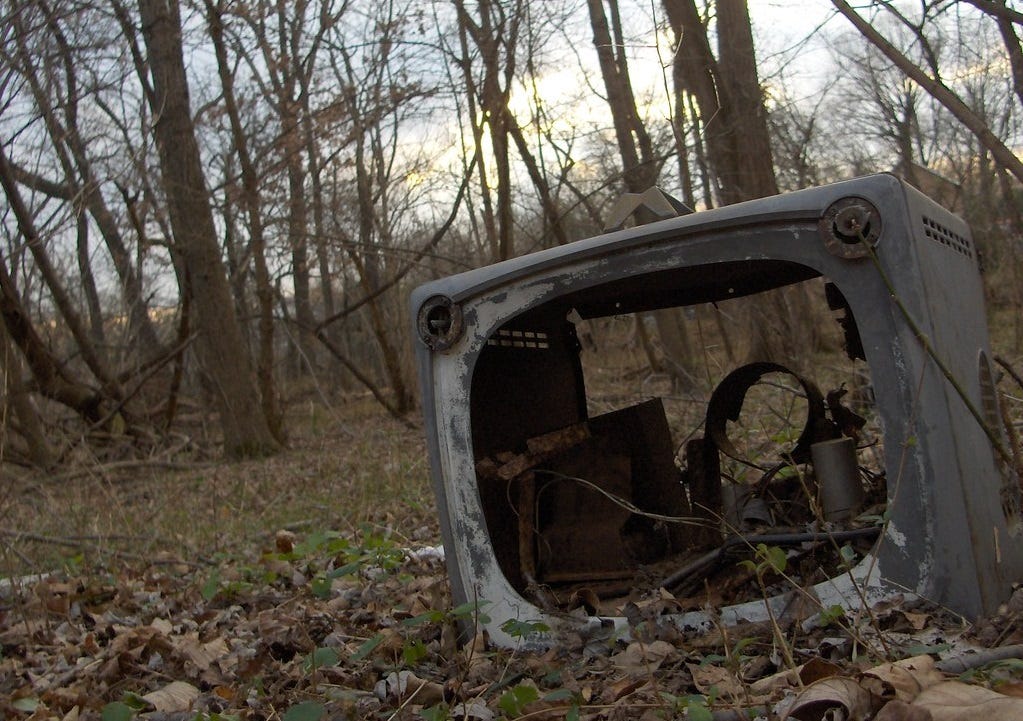
Voting in the dead of night, when so many crimes occur, the House of Representatives passed a $9.4 billion package of cuts to federal spending, most of which went to defunding almost all foreign aid, but also eliminating the $1.1 billion budget for the Corporation for Public Broadcasting (CPB) for the next two years. The vote brings to fruition the beloved dream of rightwingers to defund public TV and radio stations, which Republicans in Congress have hated forever.
The bill also eliminates most funding for foreign humanitarian aid, formalizing the huge cuts to foreign assistance Donald Trump and Elon Musk already made when Musk illegally closed the US Agency for International Development. An amendment in the Senate version of the rescissions bill restored $400 million in funding for the President’s Emergency Plan for AIDS Relief (PEPFAR), the GW Bush program that funded HIV/AIDS prevention in Africa and elsewhere. Whether the Trump administration will actually release the funds is anyone’s guess, now that Republicans all agree that the Constitution doesn’t matter and that congressional appropriations are merely a suggestion.
The funding cuts won’t necessarily murder National Public Radio and the Public Broadcasting Service, which have over the decades taken steps to insulate their funding from political attacks by building up funding from foundations and corporate giving so they’re less dependent on direct federal funding. But the thousands of local NPR and PBS affiliate stations rely on CPB funds for much of their budgets, and when the cuts go into effect in October, many smaller stations in rural areas will be hit hard. Eventually, without a new source of funds, many will go dark.
Bigger stations in cities are likely to be able to struggle through, though they’ll likely need to cut back on staff and programming, too. So the real outcome of Republicans’ win over Big Bird is that they’ll still be grinding their teeth hearing NPR’s “All Things Considered” in cities anyway, but many of their constituents will no longer be getting emergency weather alerts or local news, since in remote areas small public radio stations are the only local broadcast media.
Under the rules for rescissions bills, Republicans only needed a simple majority in the Senate to pass the bill after the White House requested the package of cuts, many of which the administration had been putting into place even without the vote, because Donald Trump is King now. So hey, look on the bright side: even if congressional Rs hadn’t fucked over public TV and radio stations, the executive branch probably would have done so by illegally withholding any funds that were passed.
For an excellent, detailed look at how public media funding works in practice, check out this January episode of WNYC’s "On the Media," which includes a profile of KYUK, a public radio station in Bethel, Alaska, that primarily serves Native Alaskan villages where there are no other local TV or radio, and where internet service is spotty to nonexistent. The network’s winter broadcasts, in English and Yup’ik, have literally saved lives as well as providing a community forum.
In an amendment to the Senate version of the bill, a small portion of funding — $9.4 million — was preserved to partially fund two dozen Native American radio stations around the country. But that won’t be CBP funding; instead, Sen. Mike Rounds (R-South Dakota) says he got an agreement from White House budget director Russell Vought to shift the money from the Interior Department. The side deal Rounds got — even if Vought honors it — wasn’t enough to win support from Sen. Lisa Murkowski (R-Alaska), who with Susan Collins of Maine voted against the Senate version of the rescission package.
However, the funding only helps radio stations run by tribes; other rural stations serving Native American audiences, including KYUK, are still going to have their budgets hammered.
“We aren’t tribally owned, so frankly, it’s unclear whether or not those potential funds could even benefit a station like KYUK,” said station manager Kristin Hall.
The funding secured for from another source is “not an apples-to-apples replacement for the funding for tribal stations,” said Hall. “Although it may support a small portion of us for a limited amount of time, with the limited details that I have, it doesn’t seem like a viable replacement for the entire network.”
KYUK is facing a $1.4 million cut, about 20 percent of its budget. Alaska Public Media president Ed Ulman said the statewide network would work with donors to help fill the budget hole for KYUK and other rural stations, but it won’t be easy. Hall pointed out that with a staff of around a dozen people, losing even one of them would be “devastating.”
Hall said her top priority in the face of the cuts will now be making sure the station can broadcast emergency alerts. In what was either a coincidence or an indication that tectonic plates have a grim sense of irony, a few hours before the Senate vote at 2 AM Thursday, a 7.3 magnitude earthquake in the Aleutian Islands triggered a tsunami warning, which was transmitted on public radio stations across coastal Alaska. The tsunami warning was soon cancelled, so really, who needs emergency alerts?
And that’s now going to be the situation faced by small public TV and radio stations around the country: scrambling to find donors and to decide what cuts can be made so they can stay on the air with at least minimal services for a year or three longer. Maybe some party that gives a shit will be elected and can reverse some of the damage.


[NPR / CNN / On the Media / Anchorage Daily News]
Yr Wonkette is funded entirely by reader donations. If you can, please become a paid subscriber, or if you’d like to make a one-time donation, this button won’t get you a tote bag, but it does keep us going!
Some families are really going to miss their babysitter in a box, PBS Kids has great programming.
"PBS Kids also offers free, self-paced lessons for students and teachers, along with educational games for students in K-2. It has offered such content for children for more than 50 years and is available in 98 percent of U.S. households.
PBS Kids says videos on its website average 13 million viewers, while its YouTube channel gets 34 million viewers per month. On average, 41 million games are played on its site each month. " https://thehill.com/homenews/education/5404646-trump-funding-cuts-pbs-cpb-rescissions-package/
Before I stopped working (outside of my basement troll sewing dungeon), I worked in public service jobs my entire working life. There were Boards. Every time the people elected a “reduce spending! Shrink the agency!” candidate, it would take months to a year for that member to learn that everything they thought was unnecessary, was quite necessary to and intertwined with the few things they did think important, and very inexpensive to boot. So they’d reluctantly stop their “reduce gov’t spending” crusade or they’d not get reelected because their idiotic cuts would kill the services the voters liked.
Every cut this government is making is the same. They have always imagined waste where there is none. They have always imagined that the complexity can be reduced if only those eggheads would stop butting in to what ought to be simple. They have always imagined that someone is getting away with something somewhere, no one could be acting in good faith, so there must be a grift, and why shouldn’t they get in on it?
None of it is true, and governing based on vibes and lies and oppression is a bad move. But I fear we are too far gone now to have all the nice things anymore in my lifetime.