

A new poll from KFF about Americans’ awareness of common disinformation about vaccines offers some reassuring news: While lots of us have heard the lies, like the claim that vaccines cause autism, only small percentages of us actually think they’re true. A clear majority of Americans rejects each of the four lies KFF asked about, with a solid 55 percent rejecting all four. Even so, roughly a third of those polled fell into a “mixed middle,” rejecting some of the false claims but granting some credence to others. (Yes, yes, we’ll identify the lies a few paragraphs down, hold your horses and give them ivermectin.)
Also, the nice nonpartisan health policy wonks at KFF use the term “myths” instead of lies, disinformation, codswallop, or fucking bullshit. Professional and all, but probably too kind. (The authors do clearly identify the lies as “false beliefs,” so that’s a plus.)
The poll also turned up some really interesting correlations: People who have a “relationship with a trusted health care provider” are far less likely to believe the bullshit than those who don’t, which sure sounds to us like another excellent reason for universal healthcare. Also, big surprise: People who use social media and AI chatbots like ChatGPT are more likely to believe anti-vaccine disinformation.
We won’t pretend to be surprised by either of those findings, but they really underline how important it is for people to be connected with reliable sources of information — about healthcare or anything else.
Antivaxxers would of course turn that around and insist the findings show that Big Medicine relies on keeping people propagandized with facts and expertise, and once folks free themselves from all that, they can finally cure everything with carrot juice, sunshine, and horse dewormers. (All at the low, low price of endangering their kids’ health.)
Prefer a non-Substack subscription? The button below will take any amount of your choosing at Paypal — let us know if you want the newsletter subscription too! they’re separate! — or we have a Patreon too.
Now, about the lies themselves. The KFF poll found that lots of American adults have heard of four false claims about vaccines, although we were a little surprised that only one of them was known to a majority of respondents: 66 percent of people said they had heard the false claim that “the measles, mumps, and rubella (MMR) vaccines have been proven to cause autism in children.” Fewer than half of folks were familiar with the other three lies, which are
that more people have died from the COVID-19 vaccines than the virus (46%), that mRNA vaccines can alter DNA (36%), or that measles vaccines are more dangerous than measles itself (29%).
That seems encouraging, especially with the nation’s public health system being run by Bobby Brainworms. KFF has been doing the tracking poll since June of 2023, and in that time, the percentages of people who’ve heard of the various lies has remained largely consistent, with some slight variations — familiarity with the notion that mRNA vaccines can alter your DNA has “dropped by 9 percentage points since April 2025 (from 45% to 36%)” for instance.
The responses suggest that while vaccine myths have remarkable staying power once they spread, only a tiny minority of Americans believe they’re “definitely true,” and a somewhat larger minority saying they’re “probably” true — and those numbers remain fairly consistent over time.
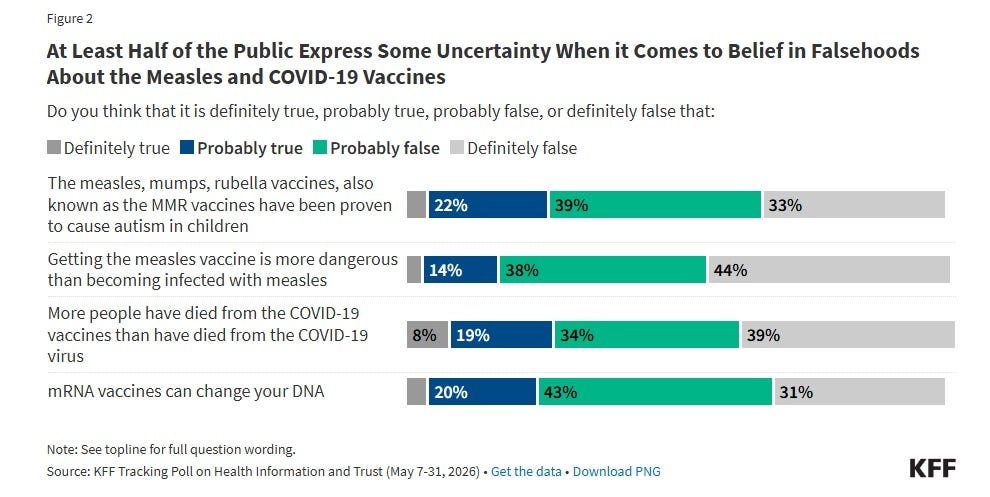
The tracking poll indicates that over time, roughly half of total respondents fall into what authors call the “malleable middle” for each question, saying the myth is “probably” true or false, which KFF says indicates “uncertainty” about the validity of the claim.
Fair enough; ideally everyone would recognize that a lie is definitely false. The encouraging thing to me is that for years now, the percentage of people who think the myths are “probably true” has been vastly outnumbered by those who say they’re “probably false.” That’s some healthy skepticism of foolishness, and let’s hope it continues now that the people actually setting US health policy are in the anti-vaxxer camp.
For our money, the poll’s most significant finding is the linkage between not having a trusted healthcare provider and the openness to believing vaccine myths.
For example, among adults who say they do not have a doctor or health care provider they trust to answer questions about their health (16% of all adults), nearly half (46%) say it is either “definitely” or “probably true” that more people have died from COVID-19 vaccines than from the COVID-19 virus, compared to a quarter (24%) among those who say they have a trusted health care provider.
The study also points out that folks who say they don’t have a healthcare provider to answer questions about vaccines tend to be uninsured. But it cautions that lack of access to healthcare may not be the only reason, since not having a provider could be more related to not trusting doctors and the healthcare system in general.
Similarly, the finding that people who rely on social media or AI chatbots are more prone to believe antivaxxer claims is concerning, especially since the more frequently people use either source for health “information,” the more likely they are to believe the myths. For both those situations, it’s a small but significant chunk of the population: 26 percent of adults say they use social media at least weekly for health information or advice, while 20 percent seek health information weekly from AI chatbots. And here too, the correlation between relying on those sources and believing in crap is significant, although it can be small for some of the myths, and thank Crom most people know better.
In other findings, the poll shows that parents who skip or delay their children’s vaccines are about twice as likely to endorse antivax lies, which is depressing but not terribly surprising, and that among the “mixed middle” — the almost-third of people who reject some vaccine myths but accept others — Republicans and people without college degrees are more likely to have those murky vaccine beliefs, as are about a third of Black respondents and about 40 percent of Hispanics. KFF notes that its findings “suggest these groups who disproportionately fall in the “mixed middle” may be an important focus for those looking to counter vaccine misinformation and dispel confusion.” OK, but good luck trying to dispel myths among Republicans, amirite?
The poll also makes a persuasive case for keeping the hell away from social media and AI chatbots, but yeesh, we already knew that, the end.


[KFF poll / KFF press release]
Yr Wonkette is funded entirely by reader donations. If you can, please become a paid subscriber, or if you’d like to make a one-time (or recurring) donation, you can click this here button.
Nothing like killing your own voting base. A few years ago during the height of Covid, those red state Covid deaths were said to have actually made a difference in a few elections. They say their higher birthrates can make up for their anti-health policies; maybe, maybe not.
Almost seems like a plan.
But, nya.
Their last vinyl solution (reflecting pool) never worked either . . .