


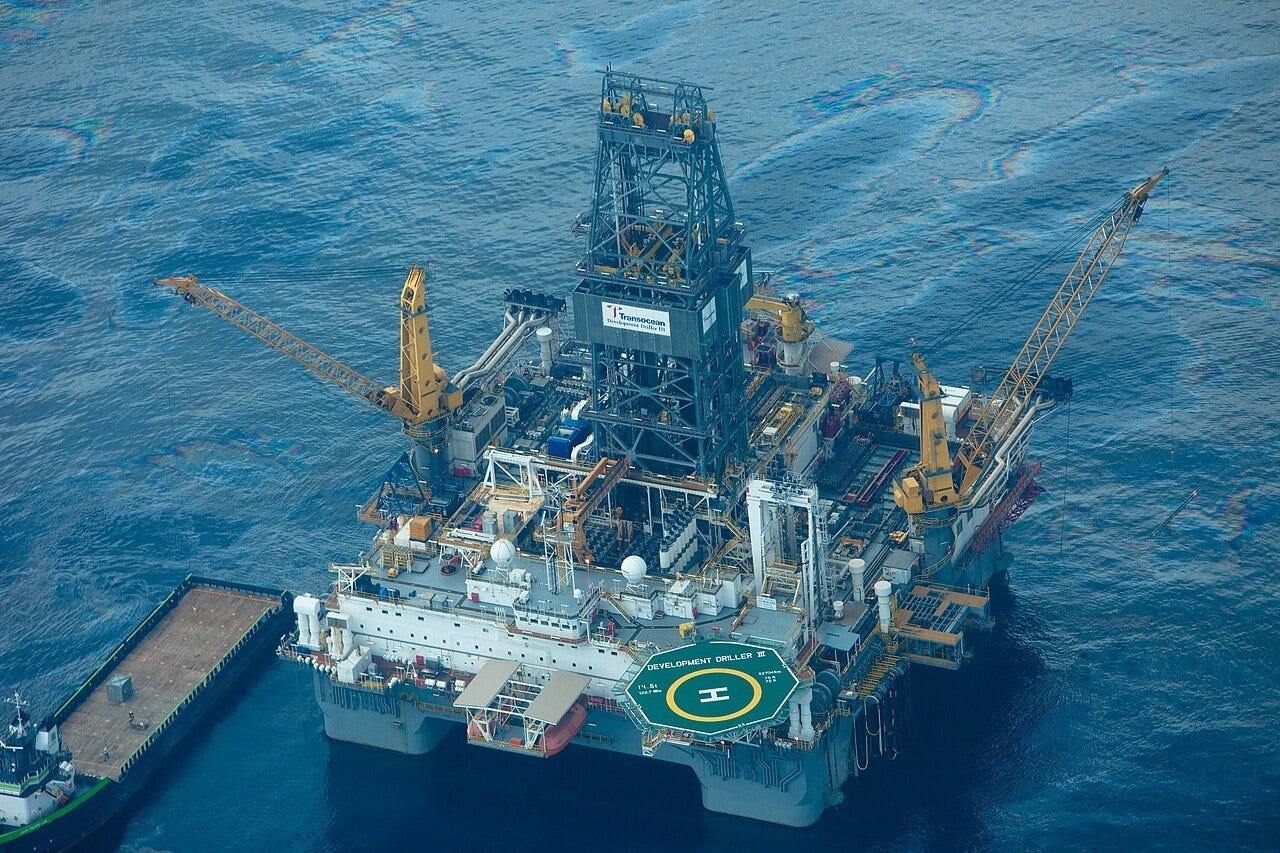
In a seriously weird legal maneuver — as if any part of the law these days can be called normal — Defense Secretary Pete Hegseth is invoking “national security” as an excuse to let oil companies kill off endangered whales in the Gulf of Mexico. The administration wants to broadly exempt oil companies from complying with the Endangered Species Act (ESA) across the Gulf, and called a meeting of the Endangered Species Committee, sometimes called the “God Squad” because its officials can grant such exemptions. Just a little “power of life and death” joke there.
If the policy change holds, it would mean oil and gas companies wouldn’t have to take harm to marine life, even threatened and endangered species, into account at all. That would apply not just to new exploration or drilling operations, but all their operations in the Gulf.
That meeting is set for next Tuesday, March 31, and a group of four environmental groups have filed a lawsuit seeking to force the government to abide by the terms of the ESA. The complaint asks a federal court to put that meeting on hold while the suit goes forward.
And here’s the kicker: As with so many things in the Trump era, the Defense Department’s role in trying to let oil companies run rampant only came to light because of the lawsuit. When the environmental groups sued, they only knew that a meeting of the “God Squad” had been called to wipe away endangered species protections, but not what agency was behind the request. Hegseth’s involvement and the “national security” claim only became clear when it was revealed in the Interior Department’s filing in response to the lawsuit.
In that filing, federal lawyers explain, “Secretary of War notified the Secretary of the Interior that the Secretary of War found it necessary for reasons of national security to exempt from the ESA’s requirements all Gulf of America oil and gas exploration and development activities,” although the filing doesn’t say what those “national security” reasons are. Those reasons are probably secret, for national security.
The government’s filing also helpfully notes that the Endangered Species Act has a convenient escape clause built right into it, stating that the “Committee shall grant an exemption for any agency action if the Secretary of [War] finds that such exemption is necessary for reasons of national security.” We like how the filing uses brackets to skip past the real name of Pete Hegseth’s job. Since the Endangered Species Act passed in 1973, no Defense secretary has actually invoked “national security” to create such an exemption. Honestly, we’d love to see a judge refuse to accept any court filings that fail to get the title right.
Oh, and before we get to the whales and other details, here’s more darkly amusing trivia: The plaintiffs’ complaint refers to the body of water as the “Gulf of Mexico” (frequently shortening that to just “the Gulf”), while the Interior Department’s response petulantly calls it the “Gulf of America.”
The case is a little complicated, because it involves a bunch of different agencies, laws, and regulatory arcana, and the acronyms related to each. The larger issue is whether the government can throw away the Endangered Species Act protections to let oil companies do anything they want in the Gulf, using the ESA’s “national security” clause as a Get Out Of Behaving Legally card. And it’s likely that question will be central to the case as it moves forward.
As Brett Hartl of the Center for Biological Diversity, one of the four groups suing to block the new policy, said in a statement, “Hegseth is illegally perverting a narrow, pressure-release mechanism within the Endangered Species Act by asserting he can essentially suspend the law whenever he wants.”
But many of the particulars in the case — particularly as the environmental groups frame it in their complaint — come down to protections for one endangered species in particular, “Rice’s whales,” which live exclusively in the Gulf and are the most critically endangered whale species in America.
The whales aren’t the only sea creatures that will be harmed if the government strips away Endangered Species Act protections in the Gulf; sperm whales, Gulf sturgeon, multiple sea turtle species, and many other critters would be at higher risk, too. But the whales face the most immediate risk of extinction, in large part because they were already threatened in 2010 when BP’s Deepwater Horizon reduced the population to about 50 animals today.
Even when it comes to the whales, while they face a number of threats including climate change and the risk of another Deepwater Horizon-scale oil spill, the lawsuit notes that the most direct threat would come from rolling back a really simple protection currently in place: keeping them safe from being hit and fatally injured by ships.
The government, through a National Marine Fisheries Service (NMSF) assessment, claims it has a real good plan to reduce such “vessel strikes” to zero, but the complaint points out (p. 23) that the government’s plan “offered no reasoned analysis for that assertion,” that much of it is “is based on technology that does not yet exist,” and that the proposal “consists of little more than a plan to make a plan,” which sure sounds familiar to us. Damningly, the proposal ignores a simple fact that the NMFS has “previously and repeatedly determined” that the most effective way to reduce fatal collisions with whales is to limit vessel speeds.
But that means going slow and being careful, and considering all the ship traffic necessary not only for new oil exploration but also for servicing the rigs already operating in the Gulf, slowing down is very inconvenient and costly for oil extraction companies.
As the Center for Biological Diversity points out, letting ships go as fast as they can in the Gulf would also create danger for other species like sea turtles and sperm whales, but the most direct threat would be to the Rice’s whales. The Sierra Club points to previous findings by the Fisheries Service (under sane administrations of both parties) that “losing even a single breeding female could collapse the population.” Seems like a shame to kill off an entire species — potentially the first time humans will cause the extinction of a great whale species — just to let ships move around the Gulf at higher speeds.
As we say, the exemption would potentially harm many other species, and about other threats to the whales. But in the specifics, it comes down to killing whales so oil companies can make ships go faster. It’s a very real threat, unlike Trump’s weird lie that offshore wind turbines somehow “make the whales go crazy.”
But now that the government is pushing the “national defense” argument, it’s very possible that issue will short-circuit any discussion of the whales, or will have to be decided before the rest of the case moves forward.
Speaking of whales, the Gulf, and oil, remember that time when rightwing idiots seriously argued it would be smart to use a nuclear bomb to try to shut off the 2010 Deepwater Horizon leak? Now, in the pursuit of oil company profits, Pete Hegseth may really have a chance to nuke the whales.
We’ll close on a happier note, though: France 24 reported Friday on a new scientific paper about how a pod of sperm whales in the Caribbean were observed in 2023 helping one of the pod’s members give birth. The 19-year-old whale, named Rounder by scientists, was supported during her labor by her grandmother, and by other whales in the pod, including whales not related to her.
"This is the first evidence of birth assistance in non-primates," Project CETI team member Shane Gero told the New Scientist.
"It is fascinating to see the intergenerational support from the grandmother to her labouring daughter, and the support from the other, unrelated females."
Once the calf was born, the other whales surrounded and nosed it up to the surface to make sure it could breathe in the first minutes after it was born. (Baby sperm whales need a few hours to learn to swim).
All the adults were “squeezing the newborn's body between theirs, touching it with their heads”, the researchers wrote.
The whales pointed their noses towards the newborn, “pushing it around, under the water, and onto and across their bodies above the surface”,
Video of the birth and the whales surrounding the newborn was released not long after, but the publication of the paper has the story back in the news. Keep in mind that every last one of the marine mammals in this video is kinder and more empathetic that Pete Hegseth:
Go, whales.

But What If We Could Vaccinate Against Windmill Cancer? What If We Painted The Wind Turbines Gold?

[NOTUS (free, but email address needed to read) / Sierra Club / Sierra Club v. NMFS complaint / Interior Department response / Center for Biological Diversity / KTAL / France 24]
Yr Wonkette is funded entirely by reader donations. If you can, please become a paid subscriber, or make a one-time (or recurring) donation with this here button. Maybe it’ll save a whale, or at least some of your brain cells.
I am watching the birth of that precious new calf whale so gently attended into the world by other loving, devoted members of that pod and my eyes are leaking again.
Matriarchal societies keep trying to show us how this is supposed to be done and we're NOT paying attention.
I'm still waiting for someone in the Pentagon to frag this guy....