


On Thursday, Axios released a poll that found that a majority of Americans do not believe that the policies of Donald Trump and Health and Human Services Secretary Robert F. Kennedy Jr. have made America healthy. In fact, only 42 percent of Republicans said that they believed this.
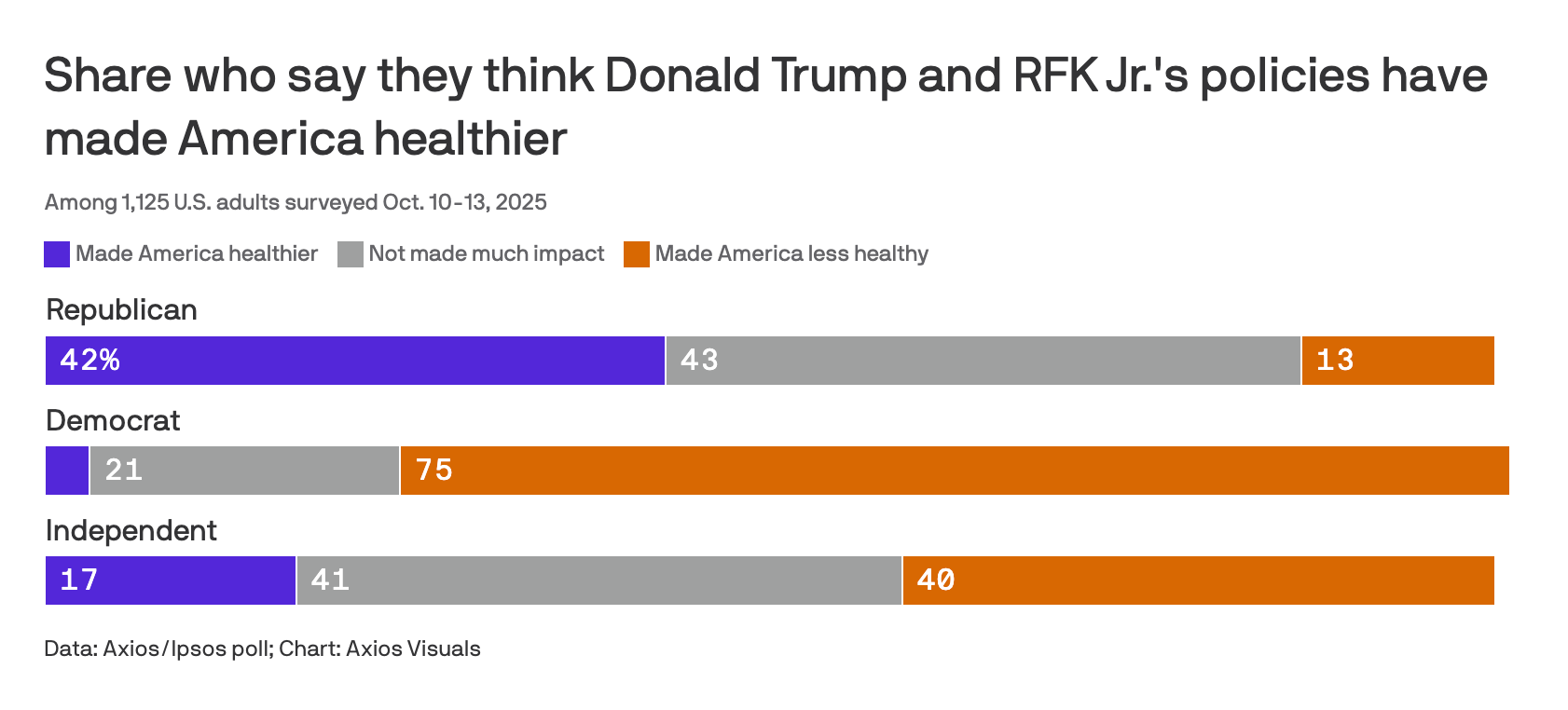
The survey also found that trust in health agencies has declined, which is interesting if only for the fact that Kennedy and others keep talking about how their goal is to restore the trust that was broken during the pandemic, on account of all of the people who decided to trust weird conspiracy theorists instead.
Clearly it hasn’t worked all that well, as only 19 percent of Americans believe his new line about Tylenol causing autism. But perhaps a rant about teen sperm might change their minds? Anything is possible!
On Thursday, during an announcement about the administration’s concept-of-a-plan to make IVF more affordable (not free, as Trump had promised on the campaign trail) Kennedy took a moment for himself to go on a bizarre rant about teenage sperms.
“Today, the average teenager in this country has 50 percent of the sperm count, 50 percent of the testosterone as a 65-year-old man,” he said. “Our girls are hitting puberty six years earlier, and that’s bad, but also our parents aren’t having children.”
Is this true? It is not! Parents are definitely having children, as this is what makes them parents in the first place (other than adoption, obviously). Teenage boys do not have “half the testosterone of a 65-year-old man,” and the idea that they might is entirely preposterous, as testosterone declines with age. It’s just not true. It is true that testosterone levels are decreasing — on average, young men today have less of it than the average 65-year-old man would have had as a teenager, and the average 65-year-old man has less than a man that age would have had several decades ago as well. We don’t know exactly why that is, yet, and it could likely be attributable to lifestyle factors, like the fact that people are simply more sedentary than they once were.
Perhaps ironically, given Kennedy’s assertions here, men who get married and become fathers have, on average, lower testosterone levels than those who do not. This comports with a theory proposed by evolutionary biologists that testosterone has decreased as cooperation has become more important to survival than combat, and as women have purposely avoided selecting “hugely dominant, aggressive males” as mates. You know, because we don’t want them to murder us.
Whether or not sperm counts are decreasing is a matter of some debate. In 2017, researchers put out a highly publicised meta-analysis of sperm count-related studies that came to the conclusion that sperm counts were decreasing over time. This is likely what he was referring to, although there is no study anywhere making the claim that teenagers have sperm counts 50 percent lower than 65-year-old men. However, many studies since then have found that this was not true, that the meta-analysis was flawed and that there were other, more likely, explanations for what those researchers found — such as the fact that we are more able to accurately count sperm than we were 50 years ago.
Additionally, the decreases in the meta-analysis all still fell within the “normal” range of sperm count and most scientists do not actually believe there is a relation between sperm count and fertility.
“Doubling your sperm count from 25 to 50 million doesn’t double your chances,” Allan Pacey, an andrologist at the University of Sheffield and the editor of Human Fertility, told The New York Times in 2021. “Doubling it from 100 to 200 million doesn’t double your chances — in fact it flattens off, if anything. So this relationship between sperm count and fertility is weak.”
So that’s the menfolk. What about the girls? The girls who are going through puberty six years earlier?!?!
Also not a thing. On average, girls today now get their periods six months earlier than girls in the 1950s and ‘60s did. That is very, very different from six years. Six years would be six or seven years old, which would count as precocious puberty. Actually, puberty in general starts around eight for girls and nine for boys, meaning that by Kennedy’s metrics, girls would be starting puberty at age two.
Scientists have found that the incidence of precocious puberty has increased somewhat over the years, but it’s been around for quite a while. In fact, that’s actually how we know that puberty blockers are, contrary to what transphobes will tell you, safe to use — they’ve been used since the early 1980s to treat precocious puberty.
This is far from the first time that Kennedy has made these claims, and the fact that he either hasn’t been corrected or has been corrected and ignored that correction is … well, it’s not great. But what can we expect from a man whose mantra this whole time has been “stop trusting experts”?
PREVIOUSLY ON WONKETTE!


So we’ve reached the “precious bodily fluids” stage of this idiocy now, have we?
Imagine being a Kennedy and worrying that people are shooting blanks.