



We are coming to a pretty difficult point in the economic history of our country. On the one hand, you have Republicans pushing for work requirements for public assistance programs at a time when people are really struggling to find work, claiming that every draconian measure they want to take is for our own good, to motivate people to work harder, which is the most important thing in the world.
On the second hand, you have tech oligarchs endlessly gushing about how we’re all going to lose our jobs to robots in a few short years, as if we’re all supposed to be very excited about it as well. I guess it doesn’t occur to billionaires that there are people out there who need to work in order to make their rent.
Of course, you won’t be able to pay for those goods and services if you don’t have a job.
Now, I believe that the AI freaks are vastly overstating what AI is capable of doing and what people will accept it doing for them. I don’t think most people really want to watch AI movies with stolen faces or read books “written” by AI with stolen words. I also don’t think they want to go out to restaurants or stores where no one is working. Sure, people have gotten a lot more militantly introverted over the last decade (I blame Thought Catalog), but that just seems lonely and depressing as hell. Not too many people actually want to be that Twilight Zone guy who got his wish to be left alone to read all of the books that were somehow spared and placed into neat little piles everywhere, and then ended up breaking his glasses with no one to fix them.

But I digress. If the plan is for these robots to take over all of the jobs in between C-level executives and hard manual labor, then what is everyone else supposed to do? Especially in a society so fixated on the idea that no one should get anything without putting in some very hard work (unless they were born into wealth, in which case they definitely shouldn’t have to pay taxes on their millions and/or billions).
It is entirely irresponsible to not at least start talking about how we take care of ourselves, as a nation, should the robots take all of our jobs, and start building a country that can withstand such a change. Thankfully, Bernie Sanders and the Senate Health, Education, Labor and Pensions Committee (HELP Committee) minority staff have some very good ideas about how to ensure that, if that’s going to happen, workers benefit alongside executives and owners.
Sanders issued a report this week highlighting the number of job losses we stand to face over the next decade, as well as Trump’s zeal to move us into that future as quickly as possible by deregulating the technology entirely and trying to ban individual states from doing so.
For instance:
The Trump administration has already partnered with Google, OpenAI, and Anthropic to set the table for a large-scale replacement of federal workers with AI. In July, the Defense Department entered into $200 million contracts with leading AI firms “to develop agentic AI workflows across a variety of mission areas.” 82 Most recently, the Trump administration partnered with xAI, owned by Elon Musk, to integrate the AI chatbot “Grok” into the federal government.83 This is the same chatbot that earlier this year referred to itself as “MechaHitler” and will now be entrusted with sensitive government data.
What could possibly go wrong with that?
Thankfully, they also have solutions — the biggest of which would be a Robot Tax. Not a tax for robots to pay once they become our sentient mechanical overlords, but a tax for companies who use them to pay.
“Instead of providing hundreds of billions of dollars in additional tax breaks to expand automation—as the Trump’s One Big Beautiful Bill Act does—we should instead enact a robot tax on large corporations and use the revenue to benefit workers harmed by AI,” the report read.
AI businesses are already marketing their products to executives as something that will save them money on labor costs, as the report notes.
AI companies acknowledge their goal is to make it easier to pay workers less.
Salesforce, a technology services firm for businesses, says it is “pioneering a new kind of workforce” with the “first digital labor” platform and that its agents can “lower costs.”
Mechanize, a startup aiming to create artificial labor, notes on its website that “the market potential here is absurdly large” and points to the total income earned by workers.
Artisan, another AI company, is advertising its services to get companies to “stop hiring humans.”
Self-driving truck companies are especially clear. Kodiak says it aims to “address challenges with driver recruitment” including “high labor costs.” Gatik says its transportation model “lowers transportation costs.” Aurora says it can “reduce customers’ driver costs by ~24-40%” while noting driverless trucking means “no workers compensation” and “no ongoing driver training.”
It stands to reason and basic fairness that if the executives and stockholders are going to make huge amounts of profit off of these robots taking over human jobs, that they should have to share that with the workers who will no longer have jobs because of this fabulous cost-saving measure.
Additionally, making it just as expensive (or even more) to hire robots over people may deter executives from giving those jobs away.
The Committee staff also (ironically?) asked ChatGPT about which jobs would be the most likely to be replaced by AI in the near future. And it’s a lot of them.
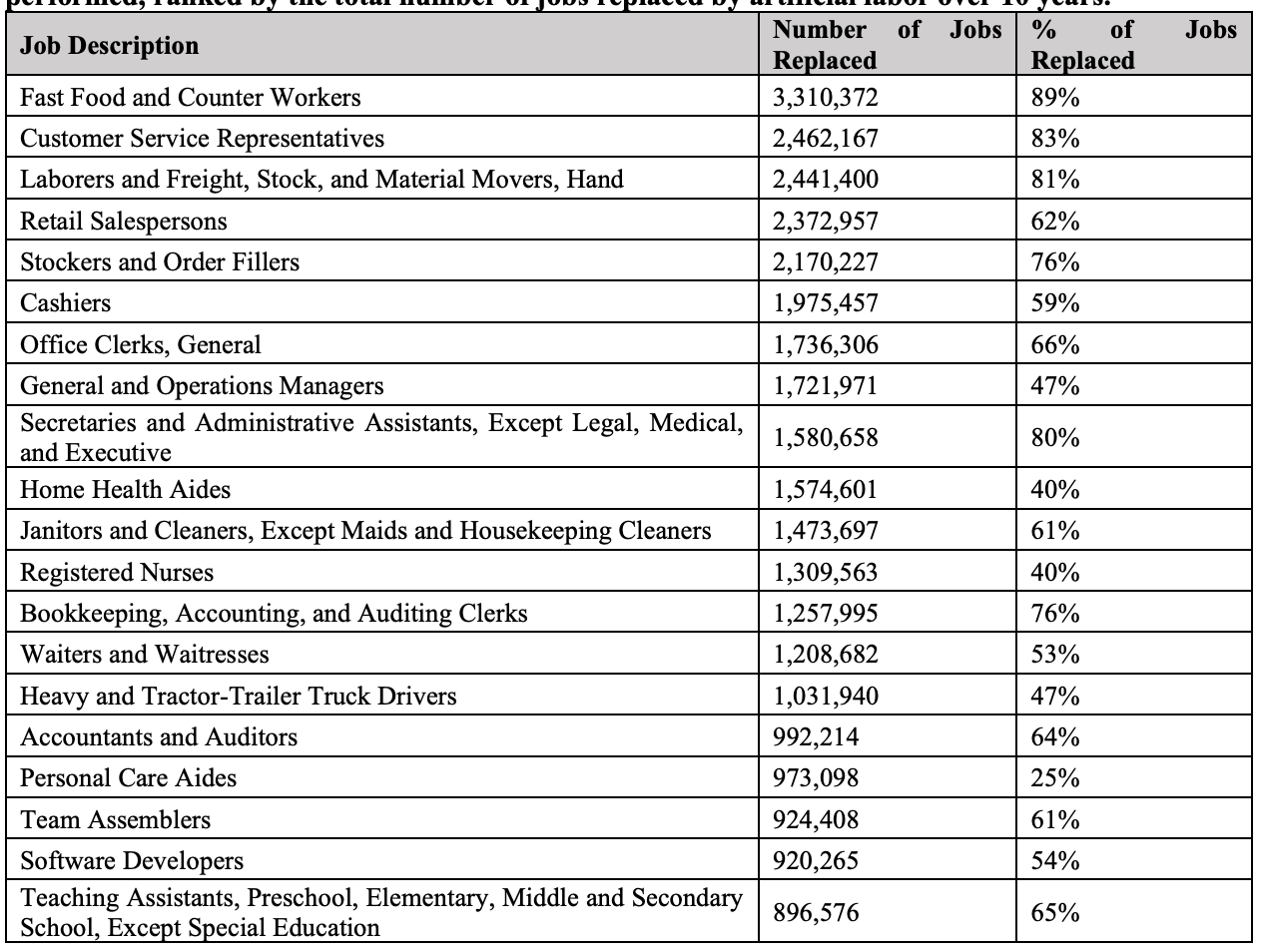
That is at least 30 million people who will be out of a job, and who will probably have a pretty hard time finding another to replace it. That is five times as many people who are unemployed right now. We cannot be a functioning society with that many people out of work with no food, no money, no home, no car, no health care.
In addition to the robot tax, Sanders and the HELP staff recommend measures like moving to a 32-hour work week with no loss in pay, requiring large corporations to distribute 20 percent of their stock to workers, requiring that workers should be at least 45 percent of any corporate board, providing financial assistance to those who want to establish or become an employee-owned business, doubling union membership in order to protect workers, guaranteeing paid family and medical leave, bringing back defined benefit pensions to guarantee workers a weekly income other than social security once they retire, and, of course, banning stock buybacks.
The logistics, certainly, are something that would need to be worked out, especially with regard to any robot tax. We’d need to define “robot” and to figure out a mechanism for taxing them, and how that money would be used to take care of workers. The report doesn’t say, exactly, but one would assume the robot tax would be meant to provide some kind of Universal Basic Income to those for whom we no longer have employment.
Given who we have in charge of everything right now, these things sound like impossible, pie-in-the-sky asks. But so far, it seems like the only plan Republicans have is for people to work in fields and factories until they die (because it’s gonna be even harder to afford Social Security with only a small percentage of the nation being able to work), which doesn’t sound like a very good time for anyone but the very, very wealthy.
While not all of the measures are directly related to protecting workers from the robots who are coming for their jobs, they are necessary to creating a society that cares for its people (as much of a long way off as that may seem right now) and the infrastructure to accommodate the future as it comes. We need to let the people know which side it is that wants to do these things and who will be willing and able to figure out solutions to any job loss that the coming AI-pocalypse might cause.
PREVIOUSLY ON WONKETTE!


A consumer economy where almost no one has money to consume. Fucking brilliant.
Step 1: Establish a consumer economy.
Step 2: Do everything you can to impoverish said consumers.
Step 3: ???
Step 4: PROFIT!