


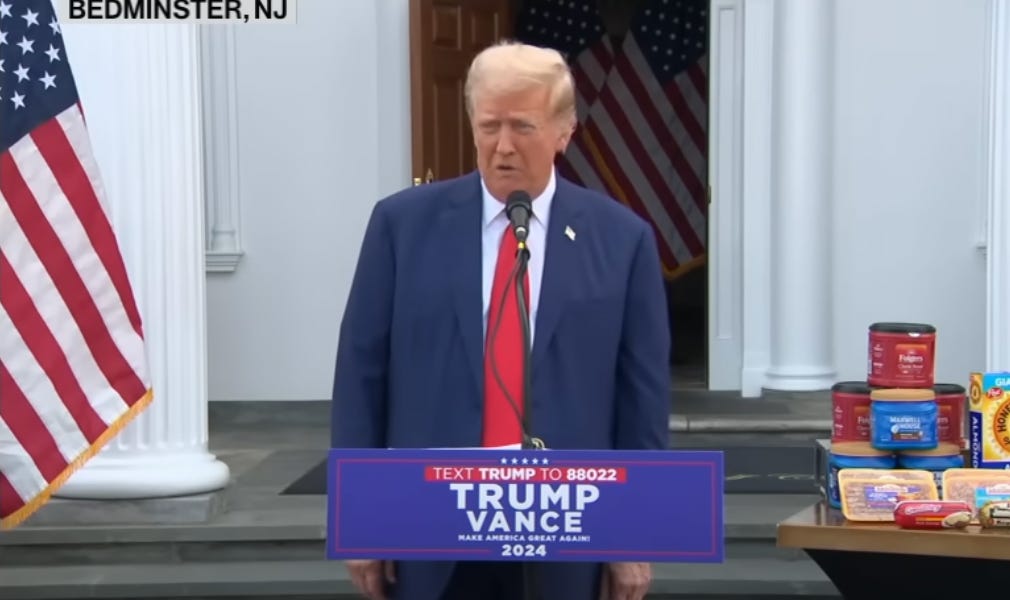
Speaking to the press in front of some breakfast foods and his Bedminster, New Jersey, golf club — which he’s apparently tarted up to look like the White House — Donald Trump warned that by electing Kamala Harris president, Americans might end up with universal healthcare, just like they have in every other civilized country on earth.
“She cosponsored legislation to abolish very popular private health insurance, which 150 Americans [yes, he said 150 Americans] rely on,” he said, “dumping everyone onto inferior socialist government-run health care systems with rationing and deadly wait times, while massively raising your taxes. She wants to take away your private health care.”
Now, first of all — that is just insulting and rude to our nation’s private health insurance companies. One of the main features of our healthcare system is that we actually have far longer wait times than countries where “everyone has healthcare.” We also don’t track wait times for most things as well because we happen to like a little mystery, okay? And just think of how long the wait times are for people who don’t get to have any healthcare at all!
Second, we have rationing as well. The whole reason people like Trump believe we have shorter wait times in the first place is because not everyone has healthcare. We ration based on money rather than need. In fact, so many doctors have switched to offering concierge services to rich patients only and have given up on offering regular healthcare to regular patients that it’s actually becoming a problem.
America!
“There are many people in this country who spend a lot of money on private health care,” he continued (fact check true). “It's the best healthcare in the world by the way (fact check false), but they want to do it, they worked hard to make money and they want to do it.”
I’ll give him that one. I’ve literally been arguing for single payer since elementary school. No one overstands more than I do how much people in this country really do love paying lots and lots of money to private health insurance companies who then take that money to pay people to figure out how to not give it back to them.
“Under her,” he said, “you're not going to have private health care plans anymore and you can be a wealthy person or a middle income person and you want to spend on a real good plan better than a government plan could be far better and you're not going to be allowed.”
It has never actually been clear to me what would actually be better than all healthcare being automatically covered and free at the point of service but, I will say, people very much do prefer the idea of having “choice” over what’s covered versus just having everything covered. Although, actually, most people don’t actually get to choose their plan and instead just get whatever their employer gets, but it’s fun to play pretend, no?
“You're all going to be thrown into a communist system it's a communist system you're going to be thrown into a system where everybody gets health care. You wait for your doctor like 10 months, 12 months, 11 months. You got to see some of these plans how they work in other countries, it's disgraceful.”
I have, and it’s actually pretty amazing — but again, this is very much not true and we have much longer wait times than many countries that have universal healthcare. Also, only a sociopath’s answer to the problem of “long wait times” would be “so some people just shouldn’t have any healthcare at all” rather than “how about we just teach and train more doctors and also stop charging people to go to medical school entirely, especially while we have a doctor shortage.”
But hey, that, too would be communism. Like in Cuba, where not only do they have no wait times, they have so many doctors that they regularly send doctors abroad to other countries that need doctors.
And who would want that?
“So private health care is gone, she wants it out now,” he said. “She could change on that and she might change on that she's changed on everything. But I said ‘why are you changing?’ I actually was asking somebody that knows her why is she changing. She had these policies and ideas for years and years and years and was very solid on them. All you have to do is go back and look at your tapes, which many have been discarded because they don't want — discarded by the fake news because they don't want people to see what she said.”
Actually … as much as some of us might like her to, Harris very much does not support single payer Medicare for All, and despite cosponsoring some legislation (along with a number of other senators who didn’t actually support it), has never been a strong advocate for it.
What would universal care look like? Nebraska senator Kerrey and others have advocated a version of the Canadian-style, single-payer system in which all payments for medical care are made to a single agency (as opposed to the large number of HMOs and insurance companies, with their diverse rules, claim forms, and déductibles ).
A recent study done by the Massachusetts Medical Society says that in Massachusetts the single-payer plan would save $5 billion or about one-seventh of the overhead spent on medical care. Administrative costs across America make up 25 percent of the healthcare dollar, which is two-and-a-half times the cost of healthcare administration in Canada. Doctors might be paid less than they are now, as is the case in Canada, but they would be able to treat more patients because of the reduction in their paperwork.
The Canadian plan also helps Canadians live longer and healthier than Americans. There are fewer medical lawsuits, less loss of labor to sickness, and lower costs to companies paying for the medical care of their employees. If the program were in place in Massachusetts in 1999 it would have reduced administrative costs by $ 2.5 million. We need, as a nation, to reexamine the single-payer plan, as many individual states are doing.
Guess where that is from? Guess! Okay, don’t guess — it is from a book titled The America We Deserve, “written” by one Donald Trump, in the year 2000, and it is remarkably correct. Startlingly correct, really.
Whoops!
Again, when I was in my 20s and had total kidney failure, my mom's insurance kept trying to deny the coverage of dialysis treatments on the grounds that I did not actually exist.
No really, they claimed I wasn't a real person so they wouldn't pay the money. At one point my mom told them she would gladly pay for a plane ticket for me to show up in person at their corporate headquarters, followed by a lawsuit.
They made the payments.
We have the private insurance nightmare in this country because there's a lot of money to be made insuring healthy people.
But, I've always had a spare, grim chuckle for the ironies of how we ended up with this service model in the first place.
To prevent inflation from eroding the value of the precious national capital expended to prosecute World War II, Congress and FDR instituted wage controls. Kaiser Steel needed more and better workers, but couldn't offer more pay because of the controls. Hank Kaiser asked the feds, could I sweeten the pot by letting workers see factory doctors and nurses for more than injuries? US said sure. Kaiser married health care to employment.
The war ends with Allied victory. Do-Nothing Republican Congress refuses Truman's totally practical national health care plan. By mid-century, Kaiser's factory doctor's offices have become entire systems of doctors and hospitals. In 1961, a washed-up 1940s actor is hired by the American Medical Association to give speeches criticizing "socialized medicine." The actor, a fellow named Ronald Reagan, cuts the speech as a long-playing vinyl record. On it, he intones: "Pretty soon your son won't decide when he's in school, where he will go or what he will do for a living. He will wait for the government to tell him."
American manufacturing employment peaks in the mid-1960s. During the Great Society Era, there's enough of federal revenue surplus that powerful Ways & Means Chairman Wilbur Mills (when not wrestling a burlesque artist in DC's Tidal Basin) and LBJ (when not inventing military confrontations in the Gulf of Tonkin) pass a stripped down version of Truman's health coverage plan. It only applies only to the elderly.
Meanwhile, economic royalists the Koch Brothers invite "Austrian School" economist Friedrich Hayek to return to the United States to work for their new right-wing political organization. (They were big fans of Hayek's "The Road to Serfdom," a polemic warning that Western European social democracy will lead to governments that decide where people go, what students will study and what workers will do for a living.)
Hayek politely declines, citing his age and failing health, and noting that the United States does not, unlike Austria, provide socially-insured health care. He explains that he would lose his if he moved back to the States. The Kochs send Hayek a Medicare brochure. Hayek elects to remain at the University of Salzburg.
Deindustrialization begins, accelerating through the 1970s and going into a flat-out run in the 1980s. As just one example, the Lackawanna Works of Bethlehem Steel, one of the largest full-run (ore to finished goods) mills on the planet, is essentially shuttered in a day, putting tens of thousands of people out of work, bankrupting its home city and leaving square miles of decaying buildings and utterly polluted brownfield to litter the shore of Lake Erie.
Anti-Medicare shill Ronald Reagan, now president of the United States, answers the pleas of affected workers with a suggestion they all move to Texas where there are jobs. He offers no idea as to who would, or why anyone would, buy workers' now-worthless homes.
The industrial might that coupled health care to employment rapidly disappears, but the health care-insurance model remains -- it's hugely profitable, as long as insurers don't have to insure sick people.
Technical fixes like "managed care," which limit "utilization" keep profits up while reducing value to consumers. But with the number of insured people declining as non-manufacturing and non-union employers drop insurance as a benefit, each technical 'fix' has diminishing returns. Through the George HW Bush years, health insurance pricing soars. The United States Government, through Medicare, Medicaid and veteran's benefits pays for a full third of all health care in the country. Yet, profit interests drive the industry.
During a 1992 campaign stop in Ohio, born-rich President George HW Bush draws grim laughs from a crowd when he criticizes wait times of up to two hours in Toronto emergency rooms, blaming the circumstance on Ontario's sales-tax funded, single-payer system. The audience knew Cleveland hospitals waits were far longer, and not free.
A new president, the first Democratic Southern governor elected since Jimmy Carter, proposes "Health Security," a single-payer plan. He flashes a prototype card at an address to Congress. The details haven't been worked out. Clinton appoints his spouse to leadership role in policy development. Their political rivals use TV ads, and new tools of talk radio, fax newsletters and targeted communication to a growing number of armed anti-government cliques, known as 'militias' to smear Hillary Clinton. In the next by-election, a new breed of vicious Republicans defeat Bill Clinton's Democrats to take control of the US House for the first time since before Watergate. The Health Security plan is dead.
The stuff since then you know.