


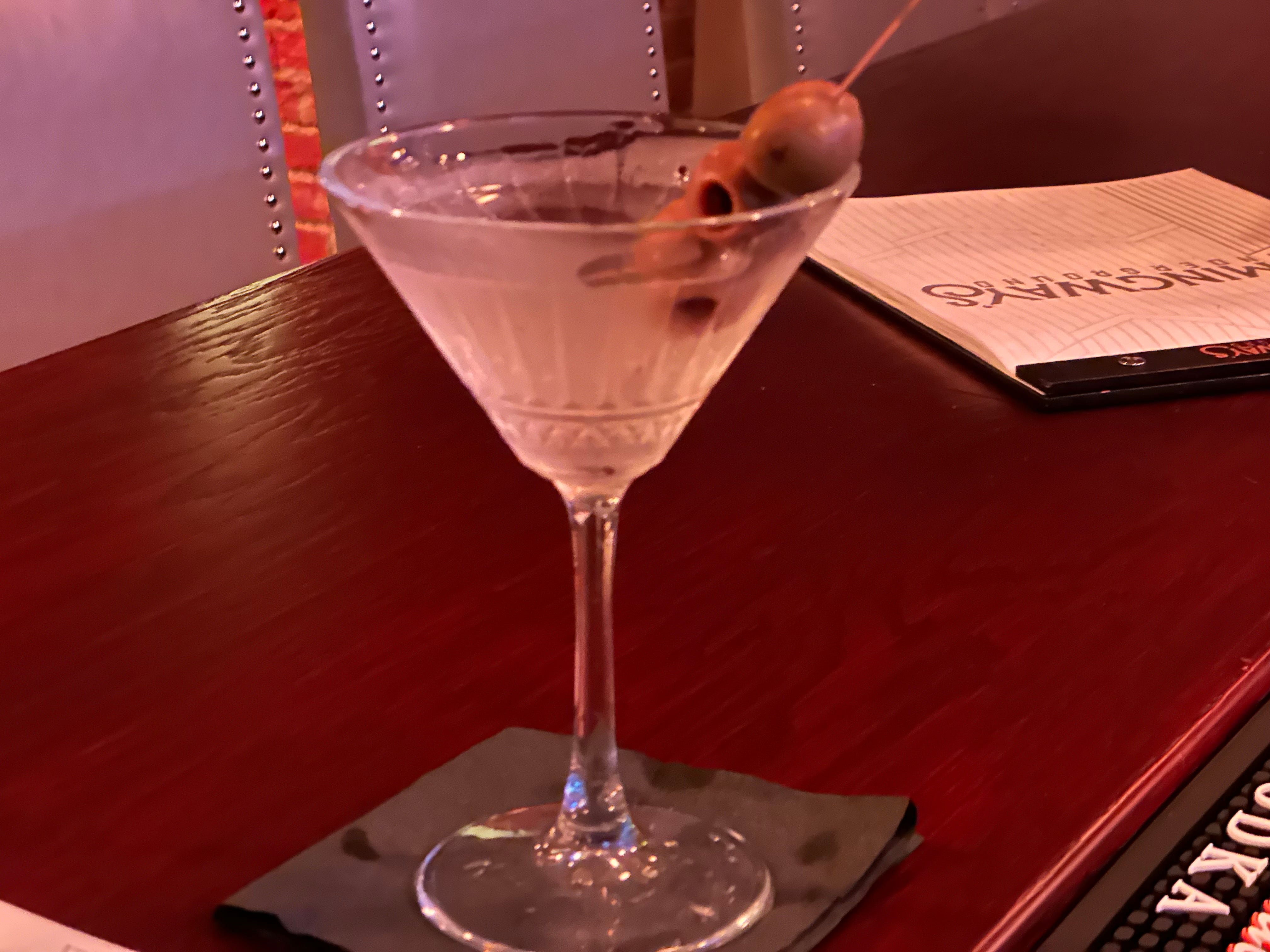
How do you take something good and make it great? We’re condensing Hemingway’s menu to 20 cocktails; it was close to 65 last winter. My drinks are well represented on that list of 20. I need to make sure each of my drinks earns its place on the menu every day. That means tearing the drink apart, re-examining every choice that made it succeed, and seeing if it can be improved. This week, I worked on The Filthiest Martini Ever. It’s become a lot more sophisticated. Does that make it … Soiled? I’m not sure. In any case, here’s the latest recipe for a very popular, very successful drink:
Better Filthiest Martini Ever
2 ½ oz Chopin vodka
1 oz olive brine
3 unstuffed green olives
Pinch smoked sea salt
3 bleu cheese stuffed olives
Extra virgin olive oil
Add the vodka and brine to a cocktail shaker. Add ice and water to a martini glass to chill. Muddle the unstuffed green olives in the shaker. Add the salt and shake vigorously for 13 seconds. Dump the ice and water from the martini glass. Double-strain the cocktail into the martini glass. Using a dropper, add 7-8 drops of extra virgin olive oil to the cocktail. Garnish with 3 stuffed olives.
I taught a class on this cocktail at the end of May, and realistically, not much has changed about the drink. It was already a successful cocktail. Every bar in town has a dirty martini. Ours had to be unmistakably better than every other glass in 50 miles. Muddled olives made it murky; salt made it brinier; olive oil made it sweeter. It was a hit.
But now that it’s one of only 20 featured cocktails, “better” isn’t good enough. This drink’s been put on a pedestal. It’s become a genuine piece of art, and every choice I made about the cocktail deserves to be re-examined. There was a joke we made back in college:
Q: How many theatre students does it take to change a lightbulb?
A: Why does it need to be a lightbulb?
I’m asking, “Why does it need to be a lightbulb?” about every part of this drink. Why is this ingredient there? What purpose does it serve? Does it contribute to the cocktail’s core mission? This cocktail is meant to be cold, briny, rich, and olive forward. Does everything in the glass serve that purpose?
Some of the changes I made were just best practices I’d been ignoring. Chilling the glass keeps the cocktail at the ideal temperature longer. Using smaller, more precise drops of olive oil means we don’t need as much oil behind the bar; we can also rotate it more frequently and keep it in the fridge so it doesn’t develop off-flavors. As for the rest… well, let’s walk through the ingredients and see what can work better.
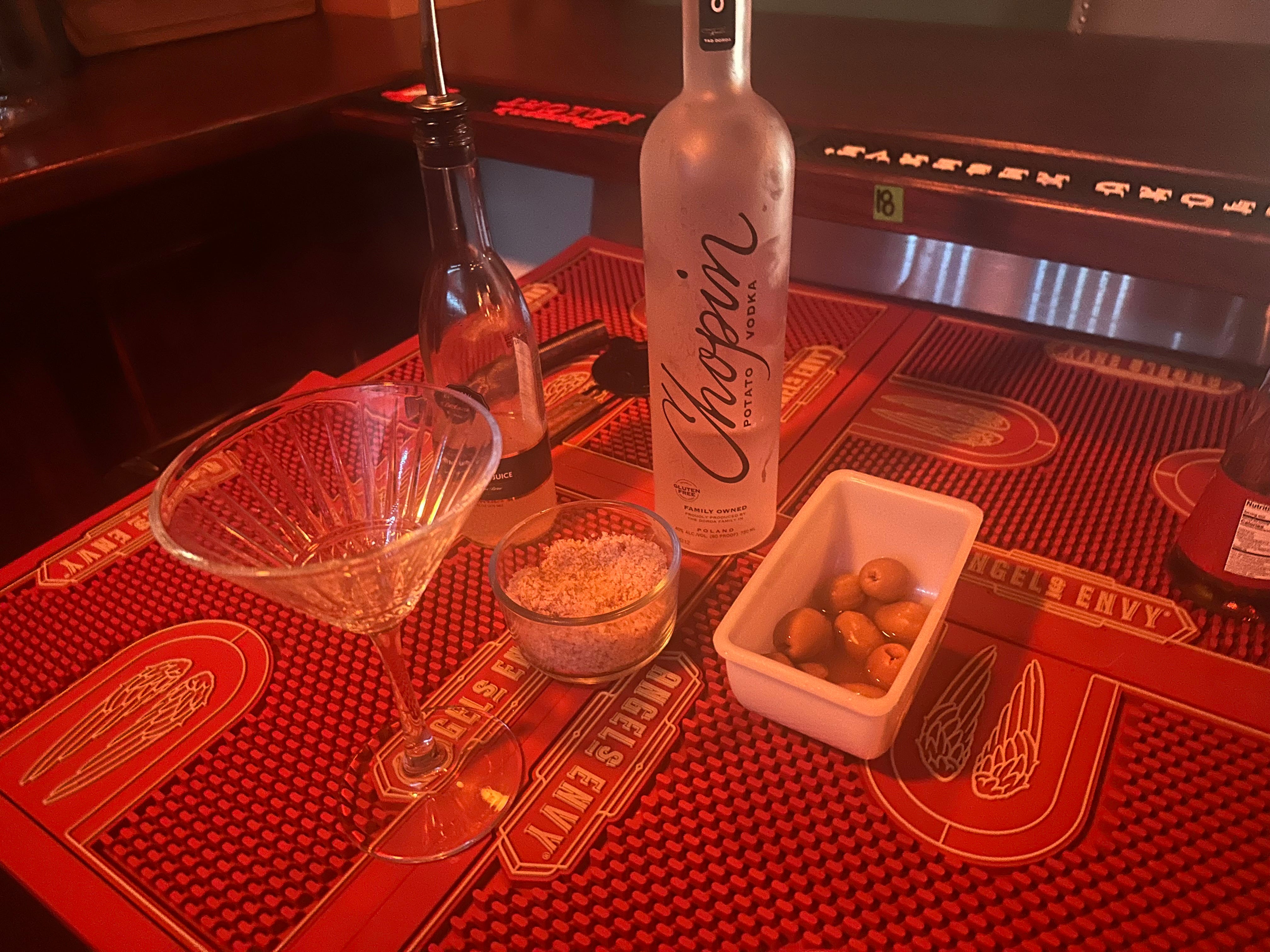
Chopin vodka: We’ve been using an inexpensive potato vodka in the drink to date. Previous experience taught me that a light, sweet vodka, like Tito’s, undercut the core flavors of the cocktail. This drink needs to be earthy, briny, and rich. We also needed to manage a bitter vegetal flavor in the front of the cocktail.
So how about gin? Nope. The juniper didn’t hit the palate at the same time as the bitterness, creating a confusing drink, alternating between bitter and sweet in all the wrong places. Bisongrass vodka? Yuck. Bisongrass vodka has some rich coconut notes. Coconut and olives don't taste good together.
A premium potato vodka — Chopin — proved to be the answer. The bitter note died down to a whisper with a better quality base spirit. Using a better vodka means raising the drink’s price by a few bucks, but the cocktail’s quality justifies the premium.
Olive brine: Does making our own brine from scratch make sense? Maybe. Do we have the kitchen space, storage space, and time to make it? Regrettably, no. We’ll re-examine this issue later; for now, commercial brine is good enough.
Muddled olives: Our menu is Greek. We’re already using some terrific olives for muddling. I’ve been using two olives, which made the drink murky. Three olives make the drink opaque. Now that, neighbors, is filthy.
Smoked sea salt: The salt’s smokiness adds another dimension to the cocktail. Plain sea salt would make a cleaner-tasting drink, but, well, it’s a filthy martini. What about a little MSG instead of salt? I tried it once, and the MSG’s flavor was too strong. I’ll try a weaker solution and see what happens. We’ve already got smoked sea salt in the kitchen. We might be able to improve this, but it’ll take experimentation.
Three stuffed olives: I’ve been using only one olive in the cocktail to date, out of frugality. Three olives stay balanced on the cocktail rim better and convey the sense of luxury the drink deserves. They also provide a big olive scent when the customer first brings the cocktail to their lips. A drink that smells good, tastes great.
Extra virgin olive oil: The EVOO provides a long, fruity richness at the end of the sip that can’t be matched. If the cocktail is as cold as possible, the oil will congeal slightly at the edges, preventing the oil droplets from coalescing into a large pool in the middle of the glass. A cocktail that’s shaken firmly for 13 seconds is as cold as it can possibly get. (Yes, we’ve done the science.)
The Filthiest Martini Ever? Certainly. The Best Filthiest Martini Ever? Possibly. It’s always a process. The work deserves no less.
My home bar is Hemingway’s Underground, the hottest cocktail bar in pretty little Medina, Ohio. I’m behind the stick Wednesday-Saturday, 4-10. Last call’s at midnight. Swing on by, and I’ll make a drink for you … or anything else from our little Happy Hour here at Wonkette. We’ll make it through this together.
OPEN THREAD!
Busy questions here.
That makes 3 in the one year I have been watching.
People who have pulled anyway from the gas pump with the nozzle still attached. I am going to draw little nozzles on the window sill to keep track.
The first one pulled the thing totally off the pump, got out of the car, removed the nozzle, dropped it on the ground and drove away. Gas station worker came out, picked it up and took it inside the little store, he has probably seen it hundreds of times more than me.
The second one, the nozzle popped out of the car before it broke away. The guy got out and apologized loudly to the air, put the nozzle back and drove away.
The last one also popped out before breaking off, but this driver kept going.
Get off your damn phones, that was definitely the last one, also who holds their phones up to their ear in the car?