


As we like reminding you, with Donald Trump trying to kill clean energy, Europe has become the source of much of our clean energy Nice Times lately. Here’s one more example: Spain is among the big sleeper hits on Europe’s energy transition pop chart. In just a decade, Spain has ramped up its use of wind and solar power, resulting in some of the lowest wholesale electricity prices on the continent.
Oxford prof and energy policy analyst Jan Rosenow gets into the details at his “Bright Spots” newsletter, which we’ll recommend for folks who need a dose of climate optimism about now:
In the first four months of 2026, the average wholesale electricity price in Spain was €44 per megawatt-hour. In Italy, it was €127. In Germany, €96. In the UK, €103. Spain is now cheaper than France, well below the central-European bloc, and within striking distance of the Nordic hydro-and-nuclear heavyweights that have always topped the cheap-power league.
The basic reason is pretty simple, Rosenow explains, although he also goes into further detail beyond this. “Spain increasingly pushed gas increasingly out of its electricity supply, and the price of electricity followed.”
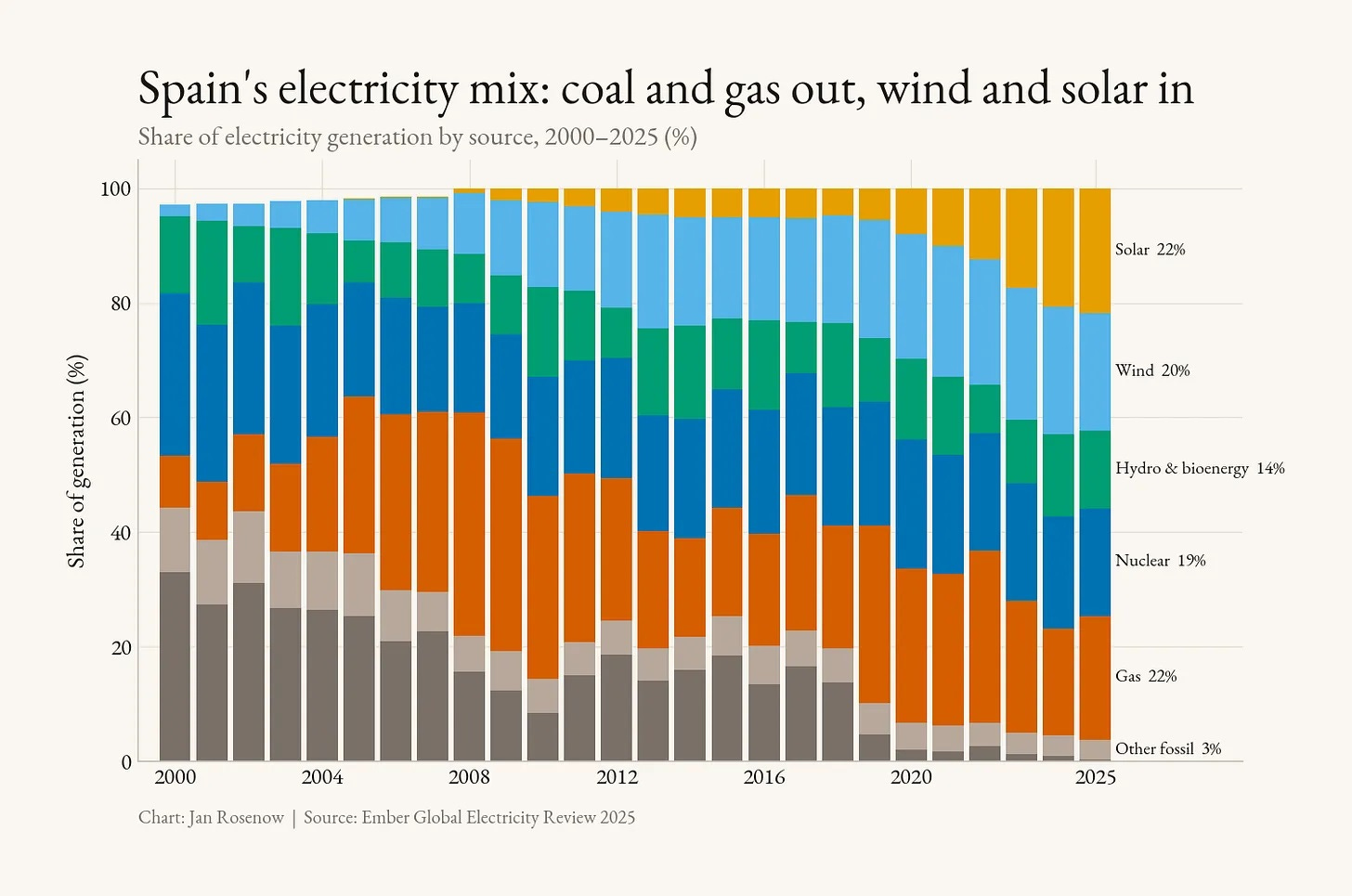
Over the last 25 years, Spain has gone from getting a third of its electricity from coal to effectively having zero coal power. Spain replaced most of that capacity with cheaper (and relatively cleaner but still climate-unfriendly) fossil gas, and it’s now replacing gas with renewables. Gas peaked at about 30 percent of Spain’s energy mix near the end of the 2000s, and is now down to about 19 percent. Another 19 percent comes from nuclear, which hasn’t changed over the last few decades and 14 percent is from hydro and bioenergy. The rest has been solar and wind, which combined are up to 42 percent of the mix in 2026. Here’s a pretty chart, with cheerful yellow solar energy and cool blue wind energy growing, and icky grey coal rapidly fading into nothing.
Prefer a non-Substack subscription? The button below will take any amount of your choosing at Paypal — let us know if you want the newsletter subscription too! they’re separate! — or we have a Patreon too.
Here’s why the replacement of gas with renewables matters so much: Because wholesale electricity prices at any given time are set by the most expensive energy plants needed to meet demand, and gas is usually that most expensive source, getting more solar and wind on the grid during high-demand daylight hours brings down wholesale prices a lot.
A side note Rosenow doesn’t get into: Spain is behind the rest of Europe in building up storage battery capacity, but the government is working on catching up. Again, that matters because batteries are great for storing the excess power generated by solar during the day, then using it during peak demand hours just after sunset, delaying expensive gas generation from being needed until lower-demand nighttime hours. In the US, Texas and California have added so much storage capacity that batteries can handle much of peak evening demand.
Unfortunately, for a bunch of reasons that Rosenow explains, Spain’s wholesale price savings haven’t shown up in household electricity prices, which are still above the EU average. (Markets: They are complex.)
Also, whenever you mention “Spain” and “renewables,” some fossil fool will show up to insist that the daylong power blackout that hit Spain and Portugal on April 28, 2025, was the result of Spain relying “too much” on wind and solar, so we dare not expand them. As an investigation by European power regulators determined, the problem was actually a shortfall in managing voltage changes across the grid, particularly when it came to ramping up gas and nuclear power that was supposed to serve as a backup to solar and wind. Plants that should have come online instead shut down their grid connections to prevent damage from rapid voltage variations, making things worse. For a detailed look at what went wrong, see this analysis at PV Magazine.
As Rosenow explains, “The real lesson is not that Spain has gone too far on wind and solar, but that every country in Europe needs to modernise how it handles voltage stability.” The technology necessary to keep grids stable already exists, but every grid that’s transitioning from expensive dirty energy to affordable clean power needs to install those voltage management systems to keep the grid operating smoothly.
Meanwhile, back in the USA, Donald Trump’s weird war on wind energy continues. We noted earlier this month that Trump’s Defense Department has been exploiting a catch in the permitting process that allows the Pentagon to effectively hold up new wind projects forever. That logjam has only gotten worse. Last week, the Texas Tribune reported that the Pentagon’s delays for “national security” review have held up 54 onshore wind projects in Texas alone. Nationwide, the Pentagon foot-dragging has held up about $50 billion in onshore wind development, putting some 150,000 jobs at risk. And no, those jobs won’t be replaced in oil fields.
Spain provides just one more example of what we should be doing with our energy grid, and which we would be doing if Trump weren’t deliberately trying to keep dirty, expensive energy in place for a few more years of obscene profits for Big Fossil. Or to close on a positive note, once That Man is gone, we can finally get back on track to transition to clean, more affordable energy.
OPEN THREAD.


[Bright Spots / Canary Media / Inside Climate News / PV Magazine / Texas Tribune / Bloomberg via Energy Connects]
Yr Wonkette is funded entirely by reader donations. If you can, please become a paid subscriber, or if you’d like to make a one-time (or recurring) donation to help us keep your batteries topped off, you can click this here button.
Hmmm. Maybe "Nobody Expects the Spanish E-Transition" scans better...
I just saw a headline about a dog shooting a woman with a shotgun in Nebraska.
Has Kristi Noem gone into hiding yet?