


It’s been a good week in American politics, hasn’t it? Just a couple of quick good climate news updates before we get into our discussion of Bill McKibben’s 2025 bestseller Here Comes the Sun: A Last Chance for the Climate and a Fresh Chance for Civilization (Wonkette affiliate link).
Now that Democrats have taken charge of Congress — and a bunch of state governments, too! — Heatmap News executive editor Robinson Meyer says Trump’s Energy Revolution Is Over. Now a New Era Begins. Trump will no doubt try to keep giving gifts to the fossil fuel CEOs what paid his way to office, but he’s going to face a very angry Congress.
Sammy Roth at Climate Colored Goggles looked at the midterm results and said, “Wow, climate won absolutely everywhere.”
From Bill McKibben and Ayana Elizabeth Johnson, a special midterm elections edition of their podcast “What If We Get It Right?” I bet it starts with just the two of them saying “wow!” back and forth for a while.
At Heated, Emily Atkin reviews some of the many races where Big Oil blew $182 million trying to elect friendly stooges, and LOST BIG.
And while it’s not primarily about climate, I also recommend this lovely reflection on the midterms by the indispensable Rebecca Solnit, who wants you to know it’s OK to be freaking elated.
Feel free to talk about any of these in our discussion today, along with the book talk! It’s all connected! Now, on to our discussion of Here Comes the Sun.
In today’s section of the book, “There’s No Reason Not to Do This,” McKibben tackles some of the questions or objections that are often raised about the project of transitioning the world from fossil energy to clean wind and solar power. I found these chapters really useful for the imaginary arguments I have in my head with people who think moving from fossil fuels to clean energy is a nice idea, but it’ll never work because reasons.
And it often turns out that their objections to wind and solar are based on outdated notions about the technology, or on disinformation that’s been spread by the fossil fuel industry’s well-funded lobbying arm. More benignly, though, much of what McKibben discussed here isn’t exactly new, but hasn’t yet become mainstream knowledge. McKibben clearly wrote this section to do just that, so we can have more well-informed discussions about all of this.
McKibben has a real knack for tossing in juicy little facts you’ll want to tell others about. For me, it was the observation that “In India, it costs less to put up a new solar farm than it does to buy the coal to fire an existing already-paid-for power plant.” Dang, that’s really something!
You can also use the button below to donate an amount of your choice at Paypal or Venmo, or we have a Patreon too.
McKibben chooses four general questions/objections for this section: “Can We Afford It?” “But Can the Poor World Afford It?” “But Is There Enough Stuff?” and “Do We Have Enough Land?” The answer to each is a resounding yes, and often “yes, and you’d be amazed at how doable this is,” with a careful case to support it, as well as acknowledgements that some parts of the project may be easier said than done.
Chapter 5 makes a solid case that, if anything, clean energy is an even better fit for the developing world than it is for the rich nations that are currently in the lead in their energy transitions. That lead is the result of Western nations’ great wealth, but the simple fact is that solar is now so cheap that it’s being adopted even more quickly by developing countries where there’s no embedded fossil energy infrastructure that has to be shoved aside. Another “wow” detail that’s stuck with me:
Eighty percent of human beings live in countries that are net importers of fossil fuel, which is one of those statistics that takes a minute to sink in. But as it does penetrate you start to truly understand the liberating possibilities of power from the sun.
Trivia fun: Searching my ebook of Here Comes the Sun for that “80 percent” statistic was hopeless because McKibben faithfully adheres to New Yorker style, writing out numbers less than 100 as words. (Here at Wonkette we only spell out one through nine.)
Back to the point: Many of the poor countries that can benefit most from solar are located near the equator, where 1) solar is most efficient, and 2) much of the population lacks electricity. It’s a perfect fit for individual solar installations for homes and businesses, and for solar microgrids with battery backup, and both are already springing up as cheap Chinese solar panels reach people who need power. (My very Catholic mother might have said God planned it that way.)
McKibben writes about the rapid adoption of solar energy in Pakistan with an almost awestruck tone — didja notice he describes it as a “miracle” three times in just two paragraphs?
But he also notes that miracles can be complicated, bringing up one of the paradoxes that clean energy advocates worry about even in wealthy nations. As more and more people go solar, it can lead to a “doom loop” for the utilities that operate national grids powered by big coal- or gas-fired power plants. The plants were built with leveraged debt, on the assumption that bringing more electricity to new and existing customers will cover the debt and create profits.
To make up for the profits lost as ratepayers shift to getting most or all of their power from rooftop panels, utilities raise their rates, making the switch to solar even more attractive to those who can afford it, leaving the grid dependent on revenue from the poorest folks who can’t afford solar. In the US, utilities have tacked on connection fees for customers who have solar, to cover some of the lost revenue; since the cost of installing solar here is fairly steep, most people stay on the grid and grumble.
In poorer countries where the grid is already unreliable but cheap solar panels are proliferating, people who weren’t connected to the grid in the first place may simply lay panels flat on the ground because metal frames cost more than the panels themselves. Others may drop off the grid too, leaving only the very poorest people connected, and they can’t afford the higher rates at all. There’s your utility “doom loop” or “death spiral,” and as the world decarbonizes, rich and poor nations will need to change how utilities work.
But none of that is a reason not to transition to clean energy, since fossil fuel dependency is far worse. McKibben wisely avoids going too far down that rabbit hole, pointing out instead that overall, widespread adoption of clean electricity will literally decentralize both electrical and political power. The trick will be making that transition equitably for as many people as possible, which was why Joe Biden’s climate plan consciously included initiatives to help the poor and minority communities already hit hardest by fossil fuel pollution and energy exploitation. But then we reelected Trump, and even planting trees in cities became unfair DEI discrimination against white people.

We also enjoyed McKibben’s discussion of those awful coal industry ads that came out as the fracking boom made gas far more affordable than coal. The CEO of Peabody Coal cried big tears about how plentiful affordable coal was needed to help bring energy to poor people in developing countries. Peabody Coal went bankrupt because its product couldn’t compete with gas. So it goes.
Funny thing, that very same bad faith argument is espoused by Donald Trump’s Energy secretary, fracking CEO Chris Wright. Imagine that.

Fortunately, this week’s elections are our best indication that Americans have had it with being bossed around by a rightwing minority of Christian nationalists and billionaires. That makes the ideas in Here Comes the Sun far more plausible, just in time for the clean energy revolution to take hold even in America.
Update/Edit: Heck, I forgot to include this kick-ass chart related to Chapter 6, “But Do We Have Enough Stuff?” Taken from a slide deck from the clean energy think tank Ember Energy, it compares the total of all the materials needed to sustain the energy transition for the coming 25 years to the amount of fossil fuels extracted in just one year today:
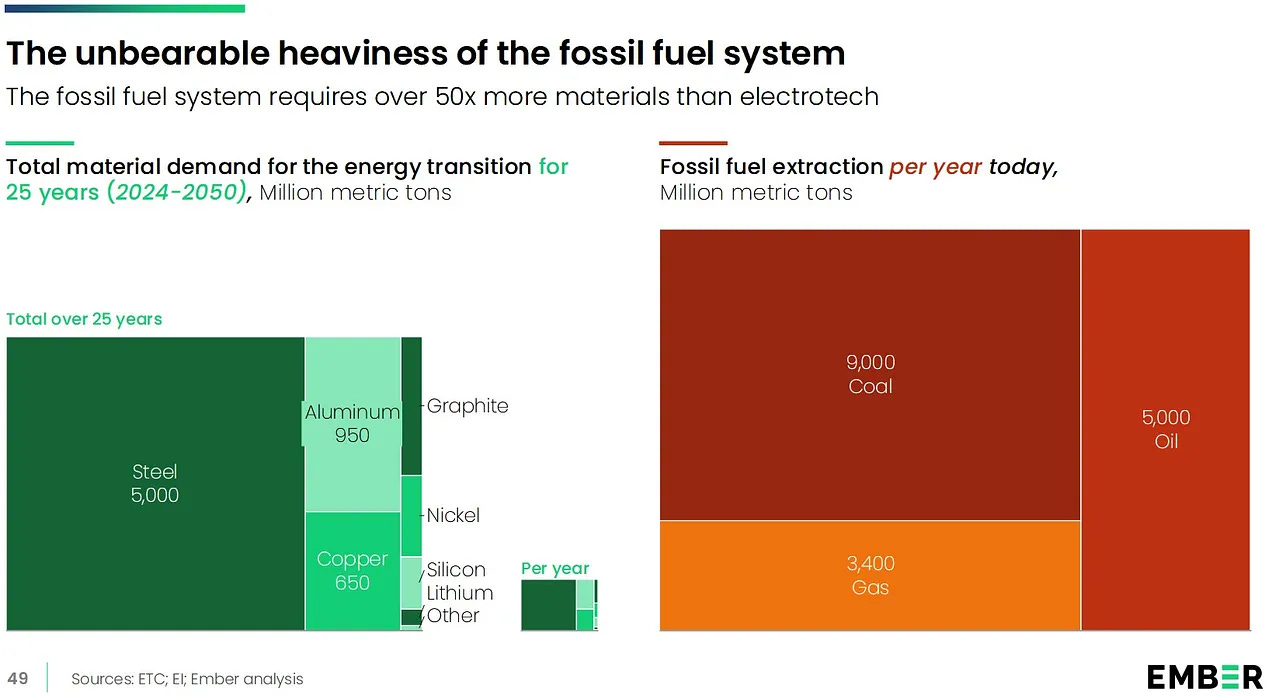
It’s from this enthusiastic review of Here Comes the Sun at The Weekly Anthropocene, which has all sorts of “Oh yeah, and then there’s this!” information and graphics that expand on points made by McKibben. He cites a Bloomberg analysis saying that as we transition away from resource-intensive fossil fuels, “the total amount of material the world mines will fall.”
Can’t believe I forgot that in the first draft this week!
Let’s discuss! What ideas or details in these four chapters made you say “wow?” What details will you be talking to friends about? Which of these objections to energy transition have you heard, and did McKibben answer them to your satisfaction? I’ll drop a few other questions in the comments, and you can do that too!
As always, remember that if you’re behind on the reading, or haven’t read the book at all, no problem, we’re not grading any of this. Jump in and talk! If you can, please try to keep the discussion on the topic of the book, and hold your Open Thread comments for the Nice Times column that’s on the way.
For next week, Sunday, November 15, we’ll finish reading Here Comes the Sun and its final section, “Let’s Do This!”
About an hour after the book club post goes up, we’ll also have a Video Book Chat meeting for anyone who wants to get on Zoom with Doktor Zoom. If you want to take part, please email me at doktorzoom at wonkette dot com so I’ll have an idea how many people may show up. And please include a question about the book or about clean energy you’d like the group to discuss, too! I’m going to spend all week trying to speak without saying “ummmm” a lot!
After we finish Here Comes the Sun, we’re going to try a new direction for our book club, so we aren’t going so long between these things. We’ll read and discuss one book a month, and instead of having multiple “meetings” like we have previously, we’ll discuss the whole book in a single post near the end of the month. We’ll have a mix of fiction and nonfiction, too. Whee!


Yr Wonkette is funded entirely by reader donations. If you can, please become a paid subscriber, or if you’d like to make a one-time (or recurring) donation, you can click this here button.
Hey kids, we're live again! Book chat time, and a reminder to please focus on talking about the book or about climate and clean energy. News of your cats, annoying neighbors (god they're so annoying!) and other open-thread content is of course cherished and should be posted in the Nice Times post coming at 1:00 EST.
Also too, I just updated the piece with a nifty chart comparing ALL the estimated material extraction necessary for the next 25 years of the energy transition, to the amount (in metric shit tons) of fossil fuels we're already mining/pumping in just one average year. Reload yr browser to see that!
Meanwhile, with these greedy, treacherous parasites:
𝗦𝘂𝗽𝗲𝗿-𝗿𝗶𝗰𝗵 𝗴𝗲𝘁 ‘𝗱𝗼𝘂𝗯𝗹𝗲 𝗱𝗶𝘃𝗶𝗱𝗲𝗻𝗱’ 𝗳𝗿𝗼𝗺 𝗰𝗮𝘂𝘀𝗲𝘀 𝗮𝗻𝗱 𝗰𝗼𝘀𝘁𝘀 𝗼𝗳 𝗰𝗹𝗶𝗺𝗮𝘁𝗲 𝗰𝗿𝗶𝘀𝗶𝘀, 𝗿𝗲𝗽𝗼𝗿𝘁 𝗳𝗶𝗻𝗱𝘀
𝘖𝘹𝘧𝘢𝘮 𝘴𝘢𝘺𝘴 𝘪𝘯𝘷𝘦𝘴𝘵𝘪𝘯𝘨 𝘣𝘺 𝘵𝘩𝘦 𝘳𝘪𝘤𝘩 𝘪𝘯 𝘥𝘪𝘴𝘢𝘴𝘵𝘦𝘳 𝘳𝘦𝘤𝘰𝘷𝘦𝘳𝘺 𝘸𝘪𝘥𝘦𝘯𝘴 𝘪𝘯𝘦𝘲𝘶𝘢𝘭𝘪𝘵𝘺 𝘢𝘯𝘥 𝘨𝘪𝘷𝘦𝘴 𝘪𝘯𝘤𝘦𝘯𝘵𝘪𝘷𝘦 𝘵𝘰 𝘥𝘦𝘭𝘢𝘺 𝘤𝘭𝘪𝘮𝘢𝘵𝘦 𝘢𝘤𝘵𝘪𝘰𝘯.
https://www.theguardian.com/environment/2026/oct/27/super-rich-double-dividend-climate-crisis-oxfam