


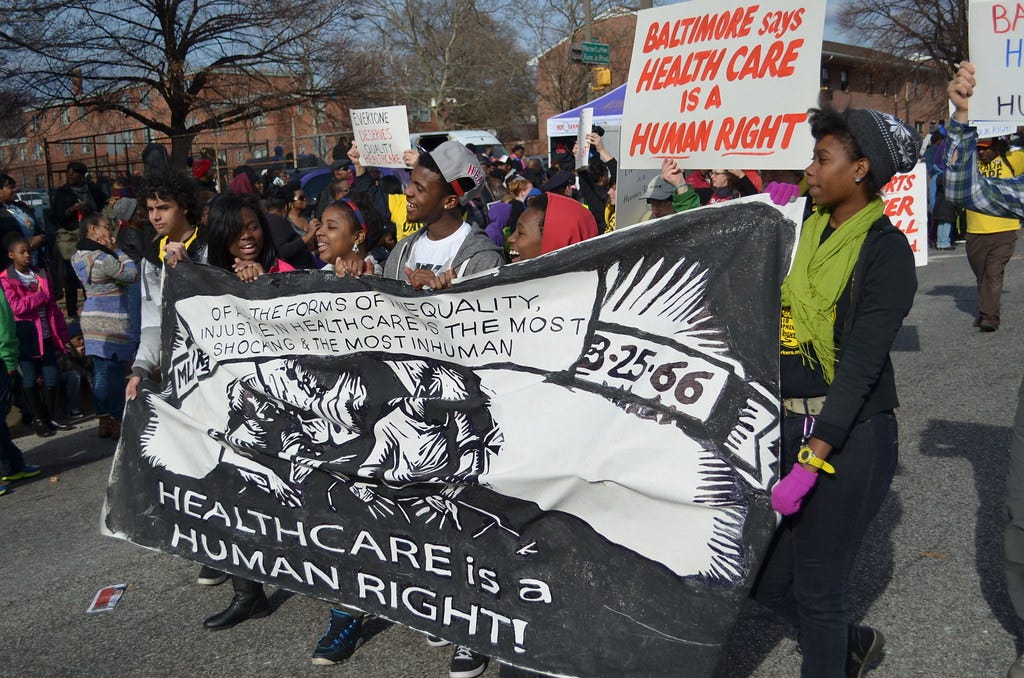
Here’s a crazy but true fact: It is actually more expensive to pay health insurance CEOs $20 million a year than it is to not do that. Even crazier? Those exorbitant salaries actually come from your insurance premiums. Even crazier than that? They also go to pay all of the people whose job it is to figure out how to deny your claims so that they don’t have to give you that money back when you need it.

Incredibly, there’s actually a way to resolve these issues — an ancient(ish) secret from foreign lands. Which foreign lands? Practically all of them. Ooh! And it’s a trick that your doctor may not want you to know about (if your doctor agrees with the AMA’s current stance, anyway). Americans love that shit, right?
That ONE WEIRD TRICK? It’s socialized medicine.
It’s true — and not just according to me and Bernie Sanders and AOC and all of the cool people who won their Democratic primaries over the past few months. It’s also true according to Yale.
Via Yale:
For the study, which has not yet been peer reviewed, the researchers modeled what would happen if the United States adopted a national public insurance program like the one proposed in the Medicare for All Act. Using 2024 spending, insurance coverage, and mortality data, they estimate that the universal coverage would reduce annual health expenditures by $1.04 trillion, or nearly 20% — even after accounting for the additional care that uninsured and underinsured people would receive. […]
Just want to pause right there and make sure you saw that’s a trillion dollars saved every year while covering literally everyone. You saw that? Okay good!
The model identified five major sources of savings: lower pharmaceutical prices, Medicare-level payments to providers, reduced administrative overhead, less fraudulent billing, and fewer avoidable emergency department visits and hospitalizations. Even under more conservative assumptions about drug prices and fraud reduction, the researchers projected that the savings would reach at least $663 billion a year. Both figures account for an estimated $304 billion in additional spending to meet unmet medical needs, reimburse care that now goes unpaid, and provide universal dental coverage.
Dental coverage! Yes! A tooth infection can kill you, this should not be considered extraneous to health care any more than your lungs or feet should!
The study also found that the policy would save 114,174 lives a year (29 thousand of whom already have insurance, interestingly enough) — but let’s be real here, Americans are not going to find that to be an especially compelling statistic. The larger the number of people living or dying, the less anyone cares that they are living or dying. People do, however, care if 1 of those 114,174 are themselves or a person they know and love.
“Healthcare costs have been rising faster than inflation, and a staggering share of that spending is consumed by administrative middlemen, soaring drug prices, and emergency care for conditions that should have been treated earlier and for less,” senior author Alison Galvani, the director of the Yale Center for Infectious Disease Modeling and Analysis, said in a statement. “Medicare for All strips out those sources of waste while providing everyone with healthcare, saving over a trillion dollars and 114,000 lives every year.”
As all of our expenses become increasingly ridiculous and confusing, people are starting to really warm up to the idea of single payer Medicare for All, and even seem to be becoming less stupid about it. There was a time when you’d see polls where large majorities of people would say they support universal M4A, but where that support would drop when they were told it would eliminate private health insurance companies. A whole lot of people really loved that statistic and were always eager to bring it up in arguments as proof that “people love their private health insurance companies and would die before letting any harm come to them (literally).”
That’s become much less of a thing now in recent years, perhaps as people realize that private health insurers may not be their friends after all. A 2025 study found that 65 percent of voters supported instituting a “national health insurance program … that would cover all Americans and replace most private health insurance plans.”
I’m glad to see the results of this study, but the fact is that anyone remotely capable of comprehending that “Health insurance is less expensive when you don’t have to pay corporate executives millions and millions of dollars” and “the bigger the group, the better leverage you have in negotiations” has understood this for years, if not decades. The problem is that we have a hard time selling it to some people for reasons that have very little to do with saving money and lives.
Part of it, weirdly enough, is that we are selling it as something that would be nice for everyone, because of how it is something that would be nice for everyone. But that is not the big selling point for a lot of Americans that it is for you and me. I think framing “private health insurance companies with C-level executives making millions upon millions a year” as a “luxury we cannot afford” might actually be more effective. Like “Sure, we’d all love to overpay for health insurance and barely get anything in return, we’d all love to see insurance company executives be able to buy fleets of private yachts, closets full of Birkins and alligator shoes, and get edible gold dust sprinkled on every ham sandwich they eat! They deserve it for fucking us all over in a very clever way and we’d love to be able to reward them for it — but it’s just not economically feasible at this time. It’s not the fiscally responsible thing to do.”
Perhaps it would be helpful to note that we basically already have socialized medicine to begin with — we’re just doing it in the most inefficient and economically absurd way imaginable. Health insurance groups are a form of collective bargaining. People pool their resources as a group so that everyone gets their basic needs met and, ideally, when something goes really wrong for you, there is money to cover that as well — and they pool their power. They use the leverage of the group to collectively bargain for lower prices on care and medications for members. Like when you buy deodorant in bulk from Costco or get a group discount on Amtrak. Or when unions tell employers “If you want to have employees, this is what you’re going to have to do.”
The way single payer works is that you do all of those things, but with a much larger group, which then gives you more leverage when you are negotiating prices on care and medications. You also do them without having to pay the aforementioned millions and millions and millions of dollars to the CEOs of private health insurance companies.
Want to send us money in an entirely different way? Click below or join our Patreon!
I hate to boil it down to a “messaging” issue, but in a lot of ways it is. We have a very large chunk of America that not only will not listen to any studies coming from Yale, but who really would rather pay more for health insurance than see someone “undeserving” get it as well, and that’s the thing we really have to overcome. However, our current economic situation is causing that to erode, and I think we need to take advantage of the fact that people are simply becoming more receptive to listening to those explaining how it would work more than those trying to stoke fear about how it would work.
Besides — what could possibly be worse than what we have now?
PREVIOUSLY ON WONKETTE!


"Dental coverage! Yes! A tooth infection can kill you, this should not be considered extraneous to health care any more than your lungs or feet should!"
That we're even making this distinction is all about the money in the first place. I think it all just should be healthcare. Depression can kill you as much as pregnancy complications as much as diabetes as much as an infected tooth, etc.
Socialized medicine works, indeed! And we don't have it in the USA because it would also be available to Black people.
That's also why, if racial minorities grow in number many Western European nations will gladly destroy the nice things they have to prevent those people with darker skin from getting it.
Same energy of, "desegregation says we can't keep Black people out of the pool? Solution: Close and destroy the public pool, and make little 'swim clubs!'"