


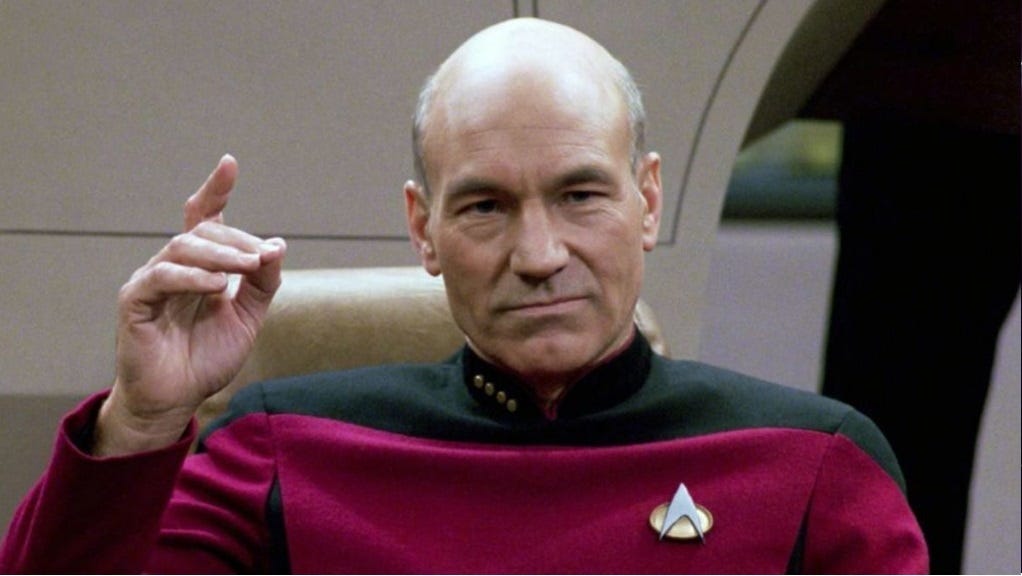
I spent a good part of Thursday afternoon scrolling through social media, reading people’s memories of Patrick Stewart, and here’s what quickly stood out to me: Every last story people told about meeting him was warm and positive. Not a single anecdote about Stewart berating a bumbling production assistant on a set, or getting impatient with a starstruck, tongue-tied fan. Instead, they were all pretty much like this delightful story from Bluesky:
Night before my GCSE Chemistry, I waited for Ian McKellen and Patrick Stewart backstage after Waiting For Godot. Patrick asked what’s in my bag, I told him about my exam. So Stewart and McKellen told the Green Room to “shush” as they both tested me on the Periodic Table.
RIP
As far as I can tell, the man never once left someone thinking, “Damn, what a jerk. Can’t believe I liked him.” This is a rare thing with celebrities.
Patrick Stewart died Wednesday at his home in Los Angeles, his family announced on social media yesterday, from Alzheimer’s disease and Lewy body dementia. The family requested that in lieu of flowers, donations be made to the Johns Hopkins Alzheimer’s Disease Research Center Fund and to Alzheimer’s Foundation of America Caregiver Resources.
Here’s the indispensable New York Times obit (gift link), tracing Stewart’s rise to fame as a member of the Royal Shakespeare Company and in the British theater, winning the “London Fringe Theater best actor award for his role as the humiliated husband, George, in the Young Vic’s production of Edward Albee’s Who’s Afraid of Virginia Woolf?”
Stewart brought all that gravitas — and wit — to American TV in 1987, as Captain Jean-Luc Picard in Star Trek: The Next Generation, which was the first spin-off from the venerable sci-fi series, and uncorked a flood of new Star Trek series and movies and endless nerdy arguments over who was the Best Captain. (Picard, full stop. OK, we’ll hear your arguments for Benjamin Sisko, too.)
When Next Generation debuted, one US newspaper said the new captain of the Enterprise was played by an “unknown British Shakespearean actor.” When Stewart arrived on the set the next day, he found a sign a fellow member of the cast had taped to the door of his trailer: “BEWARE: UNKNOWN BRITISH SHAKESPEAREAN ACTOR.”
Update: It was the LA Times, and the sign prankster was that goofball Brent Spiner, of course it was! What a goofball!
We hear Stewart was in five of those Marvel movies too, where he played an overworked professor whose grad students often made unreasonable demands on his time.
And has any Unknown British Shakespearean Actor ever looked better in a lobster costume? Here he is, about to be boiled in Tea, Earl Grey, Hot, from his Twitter feed in 2013:
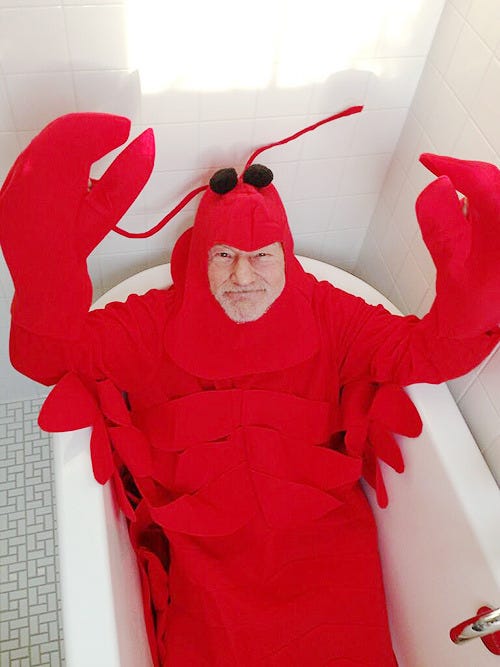
Not taking yourself too seriously is good for you.
You can also use the button below to donate an amount of your choice at Paypal, or we have a Patreon too.
Want another story to make you love Patrick Stewart all over? The Times cites a 2003 interview in The Independent in which Stewart recalled journalists who, in the early years of Next Generation, accused him of wasting his talent on popular TV instead of The Theatre:
“They used to ask me, ‘Why, why, why?’, as if I was somehow slumming it. It was ridiculous to suggest that I was betraying my background. What crap! What snobbery! […] For huge numbers of people I will always be Jean-Luc Picard, and that’s fine. I really believe we created an admirable individual.”
We are serious grownups who know better than to conflate actors with their roles. But it seems to us that part of why Picard is such a compelling character is that the man who played him was pretty freaking admirable, too.
Stewart’s passing was the second death of a Star Trek actor this week, coming just days after Walter Koenig, who played Ensign Pavel Chekov on the original series, died at the age of 90. In a series that was so often rooted in Cold War analogies, it was not a small thing that the Enterprise bridge crew included a handsome young Russian weapons officer.
It’s a little mind-blowing to remember that in June of 1984, Star Trek III: The Search for Spock* gave us the goofy scene of Chekov asking US Navy guards, “Where do you keep your nuclear wessels?” — and then on August 11, 1984, Ronald Reagan was caught on a live mic “joking” about launching Armageddon. “My fellow Americans, I am pleased to tell you today that I’ve signed legislation that will outlaw Russia forever. We begin bombing in five minutes.” That guy! What a kidder!
*Update/correction: Please revoke my Nerd Card. The nuclear wessels scene is of course from Star Wars IV: The Invention Of Whales, from released in 1986, two years after Reagan’s funny joke. Wonkette regrets the error, and Doktor Zoom has fired himself again. Into the Agony Booth I go.
And now we have another president who openly consorts with Nazis and is perfectly happy to incite his followers to acts of violence, although he too insists he’s just joking.
In A World With Too Many Andrew Tates, We Need More Patrick Stewarts
As often happens when discussing serious matters, we must first thank a clueless buffoon, in this case, Sen. Ted Cruz (R-Texas), a veritable Pakled in his comprehension of pop culture. In a 2015 New York Times Magazine interview (gift link) with Wonkette OG Anna Marie Cox, the smarmy little Denebian slime devil said he liked Captain Kirk over Captain Picard, because Kirk was a manly man and Picard was, well, kind of a soy boy when it came to captaining. “Kirk is working class; Picard is an aristocrat. Kirk is a passionate fighter for justice; Picard is a cerebral philosopher.”
On the Enterprise-D, Cruz said, Kirk was “split” into two characters, with Picard the rational side and William Riker the “passionate” side. OK, sure, and already done in the gloriously cheesy Original Series episode “The Enemy Within.” Cruz suggested that Kirk was therefore a more “complete captain” because he had “both heart and mind,” and also that Kirk is a Republican and Picard a Democrat, what with all that prissy tea-drinking, fussy concern about not violating the Prime Directive, and being French.
In his meatheaded wrongness, Cruz actually stumbled across something important here: As many of the tributes to Stewart point out, he and his fictional alter egos embody a very different version of masculinity from the macho, two-fisted Kirk, and that’s a damn good thing. Kirk was swagger and cunning, Picard was a diplomat who listened and acted ethically — and could set his phaser to “kill,” but only when that was the last resort.
Transported by aliens to strange worlds that looked like the outskirts of Los Angeles and confronted by an alien captain, Kirk used his smarts to make gunpowder from everyday materials and defeated the brutal, far stronger lizard-guy Gorn (but refused to kill him once the Gorn was helpless). Picard had to puzzle out the allusive, narrative-embedded language of the Tamarian captain, and they worked together to survive (although his new friend ultimately doesn’t make it).
Kirk was an avatar of Kennedy-era colonialism, convinced that his use of violence was justified because, well, he’s the good guy. Picard didn’t shrink from confrontation, but was never cocksure. Different Americas, different Star Treks.
In his childhood, Patrick Stewart witnessed his father’s abusive violence against his mother, and wrote a moving 2009 piece in the Guardian about how the terror and shame of seeing a man he “respected, admired, and feared” brutalize his mother shaped his own character.
The sense of guilt and loneliness provoked by domestic violence is tainting – and lasting. No one came, but everyone knew. Our small houses were close together. Every Monday morning I walked to school with my head down, praying that I would not encounter a neighbour or school friend who had heard the weekend's rows. I felt ashamed.
As an adult, Stewart says, he “struggled to overcome the bad lessons of my father's behaviour, this corrosive example of male irresponsibility.” He became an advocate and financial backer of Refuge, a British charity supporting victims of domestic violence, and that empathy was central to who he was.
Stewart’s close friendship with McKellan informed his tireless support of LGBTQ+ people, although he framed that not so much in terms of political activism as simply a matter of being human. As he told The Advocate in 2015,
“There was never a moment where I made an intellectual choice that I would be a supporter of gay civil rights. It was always a natural and uncomplicated choice. Then later in life, as I got to know well-known activists like Ian McKellen, I was only too happy to join campaigns, march, and support in whatever way I could because it always seemed to me to be something that much too much fuss was being made about.”
When the Guardian mistakenly identified Stewart as gay in 2014, he wasn’t simply unbothered; he went on Twitter to joke that in fact he had “five or even SEVEN hetero friends and we totally drink beer and eat lots of chicken wings!” He said in the same Advocate interview that “Quite frankly, I was utterly flattered by that assumption.” What a friendship, and what an acting duo!
Also making the rounds again is Stewart’s 2017 warning about the most toxic of males, Donald Trump, originally posted by the AV Club.
Patrick Stewart always made clear that we can be better people by simply giving a good goddamn about each other. That’s particularly important to hang on to as we all fight to break the hold of toxic, fascist manbabies on our government.
Let’s all make it so.


[NYT (gift link) / New Yorker / AP / Guardian]
Yr Wonkette is funded entirely by reader donations. If you can, please become a paid subscriber, or if you’d like to make a one-time (or recurring) donation, you can click this here button.
ALSO TOO: Get out your library cards or visit your preferred local new/used bookseller, because Wonkette Book Club is back, baby! This coming Sunday (November 1) we’ll start discussing Bill McKibben’s 2025 bestseller Here Comes the Sun: A Last Chance for the Climate and a Fresh Chance for Civilization (Wonkette affiliate link), all about how solar energy (and wind ‘n’ storage) can get us out of our climate fix and remake the world’s economies with justice for all (but we gotta do it fast and do it right). More here!
Wesley weighs in:
It’s only been like ten minutes since I found out, just before it hit the press, so I’m staggered and doing my best to process everything, while my phone is blowing up. There will be wonderful obituaries and reflections from so many people who knew him. I’m going to do my best to write my own, but that’s going to take a little bit.
For now, I want the world to know that Patrick wasn’t just my captain or my castmate; he was my friend and mentor. He made me a better actor, just by being in scenes with me. He never treated me like I was a kid; he always treated me like I was an equal, a fellow artist, at a time when I wasn’t mature enough to understand how precious that was.
I haven’t seen Patrick in a long time, our lives and schedules being what they are, but I thought about him almost every day. He rarely posted in our group chat, but when he did, it always made me smile. He always texted me back when I reached out to him directly, no matter what it was about, and he always — always — made me feel special.
I wish I really were a Traveler of all of space and time, so I could go to him, one final time, and tell him how much he means to me. I think he knew, but still.
There is so much more to say, and it’s going to take me some time to say it. Until then, I loved him, the same way I love the rest of the space family we shared. May his memory be a blessing.
––Wil Wheaton
𝐒𝐨 𝐒𝐭𝐞𝐰𝐚𝐫𝐭 𝐚𝐧𝐝 𝐌𝐜𝐊𝐞𝐥𝐥𝐞𝐧 𝐭𝐨𝐥𝐝 𝐭𝐡𝐞 𝐆𝐫𝐞𝐞𝐧 𝐑𝐨𝐨𝐦 𝐭𝐨 “𝐬𝐡𝐮𝐬𝐡” 𝐚𝐬 𝐭𝐡𝐞𝐲 𝐛𝐨𝐭𝐡 𝐭𝐞𝐬𝐭𝐞𝐝 𝐦𝐞 𝐨𝐧 𝐭𝐡𝐞 𝐏𝐞𝐫𝐢𝐨𝐝𝐢𝐜 𝐓𝐚𝐛𝐥𝐞.
Holy fuck!
👍