


There’s a lot of reason to expect a blue wave in November’s midterm elections, assuming people are able to vote freely and fairly, which may not be an entirely safe assumption. Democrats are likely to win control of the House of Representatives, even after Republicans gerrymandered several states in an attempt to shore up their slim majority — in some cases while voting was literally already underway.
In the Senate, Dems need to pick up a net four seats to take control — five, really, because John Fetterman — which is harder but doable. Taking the Senate back would be key to slowing down the fuckery Trump can get away with in the remaining years of his term. Election forecasters have shifted their predictions in some key races to suggest Democrats have a better chance; this week the Cook Political Report adjusted its ratings for Texas and Iowa from “Lean Republican” to “Toss-up,” which we wouldn’t have expected earlier in the year. And Fox News moved both Texas and Kansas from “Likely Republican” to “Toss-up.” Good luck, James Talarico, Josh Turek, and Adam Hamilton.
Yr Wonkette loves a good long-shot candidate challenging a terrible Trumplicking Republican incumbent, for sure. But let’s not get too crazy here, please. We already worry that our optimism for the Dems in those red states is more about irrational exuberance, falling in love with smart, charismatic candidates, and a dash of wishful thinking that at least some folks in those states will see how Trump’s policies are hurting them.
There’s no need to tempt us with stories about the supposedly credible chances of plucky Democrats seeking to unseat awful GOP incumbents in Arkansas or in Mississippi. Or for Crom’s sake, Idaho? Really, Newsweek? That’s just cruel.
And hell yes, of course we like the plucky Democrats. Maybe we should try to kick these footballs! They’re so shiny!
You can also use the button below to donate an amount of your choice at Paypal.
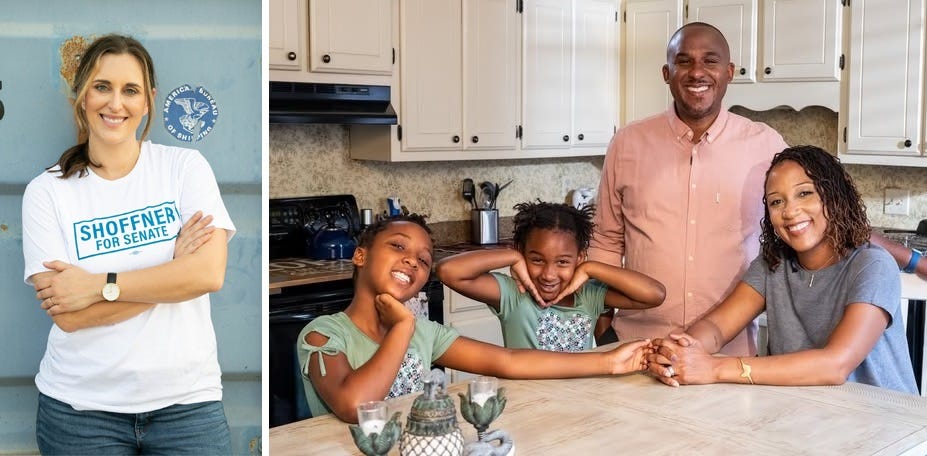
Arkansas: Hallie Shoffner Beating Tom Cotton?
In Arkansas, a poll by Talk Business & Politics and Hendrix College found that Democratic nominee Hallie Shoffner, a farmer and businesswoman, had a narrow lead (47.4 percent) against incumbent Republican Tom Cotton (44 percent), who we always mix up with Missouri’s Josh Hawley because both look like rodents.
The poll was almost certainly an outlier, experts said, and polling in the summer before campaigning goes into full swing often demonstrate more willingness among voters to think about alternatives to whoever’s in office.
That said, it’s not great news for Cotton, who has far more name recognition and campaign money than Shoffner. It’s particularly telling that in this poll, independents preferred Shoffner two-to-one over Cotton. Shoffner also had better numbers than Democrats usually do in the suburbs around Little Rock. Cotton, not surprisingly, performed well with voters 65 and older, because red state.
It’s also worth noting that a July poll by the “2040 Strategy Group” and commissioned by Shoffner’s campaign found Shoffner down by just three percentage points against Cotton (46 percent Cotton, 43 percent Shoffner, 12 percent “don’t know”). That outcome was well within the margin of error, a statistical tie.
Again, there are methodological issues with the poll, like the sample size — just 586 likely Arkansas voters — and the fact that it was paid for by the campaign. But as the Arkansas Times notes, the poll may also “quantify something you probably already knew: The bloodthirsty and charisma-deficient automaton that is Tom Cotton is just not a very likeable guy.”
2040 Strategy Group co-founder Tabitha Bonilla said voter dissatisfaction with Cotton is the big takeaway from the poll. The surprise, she said, is that “an incumbent senator with nearly universal name recognition remains below 50% while a challenger who is still introducing herself to voters is the only candidate with a net-positive image. Those are indicators of a genuinely competitive race.”
Another indicator would be that in July, Shoffner’s campaign announced it raised more funds in the most recent quarter than Cotton, although his campaign started out with a $10 million war chest and the real fall spending blitz is yet to come. Her money is coming from small donors; Cotton is largely funded by super PACs.
Shoffner certainly has a compelling personal story, having operated her family’s farm for nine years before Trump’s tariffs (the campaign page doesn’t name him; we will), rising costs, and unstable markets forced her to shut down operations in 2025 for the sake of keeping the land for her parents to retire on.
Shoffner’s website points out that “while Arkansas families like hers struggle, Tom Cotton voted against the Farm Bill, against Medicaid, against economic development, and against disaster relief - while supporting tax cuts for billionaires and blowing up the national debt.”
The campaign frames Shoffner as driven not by ambition, but by the sense that she something has to give: “She didn’t plan to run for office. She wanted to farm.” It’s a pretty good pitch!
Mississippi: Scott Colom Takes On Trumpy Relic Cindy Hyde-Smith
Mississippi is one of those states that has in recent years stayed just out of reach for Democratic candidates. Its 2023 election for governor was decided by just three percentage points, with Republican incumbent Tate Reeves narrowly beating challenger Brandon Presley, a distant cousin of that Elvis fellow.
This year, Mississippi voters could get rid of incumbent Republican Sen. Cindy Hyde-Smith, who nearly always votes how Donald Trump wants. Her fealty to Trump makes her an easy choice for MAGA loyalists, but Democratic nominee Scott Colom, a district attorney for the state’s 16th judicial district, hopes to benefit from voter disenchantment with Great Leader — especially those prized independents.
Like Shoffner in Arkansas, Colom is definitely a long shot candidate, and so far he doesn’t appear to have even outlier polls going his way. The New York Times summary only shows SPLC-funded polling from April, in which voters preferred “Someone else” by 53 percent to Hyde-Smith’s 33 percent. Once the generic “someone else” was replaced with Colom specifically, Hyde-Smith still managed only 42 percent to his 39 percent, a teensy little lead for a US senator seeking a second term.
Colom and Hyde-Smith also have a bit of history; during the Biden administration, she blocked his nomination for a federal judgeship. Colom says he’s not looking for any sort of revenge; he just wants Hyde-Smith out because she’s such a devoted pusher of Trump’s agenda, especially her support for the Big Ugly Billionaire Blowie Bill.
If Colom can win against Hyde-Smith, he’d become Mississippi’s first Black senator since Reconstruction, and its first Democratic senator since 1982. There’s just one other little history problem, as Mississippi Today columnist Bobby Harrison points out: “Mississippians do not vote incumbent senators out of office. There is no better definition of job security than holding one of Mississippi’s two U.S. Senate seats.”
In fact, the last time an incumbent senator was vote out in Mississippi was in 1942, back in Jim Crow days.
Then again, that run of reelecting incumbents is only a statistical trend, not an ironclad rule, so hey, why shouldn’t Colom be that “Someone else” who can win against Hyde-Smith? As he says on his website, Hyde-Smith “isn’t working for us anymore, voting against Mississippi jobs and investments because it serves her donors’ agenda.”
Also like Shoffner, Colom out-fundraised the Republican incumbent in the quarter ending in July, bringing in small-donor cash, not big money from Republican funding committees. He’s raised about $2 million so far, all of it without support (at least not yet) from the national party, which is sending its money to candidates with higher chances of winning, as you’d expect.
His campaign is hitting hard against Hyde-Smith’s ties to corporate donors and special interests, and as Sen. Angela Alsobrooks (D-Maryland) pointed out while campaigning for him in Mississippi, voters’ dissatisfaction with the Trump economy and his stupid Iran war could boost votes for lots of Dems running in red states this year. “They cannot afford their groceries,” Alsobrooks told the AP in an interview. “They cannot afford the cost of gas. They cannot afford housing. It’s all over the country.”
As the AP notes, Mississippi is a far smaller media market than, say, Texas, where James Talarico needs millions of dollars to go up against Ken Plankton. Ad buys in Mississippi will go farther, and retail campaigning still matters.
To win against Hyde-Smith, Colom would need a few stars to align, if he can push ‘em into place, especially if he can “increase Mississippi’s usual Black turnout by a few percentage points and get a larger share of the white vote than Democrats typically do.”
This might be the year for some surprises. You can help improve the odds by helping out Hallie Shoffner here, and/or Scott Colum here.


Mississippi Might Just Oust Gov. Tate Reeves For Elvis Presley* (Technically His Democratic Cousin)
[AP / New Republic (or via Yahoo News) / Arkansas Times / The Hill / Mississippi Today / NBC News / Hallie Shoffner for Senate / Scott Colom for Senate]
Yr Wonkette is funded entirely by reader donations. If you can, please become a paid subscriber, or if you’d like to make a one-time (or recurring) donation, you can click this here button.
A year ago I was shutting down anyone smoking hopium about the Senate being in play this year.
I’m man enough to admit when I’m wrong. This is a WEIRD cycle.
That pencil neck Tom Cotton was being bruited about as a possible Presidential candidate, for about a hot minute. No longer I think. No room at the table for him, although he's gone all in on MAGA.