


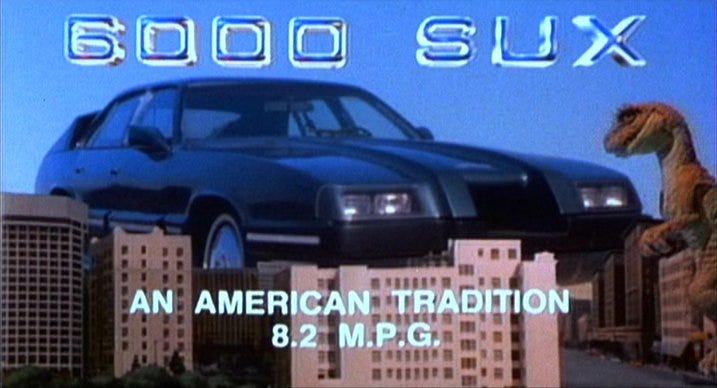
Donald Trump delivered another big gift to Big Oil Monday, making good on his promise to slash vehicle fuel efficiency standards so American manufacturers can keep selling wasteful, gas guzzling cars and trucks, even as gasoline and diesel prices continue rising thanks to Trump’s pointless war on Iran.
The new Corporate Average Fuel Economy (CAFE) standards only require automakers to meet an average fuel efficiency among their fleets of 34.9 miles per gallon by 2031. That’s a teensy bit better than the standard of 30.1 MPG, but far short of the Biden administration’s 2024 rules, which would have required 50.4 MPG by 2031. To reach that average, automakers would have had to quickly ramp up production of EVs and plug-in hybrids, although the rule left it up to automakers to decide what proportion of their fleets would rely on batteries or other tech to get there.
That’s the standard that Trump lied was an “EV mandate,” implying that the government would force everyone to buy an electric car all at once, probably at gunpoint.
Not surprisingly, Transportation Secretary Sean Duffy lied Monday that with the new standards, Great Leader and his administration “have finally ended the illegal mandate that forced automakers to produce more expensive electric vehicles that American families didn’t want.” Especially after Trump and Republicans ended the very popular $7,500 new-EV tax credit that made EVs more affordable. Duffy also ignored the fact that EV, plug-in-hybrid, and conventional hybrid car sales have increased in response to Trump’s higher gas prices.
Because of those higher fuel prices, the administration’s analysis found that the move will add an average of about $1,600 in fuel costs over the life of vehicles built to the new standards. As former Transportation Secretary Pete Buttigieg noted in an interview with NPR Tuesday morning, the estimate assumes that gas will cost less than $3 a gallon by the end of this year, which is some very wishful thinking.
No worries, though, because Trump has also declared that “affordability” is a hoax and people actually enjoy spending more money on fuel.
You can also use the button below to donate an amount of your choice at Paypal, or we have a Patreon too.
Duffy touted an estimate that automakers would see lower per-vehicle costs of around $1,300 compared to the higher Biden-era standard, and pretended consumers would see new vehicle prices drop by the same amount, although the “savings” only come from automakers not investing in the technology needed to build cleaner vehicles. There’s little reason to think actual new-car prices will drop from the current average of $50,000, even as drivers pay more for gas in their new gas-slurping cars and trucks.
The auto industry trade group “Alliance for Automotive Innovation” announced it’s delighted that US automakers won’t have to actually innovate, at least for now. John Bozzella, the group’s president and CEO, said in a statement that the federal government “made the right call to better align fuel economy standards with the law and current market conditions.” He claimed that the Biden administration standards “effectively required a switchover to electric vehicles that was out of step with market realities and customer demand,” at least if you’re only looking at some segments of the American market. This is where we remind you that before Trump was reelected, US automakers were touting their plans to go largely electric and investing in new battery and manufacturing plants. But that was a million years ago, back in 2023.
The new, lower mileage standards will also guarantee that American automakers will continue falling behind China as the rest of the world transitions to electric vehicles, but Detroit is fine with that since it means somewhat higher domestic profits for a decade or two before they can no longer compete outside the US at all. But that’s a problem for future CEOs, right?
Buttigieg pointed out that when Gerald Ford’s administration proposed the very first CAFE standards in the early 1970s, auto companies complained that improving their cars’ average fuel efficiency from 13 MPG to 17 MPG would be technically impossible and would make cars unaffordable for anyone. The industry has similarly resisted every new increase in CAFE standards with exactly the same rhetoric, even as it managed to meet them every damn time.
Buttigieg warned, as have many analysts, that by putting “a thumb on the scale for older technology,” Trump is making it even more likely that the US auto industry will fall behind other countries. Pointing to China’s enormous buildup of clean energy resources and EV manufacturing, Buttigieg said, “China is not pursuing their strategy out of environmental enthusiasm; they know that they have an opportunity to dominate the auto market.”
In addition to the lower baseline standards, the new rules actually exclude plug-in vehicles from the CAFE average altogether, removing what had been a significant incentive for manufacturers to add full EVs and plug-in hybrids to their fleets. It’s possible some manufacturers will drop electric and plug-in hybrids altogether, even though that too will put them behind the rest of the world.
Another rules change will eliminate the sale of fuel-efficiency “credits” by companies with mostly electric cars and trucks, like Rivian and Tesla, to traditional automakers, which used those credits to artificially boost their fleets’ efficiency. Tesla’s business model relied for years on selling the fuel efficiency credits to other automakers, and Rivian’s still does; it’s unclear what the long-range effect will be on either company. Rivian may be in greater danger, since Elon Musk seems to have lost interest in running a car company anyway as he’s shifted toward selling white supremacy and robotaxis.
Despite Trump’s attempts to prevent the US from ever transitioning away from fossil fuels, that’s exactly what other nations are doing. Renewable energy is so cost-effective that the energy transition will keep going forward worldwide, but Trump is determined to preserve fossil fuel companies’ profits for a couple decades longer by hindering adoption of wind and solar wherever he can. But it’s a rear-guard action, because on a purely economic basis, inefficient fossil fuels are doomed over the long term, as China has already recognized.
And of course, environmental groups are already planning to sue to stop the new standards, pointing out that Congress in the 1970s required the National Highway Traffic Safety Administration to consistently improve fuel efficiency, not let inefficient vehicles stay inefficient. While it’s unlikely that the environment will be as central an issue this year (and in 2028) as it should be, there’s also the likelihood that Trump and his crowd will be swept out of office so Democrats can once again clean up the mess the fuckers made. Maybe US automakers should remember that Trump isn’t forever?
PREVIOUSLY!


[AP / Washington Sun / Ars Technica / Inside Climate News / NPR]
Yr Wonkette is funded entirely by reader donations. If you can, please become a paid subscriber, or if you’d like to make a one-time (or recurring) donation, you can click this here button.
My best friend visited and took me out to lunch in June, and then
I treated us to ice cream.
While we had fun, his electric car was charging for FREE at the utility company lot. It's slow-charge, but it's FREE, in the backwater *I* live in.
The Ralphs supermarket nearest me has half a dozen car charging stations...and picketers demanding Ralphs remove them...from Turning Pointless...let...that...sink...in...