



The Senate is moving toward a vote next week on a bipartisan energy bill that, depending on who you talk to, is 1) vital to replacing fossil fuel power plants with clean energy, thereby reducing the extent of our already-unfolding climate disaster, or is 2) a well-intentioned effort to achieve that laudable goal, but at such a high price that it’s not worth the threats it poses to environmental and endangered species protections, as well as to the sovereignty of Native American tribes and even the ability of communities to oppose big projects that could alter them forever.
Because the bill involves the wonky details of how permits are issued for big projects like interstate electric transmission lines and gas pipelines, most Americans don’t know much of anything about the bill or what it will do. It’s called the “Bipartisan American Affordability and Jobs Act” (BAAJA), pronounced like “Baja” (the peninsula and the Blast). As the cliché goes, it might be one of the most consequential pieces of legislation you’ve never heard of. The bill was crafted over the last few months by an odd bipartisan team, Democratic Sens. Sheldon Whitehouse (Rhode Island) and Martin Heinrich (New Mexico), and Republican Sens. Shelly Moore-Capito (West Virginia) and Mike Lee (Twitter and sometimes Utah).
The bill passed a key cloture vote in the Senate Monday, with 22 Democrats joining nearly all Republicans in the 73-25 vote. Whitehouse said that the bill will now go through what he called a “healthy amendment process,” which, hell yes, it needs that.
Put simply (and it isn’t quite so simple), BAAJA would streamline the permitting process for new energy projects by revising several laws that have frequently been used to slow or stop any energy development, including the National Environmental Policy Act (NEPA) and others, and it would limit how long states can take to approve projects, giving the Federal Energy Regulatory Commission (FERC) the power to step in and approve projects after a year.
The biggest climate win is that BAAJA would make it easier for interstate power transmission lines to get built, which is huge because A) it can take over a decade to get transmission lines through the process now, and B) America’s best places for wind and solar energy aren’t where most Americans (and their electricity demand) live, except for Texas and California. That “interconnection” problem has delayed hundreds of clean energy projects from getting on the grid, and solving it is the “Holy Grail” of clean energy (without any killer rabbits). The bill also contains other provisions that would substantially move the energy transition forward, as we’ll discuss in a bit.
Unfortunately, the very compromises that won the support of Republicans are anathema to many Democrats. Since BAAJA would also allow easier permitting for both clean and fossil energy, the White House and the energy industry — both Big Oil and clean energy businesses — like it. As climate and clean energy reporter David Roberts puts it, BAAJA is “a genuinely bipartisan proposal in that it contains provisions each side loves and provisions each side hates.”
Sens. Whitehouse and Heinrich, both solid advocates for clean energy and decarbonization, argue that clearing the way to bring clean energy onto the grid is a definite win for the energy transition we need to reduce greenhouse emissions. Heinrich told reporters Monday, “If we can create an open competitive level playing field, clean is cheap and cheap wins in the marketplace.”
That’s been the chief argument for permitting reform in recent years: Making energy permitting easier for all players will ease some fossil fuel development, but since wind, solar, and storage projects make up over 90 percent of planned new energy generation, it’s vital to get that clean energy up and running as soon as possible.
Al Gore, who knows a thing or two about climate, has come out against BAAJA, sorry Sheldon and Martin.
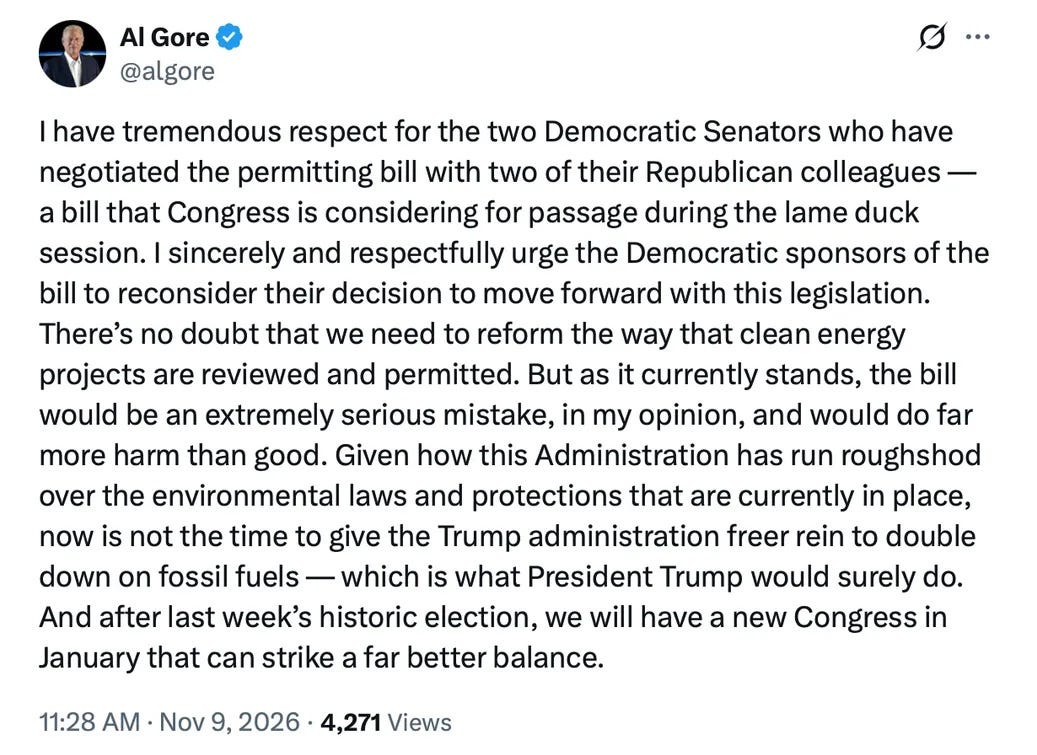
The question, as Bill McKibben puts it, is “how many pounds of flesh the fossil fuel industry would demand in return, and how close to vital organs that flesh would be located.” McKibben argues that the cost isn’t worth it, and that there’s every reason to expect global warming proponent Donald Trump and his Cabinet of fossil fools to use the law to push even more dirty energy onto the grid while continuing to hold back solar and wind projects.
Trump himself certainly seems to think that’s what he’ll do; in a bizarre impromptu presser Monday, Dear Leader blithely promised he’ll simply ignore the bill’s reforms meant to ensure rapid deployment of clean energy. In response to a reporter’s question about whether he would whip for the vote in the House, Trump lied that the bill “hasn’t been fully negotiated” yet, and insisted, “I will not approve wind turbines ‘cause wind turbines are a major loser.”
We liked the part where the reporter can be faintly heard pointing out “But that’s part of the bill, sir,” which prompted Trump to claim “the bill hasn’t been fully negotiated.” While it’s true that the bill can still be amended, nobody’s going to take out an entire sector of clean energy. In fact, the version of the bill now under consideration includes a “manager’s amendment” that added more than 75 pages of changes to the bill, including stronger protections for projects that have already been approved. One added provision even specifies that Trump can’t meddle again with permits for five big wind projects off New England unless he gets permission from a federal court.
You can also use the button below to donate an amount of your choice at Paypal, or we have a Patreon too.
Let’s dig into some specifics!
Transmission Lines
This is the one part of the bill nearly everybody in the climate / clean energy community agrees is good, and surprisingly more ambitious in its reforms than expected. It would give the Federal Energy Regulatory Commission (FERC) more control over power lines that cross multiple regions of the country, and to approve transmission lines if states block permits that would benefit the public (part of why New England doesn’t get to have cheap hydroelectric power from Canada, for instance).
For-profit utilities like things the way they are, because of the weird economics of electricity regulation, but solving the “interconnection” problem is huge for climate. Right now, nobody can make much profit by moving cleanly produced electricity from Western places with the most potential for sun and wind development to the big Eastern cities that most need cleaner energy. BAAJA will also make it easier to upgrade existing transmission lines to more efficient, high-capacity wires, enabling them to move more electricity without new power line construction.
Data Centers
Environmental groups argue that BAAJA would speed up approval of gas-powered data centers that are already in the pipeline, including several that are planned on public and tribal lands, while hindering local efforts to slow them down.
On the other hand, BAAJA would also require that data centers pay the full cost of the electricity they use, as well as for the grid improvements and new power generation necessary to bring them online. The idea is to make sure that Big Data won’t get a free ride by forcing utility ratepayers to cover the capital costs of adding data centers to the grid.
David Roberts argues the tradeoff is worth it, saying on social media, “If you’re anxious about data centers, you ought to love BAAJA,” because it forces data centers to pay their own way and would transfer some $130 billion in “wealth from hyperscalers to residential ratepayers.” It would also provide backup to states that want to rein in data centers. And with easier permitting available for wind and solar, data centers may well decide to go with the far cheaper power they provide. It currently takes around five to seven years to build new gas plants, while new solar plus storage can be operational much sooner, and once they’re built, you don’t need to keep fueling them.
Again, a lot of the argument comes down to whether the bill will speed the buildout of clean energy quickly enough for it to beat fossil fuels. Sen. Whitehouse argues that’s a good bet, saying in a statement, “We don’t have more years to lose as clean energy projects sit on the sidelines, and there’s no guarantee Congress would ever find another compromise that would be able to pass the Senate.”
The Case Against BAAJA
The chief opposition to BAAJA comes from environmental groups who argue that the faster approval process gives up too much to fossil energy developers by weakening the Clean Water Act, the National Environmental Policy Act (NEPA), and the Endangered Species Act, making it nearly impossible to block projects that will pollute. Native American tribes are outraged that the bill weakens the National Historic Preservation Act (NHPA), putting sacred sites and tribal sovereignty at risk.
The “manager’s amendment” improved matters a little bit, requiring the government to consult with tribes on energy projects, but tribes say that’s still too little. One of the amendments being proposed would go farther and remove any changes to the NHPA at all, which is what tribes have been demanding.
Another proposed amendment would strengthen the ability of future administrations to reverse Trump’s giveaways to fossil energy, which could go a long way toward preventing Trump from “locking in” his fuckery.
A coalition of 15 Democratic state attorneys general (and DC!) has called on the Senate to delay any final votes, to allow more time to discuss the bill and strengthen protections for the environment and tribes, too.
With the big new Democratic majority in Congress, some Democrats are calling for the bill to be scrapped and taken up again next year, with terms more palatable to key Democratic constituencies. The big problem with that approach is that without at least a few votes from Republicans, a new bill won’t pass in the Senate, and even if it did, Trump would almost certainly veto it. There’s definitely a case to be made that if BAJAA fails, permitting reform is likely to be dead.
I honestly find myself going back and forth on the damned thing. On the one hand, I’m inclined to agree with Bill McKibben that while there are lots of things to like about the goal of making clean energy easier to build, BAAJA is a bad deal because it gives up too much to the fossil energy companies that have pushed Senate Republicans to support it.
But I’m also persuaded by Roberts’s argument that despite the bill’s flaws, “there is no ‘better deal’ on permitting in the next Congress,” not even with Democrats’ wins in the midterms, so the choice really is between BAAJA and the status quo, in which lots of clean wind, solar, and storage are ready to come online, but stuck forever in permit hell. If the amendment process actually ends up preserving the NHPA and preserving tribal sovereignty, and adding more protections against Trump simply ignoring the law, we’d be much more willing to support it.


But What If We Could Vaccinate Against Windmill Cancer? What If We Painted The Wind Turbines Gold?
[Reuters / Searchlight / The Crucial Years / AP / NYT (gift link) / WaPo (gift link) / Searchlight / Heatmap News / Volts / Heatmap / Politico / Heatmap]
Yr Wonkette is funded entirely by reader donations. If you can, please become a paid subscriber, or if you’d like to make a one-time (or recurring) donation, you can click this here button.
ALSO TOO: Yr Fall Wonkette Book Club has just one more meeting to go, but it’s not too late to hop in! We’re reading Bill McKibben’s 2025 bestseller Here Comes the Sun (Wonkette affiliate link), all about how the clean energy revolution can get us out of our climate fix and even improve society somewhat (if we do it fast and do it right.)
After a great first meeting and a superlative second outing, we’ll wrap up this coming Sunday (November 15) by reading Section Three, “Let’s Do This!”
On top of the usual discussion in the comments, we’ll also hold a live video book chat so you can Zoom with Doktor Zoom. If you’d like to take part, email me at doktorzoom at wonkette dot com with subject line “book chat,” and include a discussion question about the book and/or clean energy. More here!
Just gonna point out that Project 2025 was *very* adamant about the primacy of fossil fuels, on the grounds of "energy affordability". Apparently they didn't count on El Caudillo's stupid stubborn foreign policy.
Heinrich was my congresscritter the last few years I lived in New Mexico. He's a good egg. If he's behind this (and he is), I'm behind it. No time for dillydallying.
Remember -- the perfect is the enemy of the good.